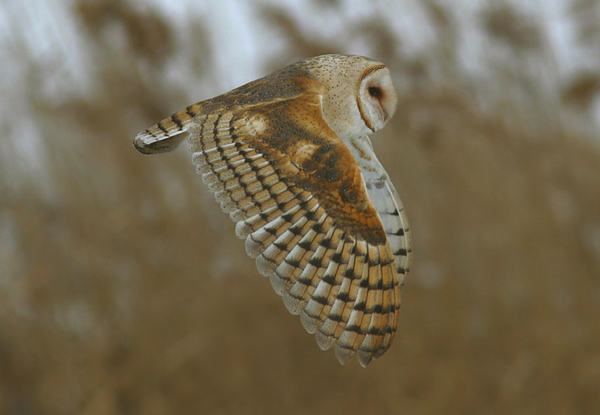
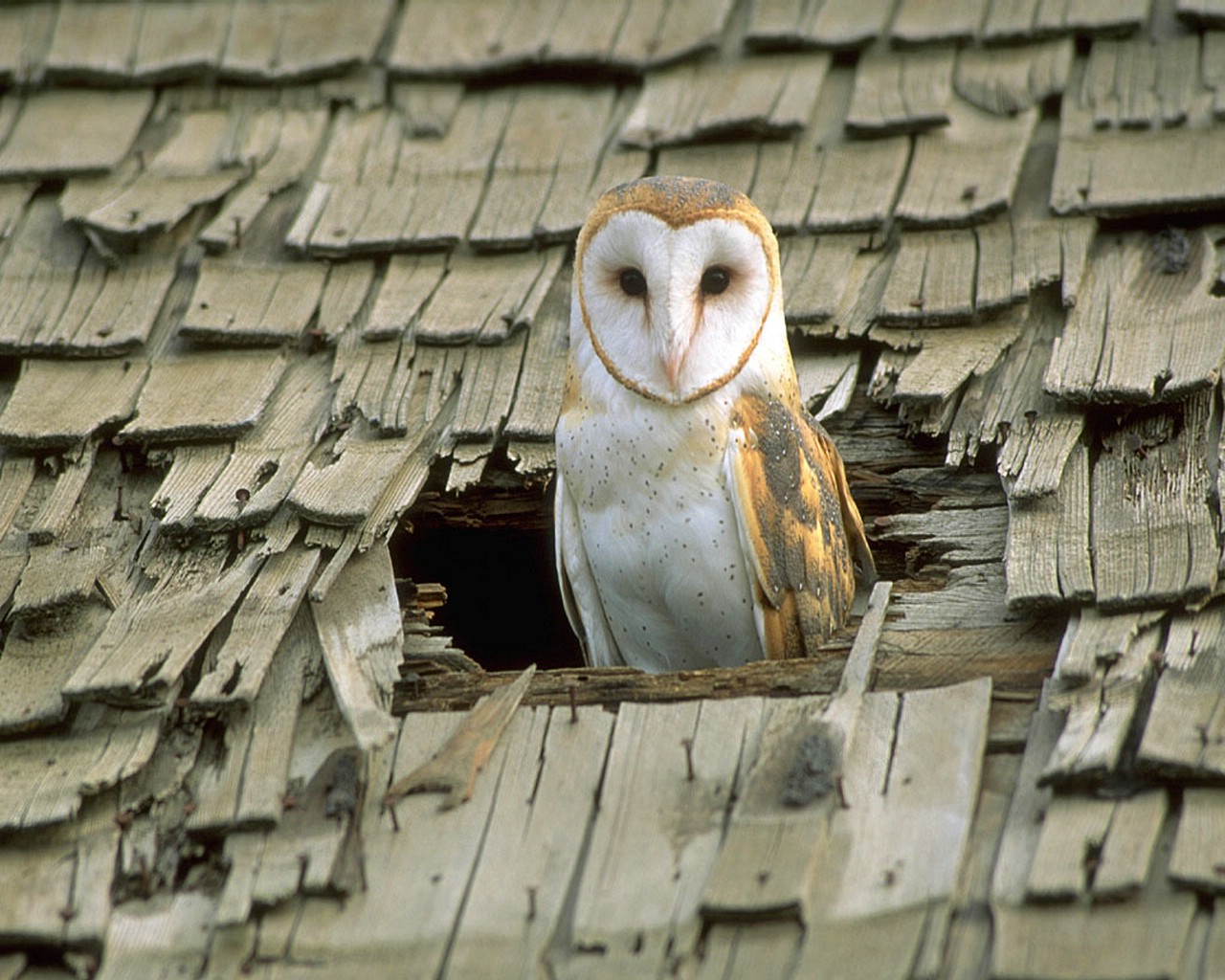
Next up in our owl series is the Common Barn Owl! Along with the Great Horned Owl, Common Barn Owls are the most commonly sighted owl in the region. When I go out to programs and exhibits with the Humans, I often overhear stories along the lines of, "I saw this HUGE owl the other day in my barn - what was it?" The answer is Common Barn Owl. However, they're not as big as they seem.
c Jerry Liguari utahbirds.org
Remember how I said Great Horned Owls weigh about 1.5-5.5 pounds? Well, the Common Barn Owl is the next largest owl commonly found in Colorado, and it weighs a mere 0.5-1.5 pounds. Yep, all that wingspan and majesty from a bird that weighs the same as a can of beans. But when it's flying silently toward your face when you enter an abandoned warehouse or a little-used barn, you probably don't care what it weighs, you just don't want it near your eyeballs. Barn Owls, however, are not aggressive birds, and they're merely trying to fly out of the barn to get away from you.
xmwallpapers.com
As the name implies, Common Barn Owls do spend a lot of time in barns. But before there were barns, where did they hang out? Barn Owls are cavity nesters, meaning that instead of building their nests in the sprawling and exposed branches of an oak or pine, they build their nests in tree cavities and hollows, as well as rock nooks and small caves. However, since barns and other Human-made features are so warm, cozy and protected, Barn Owls often opt to nest in barns, silos, warehouses, and church steeples. Barn Owls are also big fans of Human-made nesting boxes. Humans can install these nest boxes on their own properties and see if a pair of Barn Owls comes along to take up residence. Instructions for building your own box are easily found with an internet search. Humans often install Barn Owl boxes to lure Barn Owls to their property as a means of rodent/pest control, as shown in this PBS video.
One reason Barn Owls are so good at controlling rodent populations is that they're insatiable eaters. Catching and eating upwards of six vole-sized critters each night, they can really keep tight reins on the local population. Also, it's incredible how many pocket gophers they can fit into one stomach! Like most owls (including me), they generally swallow their food whole instead of ripping and tearing it like most other raptors do. And Barn Owls don't even blink when it comes to swallowing animals that seem impossibly large. Skip ahead to minute 3:30 in the video below to see what I mean.
The eating pace doesn't slow down at all when there are chicks in the nest, either. Barn Owls lay between four and seven eggs, so that's a lot of mouths to feed when they all hatch. And do they eat smaller, more appropriately sized food? No way. They eat just like mom and dad. It's unreal.
Baby Barn Owls with a feather-duster "mom" at the RMRP
Baby Barn Owls are a little goofy looking. Many Humans think they're adorable, while others think they look like alien pterodactyls. They certainly don't look much like their adult versions until they're many weeks along. Adult Barn Owls, on the other wing, are simply stunning birds. They're in the non-tufted class of owls, meaning they don't have ear tufts like I do. They still have extremely prominent facial discs, however, which is largely responsible for their success as hunters. Females of the species have slightly duskier coloration, with more brown on their faces and chests, while males are more of the snowy-white variety. This often leads to people thinking Barn Owls and Snowy Owls are the same thing, but as you can see in this picture, they're very dissimilar. For the record, Harry Potter had a Snowy Owl, not a Barn Owl.
Snowy Owl on the left, Common Barn Owl on the right
The Common Barn Owl, while obviously not common in appearance or behavior, is called "common" because of its wide range. Barn Owls are found on every continent except Antarctica, and within each continent they inhabit every imaginable ecosystem. Because of their extensive range, Barn Owls have numerous variations and subspecies, between twenty and thirty depending on who you ask. Tyto alba is the Latin name for Common Barn Owls, and the variation in North America is Tyto alba pratincola. Something kind of cool about their Latin name is that the word "tyto" is a Greek onomatopoeia meaning "owl"; "tyto" mimics the classic owl sound, like the English word "hoot".
Educational female Barn Owl foster mom guarding her charge
Barn Owls used to face a lot of intentional persecution as a species. One likely reason for this is the owl's ghostly appearance: with the white plumage, silent flight, and a knack for flying out of barns at Humans, they earned a reputation of evil associated with ghosts and death. This is reflected in their other common names, which include Demon Owl, Ghost Owl and Death Owl. Fortunately, as education about Barn Owls spreads, they're facing less and less intentional persecution. However, like all raptors, they still face threats from the usual suspects: power lines, poisoning, car strikes, and more. Habitat loss has led to the Barn Owl being listed as an endangered species in seven Midwestern states.
Educational Ambassador for the RMRP, male Barn Owl
At the Rocky Mountain Raptor Program, injured Barn Owls are admitted with all the above injuries and more. Another common way for Barn Owls to come to the RMRP is via orphaning. While their nest sites are often excellent cavities, they're not always stable or well-located homes. Nests in hay bales, under trucks, in rafters, and in the walls of buildings are accidentally knocked down each spring, leading to entire nests' worth of baby owls coming to the RMRP to be raised by our resident foster parents.
So, there you have it, the uncommon Barn Owl. Stay tuned next week for a profile on the Mexican Spotted Owl. As always, you can email me with questions or comments at talonsofdoom@gmail.com, follow me on Twitter @RaptorProgram, check us out on Facebook (Rocky Mountain Raptor Program), and find out more information and stories on our main website. If you would like to subscribe to this blog, use the box in the toolbar to the right.
We appreciate your support of the Rocky Mountain Raptor Program in helping us keep raptor populations strong and safe! We're always seeking donations to help us continue our mission of rehabilitation, education and research. Thank you!
Just a quick entry to let you know that a lot of my short-term neighbors (ie birds in rehabilitation) have been released this week!
Remember the tiny, fluffy baby American Kestrel admitted a couple months ago? She grew up strong and healthy, and was released on Sunday to a chunk of beautiful land up north.
The second-year Peregrine Falcon admitted a few months ago with high voltage trauma (HVT) from a powerline incident was a bit of a longshot: HVT cases are difficult to heal, and her wounds had left her patagial tendon exposed on one wing. The patagial tendon is critical to flight. The wound took nearly two months of patient treatment by the Humans to heal, and then she had to regain her stamina in one of the large flight cages. But soon enough she was flying like a champ, and was successfully released north of La Porte a few days ago! The Human that released her said that when she flew off, she didn't just go find a perch to land on and take a rest, she kept flying, and flying, and flying...
Four immature Great Horned Owls were released last night. They passed "rat school" a couple weeks ago, and have been perfecting feather condition since then. The way the Humans here release Great Horned Owls is called a "soft release" through an apparatus called a "hack box". Essentially, the birds were fed for a few days from a platform in the cage, so they became accustomed to getting their food there. Then, last night the door from the feeding platform to the outside world was left open, and the Owls all flew off on their own into the night. But since they're young birds with no real-world experience, and it's a drought year, it could be difficult for the birds to make ends meet, so the Humans will continue putting food on the platform for the next few weeks just in case they need to come back for a snack. When they stop coming back for food, we know they're off being wild!
Great Horned Owl flying in a cage
Common Barn Owl experiencing those awkward teenage years
Two Common Barn Owls were released a couple of evenings ago, and flew silently over open fields, until they were out of sight.
And, finally, another American Kestrel and a mature Swainson's Hawk are both being released as I type this! That's ten birds so far this week, and more are due to be sent on their way soon! While all these releases are great news, I keep watching the main building and seeing how many newly injured birds are being admitted--there are a lot. Things are not slowing down here at all. West Nile Virus is really rearing it's head, and the Humans have received results from blood tests for over a dozen birds confirming WNV, and there are many, many others with WNV symptoms who are awaiting blood test confirmation. So, as always, the work never ends! But if you are as excited as I am about the ten releases listed above, please support us by clicking on the "donate now" link on the right sidebar!
In recent weeks, things haven't been all dark nights and dead mice at the RMRP. What, would you prefer the Human phrase "sunshine and roses"? Okay, things haven't all been sunshine and roses. Recently many of the birds being admitted to the CCU have been broken beyond repair (multiple fractures, old necrotic wounds, etc). These birds have been humanely euthanized, and while that's the kindest and most ethical thing to do with those cases, it still hurts to not be able to do anything to help. In addition to the badly broken birds, the Humans are also admitting many young birds (lots of Swainson's Hawks) suffering from starvation, symptoms consistent with West Nile Virus, and often with traumatic injuries on top of all that. While these cases are extremely labor-intensive, there is a reasonable chance of fixing and releasing them, and the Humans give care wherever there is hope! Still, it's tiring and difficult work, so with an influx of such heartbreaking cases, I've decided to help keep spirits high by listing off six wonderful things that have happened in just the past couple of days!
1. This immature Kestrel is a probable West Nile Virus case (awaiting blood test confirmation). He was so neurologically impaired that for his first couple weeks at the RMRP he couldn't stand on his own, and he didn't have the beak-eye coordination to eat on his own. Now look at him! Not only is he eating on his own and standing upright, but he can stand on one foot. He still has a ways to go, but it's great to see him improving!
2. The Humans released nine Swainson's Hawks into a kettle a couple days ago! Every Swainson's Hawk that can be released into a migrating kettle is one less bird that has to be overwintered at the RMRP. Fewer beaks to feed, less dollars spent, and, most importantly, more birds getting their second chance at freedom (and a trip to Argentina).
No, your screen is not dirty: those little black dots are all Swainson's Hawks
3. This Cooper's Hawk grew up and was released today!
4. A rehabbed Peregrine Falcon is flying like a champ, and is on track for release after finishing up a molt!
5. A Common Barn Owl that was probably hit by a car tried to toe-dust yesterday. Toe-dusting is something that Barn Owls do to scare away predators and other threats. This bird suffered massive trauma and is being treated for her pain. The fact that she was feeling well enough to try to be scary is great news! The video below (not the RMRP's) will show you what toe-dusting is.
6. A Red-Tailed Hawk that was admitted with a fractured clavical was moved to a larger cage after time in the CCU, and quickly demonstrated that he can fly very well, thank you very much. It's always nice to see a broken bone heal nicely!
That's all I've got off the top of my head. Not bad considering all that happened in the past three days. Through good times and bad, the Humans at the RMRP will keep on taking care of every single raptor that comes across their threshold, and will keep on churning out success stories like these. Thank you for your support!
Also, don't forget, the Open House is this Saturday from 11:00-3:00 at the main facility on Vine Drive! Click the link for details and directions. This facility closed to the public except on Open House days, so come on over for a chance to see what happens here behind the scenes. There will be educational exhibits, lots of people to explain the ins-and-outs of the facility, and plenty of educational ambassadors on display. Oh, and there will be snacks! Hope to see you there!
Still not a whole lot going on at the RMRP, but certainly some interesting cases coming through the cages. Here's the quick-and-dirty:
--First off, I can't remember if I told everyone that the Humans released the grill-head Red-Tailed Hawk! Remember him? He was found with his head stuck in the grill of a truck, and came in looking like this:
Very sick Red-Tailed Hawk after colliding with car
Well, he was released last week! Despite a fractured skull and awful head trauma, he's out there striking fear into the hearts of small rodents again. Congratulations to the RMRP for a job well done!
--Onto more current cases, a few days ago the Humans admitted a Cooper's Hawk that hit a house window...and shattered it. Can someone who's better at physics than an Owl please explain how a soft, feathery bird that weighs about half a pound can shatter a house window? Unfortunately, the outlook for this bird isn't hopeful, but it is a good reminder to keep your bird feeders away from windows, and apply decals to your windows if you have lots of birds zooming around.
--Admitted two baby Great-Horned Owls last week! Same nest, different days! The first kid to come in was still very young. He was found at the base of the tree in fine health, but pretty vulnerable. The Humans were able to put him back in the nest with his younger sibling. Then, the very next day, the Humans had to rescue another young Owl from that same nest. This one had gone out on his maiden flight and ended up standing in the middle of the road. The Humans couldn't put that bird back in the nest because he was more flighted than his younger sibling. If they tried, the Humans would place him in the tree near the nest, he'd instantly fly away again because of the Human in his face, he'd end up on the ground, and the cycle would begin again. Therefore, when the RMRP gets in mostly-flighted babies, they have to keep the baby until it's fully-flighted. So the mostly-flighted baby is here at the RMRP, finishing growing in feathers and learning how to be a fearsome creature. Hm, I wonder where they put him?
Poor wing position, but excellent flight! Can't judge a book by it's cover...
--The Great Horned Owl with the luxated (dislocated) elbow is doing surprisingly well. Despite the fact that he holds his wing out at an awkward angle, he's doing laps around his cage like nobody's business. Soon he'll graduate to a cage with fewer perches to depend on. Then he'll attend mouse school, and if he passes that he'll be released!
--The Red-Tailed Hawk with the broken foot is out of his splint and beginning to use the foot to grab the perch. That's excellent news because while wings need to be perfect for release, feet only need to be functional enough to grab perches and food, and this guy is well on the way to two functional feet.
--There are still FOUR Bald Eagles in house. Enough said.
SWHA's nest-building skills at work
--As for Educational Ambassadors, the female Common Barn Owl is busy rolling and tending her fake eggs, and the female Swainson's Hawk is contentedly arranging sticks in her cage.
And that's all the news for this week! Time for me to get back to my baby.
I apologize for my lack of posting recently. There has not been all that much happening at the RMRP these past few weeks, so I've just been perching by the window and enjoying the spring air.
Lots of other birds here at the center are also feeling the effects of spring. For some birds, like the pair of educational Common Barn Owls, that means laying eggs. The female has popped out six of the suckers already--I don't know how she does it!
The female Swainson's Hawk, now 21 years old, is not letting age get in the way of egg-laying season. She's been over in the her cage twittering away to herself. She's spending most of her days taking sticks and rearranging them, a sure sign that she's feeling broody.
On the rehabilitation side of things, the Humans are still anxiously watching the door and waiting for the flood of babies. We Great Horned Owls got around to things a little late this year, so now it looks like orphaned Great Horned Owls and orphaned American Kestrels could be arriving all at the same time, a prospect which has the Humans on tenterhooks.
Remember the Red-Tailed Hawk that was found with his head wedged in the grill of a truck after being hit? Well, he survived his massive head trauma and skull fracture and flew away on Monday! It's always good to see such a success story as that one.
Also, the Swainson's Hawk that had all his feathers burned off in a methane burner has finally begun to molt. Once he has a new set of feathers, the Humans will be more able to assess his prospects.
The only other news is that the RMRP is now the cool place for Bald Eagles to come hang out, like Camp David or something. There are three of them at the center right now! That's a lot of Eagles to feed. Interested in helping the Humans buy food and medical supplies for the injured birds? Check out the "wishlist" page at the top of my blog, or the "donation" link on the right sidebar.
Alright, I'm going to go back to my window now and watch the spring evening steal over the meadows.
In this cage complex there are nineteen educational birds, covering fourteen species, from the little American Kestrels, to the biggest beast of us all, the Ferruginous Hawk. Some of us are nocturnal, some diurnal, and others crepuscular (active during the dawn and dusk hours). With all this variety, you can imagine how entertaining it is to live here!
Today's example comes from the cage next door to mine, which houses two Common Barn Owls, one male and one female*. He's been here for ages, whereas she came in about four years ago. Ever since they moved in together, they've been inseparable. They're always cozied up next to each other inside an A-frame, or side-by-side on a perch.
The male is very protective of his lady friend; he is at her beck and call. When food is dropped in the cage, he brings some to her before eating his own portion, and when he is taken out of the cage for enrichment or a Performance, he seems restless and eager to return to her.
I've overheard many of the Humans' theories for this behavior, including that he's been here longer and took her under his wing, or that she needs support and help because she flies poorly. Or, even, that they are in the Barn Owl version of love.
Funnily enough, it's nothing as romantic as that. If the Humans could better understand her hisses and screeches, they'd know that he feeds her before eating his own food because she is a banshee who will scream his ears off if he neglects her for even an instant. In Human language, her screaming is the equivalent of "WHERE'S MY DINNER??? BRING ME THAT MOUSE!!" followed by the sound of a whip cracking.
But don't worry: this is completely normal Common Barn Owl behavior, and they both are happy with the roles Nature gave them. In that way, I guess it is like the Barn Owl version of being in love.
Whichever way you slice it, it makes for interesting neighbors.
*Educational side note: Unlike most raptors, Common Barn Owls actually have an overt sexual dimorphism, meaning the males and females look different. Specifically, the female's chest and face is a dirty white-brown** color, whereas the male's face and chest are snowy white. **Please don't tell the female I called her "dirty white-brown", or I'll never hear the end of it.