Pages

Showing posts with label Release. Show all posts

Thursday, February 14, 2013

Happy/Sad Story

I have uplifting news and I have sad news.

The sad news first:
Earlier this week the Humans admitted a critically injured Red-Tailed Hawk.  The bird had been rescued in Berthoud after being hit by a car.  Unfortunately, its injuries were too severe, and the bird died the same afternoon it was admitted to the RMRP.

The uplifting news:
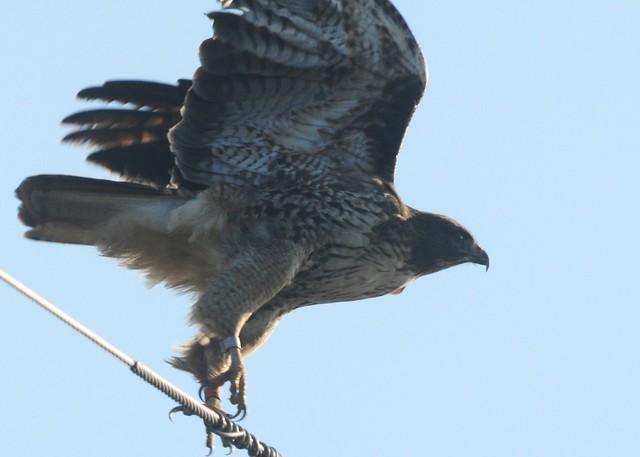
Whenever a bird is released from the RMRP, the Humans band one leg with a numbered US Fish and Wildlife Service band.  That way, if anyone ever comes across the bird again, the Humans can look up the band number and find out the bird's history.
Red-Tailed Hawk with a banded leg
The Red-Tailed Hawk that died was already banded.  Given the activity of the RMRP in the area, odds were good that it was one of our bands.  Sure enough, our Medical Director looked back in the records...and looked back further...and a little bit further...and found the history of this bird in our own facility's records.

The hawk had originally been admitted in late 2007 with head trauma, probably from another car strike, and was released in 2008 as a fully healthy bird.  When admitted in 2007, the bird was already an adult.

Why do I think this news is so good?

Because it means the RMRP took in an injured raptor, gave it everything it needed to heal up, and sent it back out to the wild for a Second Chance at Freedom.

Because the already-adult hawk lived another five full years instead of dying that day in 2007.

Because during those five years, the hawk was able to live a wild existence, rich with hunting and soaring and raising nests of new Red-Tailed Hawks each spring.

And I don't know about you, but I think that is something beautiful, something special, and something worth being happy about.


---------
To donate to the RMRP, click here
Our website
Our Facebook page
Our Twitter feed
The 20th Annual Gala is just over a week away!  Get your tickets here

Wednesday, December 5, 2012

General update 12/05/12

Good evening everyone!  It's been awhile since I've let you know what's going on at the RMRP, so I figure it's a good time for an update.  In a sentence, the overall situation can be described as "a welcome decrease in case load, with many ongoing, interesting and hopeful cases, and a whole slew of other activities."
Northern Pygmy Owl - released!!

Let's start with case load:  to date the Humans have admitted 257 birds for the year.  By comparison, last year they only admitted 242 birds.  A couple of weeks ago there were 35 active cases in house, and now the number is down to the mid-twenties.  Happily, almost all of that decrease can be chalked up to successful releases!  A quick summary of some of the birds to leave the RMRP in the past couple weeks:

-An immature Northern Goshawk (shoulder trauma)
-An American Kestrel (unknown trauma)
-A Red-Tailed Hawk with high-voltage trauma (from a power line)
-An American Kestrel (head trauma and fractured corocoid)
-An American Kestrel (hit by a car but without major injuries)
-The Northern Pygmy Owl (bit by car)
-The Boreal Owl (hit by car)
-Two Saw-Whet Owls (window strike and hit by car)
-Two Red-Tailed Hawks (hit by car and flew into truck cab)

Immature Northern Goshawk with quail lunch - released!!
I'm sure there are more, but those are the ones I can think of off the top of my head.  Of course, to make up for the exodus, the Humans have been admitting birds, as well.  Fortunately, the admit-blitz of three weeks ago (admitted eight birds in one week) was followed by a much milder week of only four admits, then just two last week.  In fact, the Critical Care unit is nearly empty at the moment, a first for the year (and a welcome change of pace).

Some interesting species in-house right now, including two Merlins, the small falcons from the north.  One is a small male, and the other a larger female.  They're both in small flight cages so the Humans can assess their flight.  Falcons are like high-performance athletes, and perfect flight is the only option for them to survive in the wild.  Prognosis is guarded on these two at the moment, but the Humans are optimistic.

Merlin - active case
There has also been an influx of American Kestrels getting into odd situations.  For example, one male bird came in covered in sticky goo after running rampant inside an icky warehouse for awhile.  It took some time to de-gunk all his feathers and give him time for a wing injury to heal, but he's making nice progress now.  Another Kestrel, a female, came in with her feet encased in hardened spray-foam, the kind used in house insulation.  The kind people who brought her in have no idea where she got into the stuff as they hadn't been using any on their property.  A mystery, but one with a happy ending as she is doing well with her feet freed.

American Kestrel with feet freed from insulation
In non-active-case news, the Humans and Educational Ambassadors like me have been busy raising money, presenting educational exhibits and programs, and preparing for events.  We've been making a fun circuit of the public libraries all year long, with a different theme education program each month.  The last one for the year didn't include me, but it sounded great:  the topic was winter residents, and the three Educational Ambassadors who attended were the Merlin, the Rough-Legged Hawk, and the Ferruginous Hawk!  Check the RMRP's calendar in January for next year's schedule (the programs are free and very entertaining and educational).

Boreal Owl - released!!
If any of you are friends of the RMRP on Facebook, you'll have noticed the fundraising campaign we were advertising this last week.  The fundraiser was hosted by Colorado Gives, a campaign to increase charitable giving in Colorado (did you know that Colorado is in the top-ten richest states, but in the bottom-five in terms of charitable giving?).  The Colorado Gives project takes one day a year to campaign fiercely to help local non-profits raise money.  This year the RMRP earned $13,000!!  Huge thanks to everyone who helped out with that, either by donating or by asking your friends to support us.  However, that's not the last fundraising campaign of the year for us, as we're considerably behind in donations compared to last year, and taking care of more injured raptors than last year.  In order to get 2013 going, the Humans will be needing more money to feed and care for us birds--details to come!

Volunteer Appreciation Party! 
Oh yeah, the Humans had a party last week to celebrate the work all the volunteers did throughout the year. I wasn't invited, but I'm not partial to salads and peach cobbler anyways.  At any rate, the Staff Humans recognized volunteers who contributed the most hours, attended the most shifts, went on the most bird rescues, attended the most programs and exhibits, and more.  So far this year volunteers have contributed 28,000 hours of work!!  When I say this program wouldn't be here without the volunteers, I mean it.  They are essential and highly valued (not to mention it's fun to scare the pants off the brand new ones with a well-timed flight across the cage).

Now they're all busy preparing for the big shindig this coming Sunday.  It's our annual winter Open House, and there's a whole list of reasons you should attend:

Educational Long-Eared Owl
  1. A behind-the-scenes look at our hospital facility, which is generally closed to the public
  2. Knowledgeable staff and volunteers on hand to answer all your questions
  3. Interesting educational posters and displays to explain what we do and why it's so important
  4. Numerous Educational Ambassadors on display, including some of our newer and shier birds that you may have never seen before!
  5. Snacks and hot drinks!
  6. Access to the amazing gift shop, which is well stocked for your holiday shopping (jewelry, books, stuffed animals, clothing, bookmarks, postcards, stationary, calendars, adopt-a-raptor, and more!)
The Open House will be held at our main facility on Vine Drive from 11:00-3:00 on Sunday December 9th.  Visit here for directions.  Hope to see you there! 

Whew, that was quite the update.  I think I'll sign off for now.  Be sure to check back tomorrow as I will be writing about Burrowing Owls! 

Friday, September 28, 2012

General Update: Welcome Fall

I have been so wrapped up in writing about awesome owls, I have completely neglected to keep readers updating on the going-ons of the Rocky Mountain Raptor Program.

Golden Eagle admiring the fall colors
The biggest, most noticeable recent change is that fall is here in a big way.  The weather slipped almost instantaneously from long, hot summer days to brisk days and brisker nights.  Rain has at last returned to Colorado, washing the dust from the leaves just as they're donning their autumn colors.  When the Humans go around for morning bird check these days, they often find us birds perched with one foot tucked up in our feathers to keep it warm, and our feathers all fluffed out for added insulation.  As the day warms up, we slick our feathers back down to cool off.  

The change in season has brought about two other annual changes for the RMRP: a change in the species being admitted to critical care, and a change in the injury/illness types.  During the latter part of summer, the bulk of the birds admitted to the RMRP were immature Swainson's Hawks, with the usual scattering of the other species.  But in the first couple weeks of September, all the Swainson's Hawks kettled up for migration and flew south out of Colorado for the winter.  The Osprey have also hightailed it out of the area, and Turkey Vultures will be next.  To replace them, Rough-Legged Hawks and Merlins (falcons) will be migrating to Colorado soon.

Sunrise outside my window
The Humans were able to rehabilitate and release the majority of the injured Swainson's Hawks before migration, releasing the youngsters into existing kettles so they would have guides to Argentina, the destination of their trip.  However, not all of the birds were ready to be released, either because they are healing from serious injuries and need time to regain flight strength and stamina, or because they suffered feather damage from West Nile Virus and need to complete a molt or two before being ready for the wild.  These birds (there are eight of them at the most recent count) will be overwintered in a large flight cage.  While this gives them all the time they need to perfect themselves for next season so they can rejoin the population, it's also a long time to support the care of these raptors.  Between the eight of them they are eating ~40 oz of food each day (that's 2 1/2 pounds of meat).  If you would like to support the RMRP in caring for these awesome hawks, please donate a few bucks to the cause.

Immature Swainson's Hawks overwintering at the RMRP
As for injuries, the end of summer saw the Humans admitting large numbers of birds with West Nile Virus.  The final numbers aren't in yet, but it was definitely the worst West Nile year in Colorado since 2003.  Fortunately, the numberof birds being admitted with the virus is tapering off as mosquitoes die and more birds gain immunity to the virus.  Unfortunately, the West Nile birds are being replaced with broken birds.  The end of summer and beginning of fall is when the RMRP starts to see a lot of birds with more severe injuries.  Many of these birds were starving to begin with, a result of a hard, dry summer among other things.  Hungry birds are desperate and confused birds, and many of them start wandering into moving cars while searching for road kill and hunting along roadsides.  Hit-by-car birds with treatable injuries often require x-rays and occasionally surgeries to rehabilitate them.  They also require a lot of supportive care to get them back up to a healthy weight.  Again, the RMRP needs donations to be able to heal and release the birds, so please consider contributing.

Peregrine Falcon release
In more heartening news, the Humans have been able to release numerous birds.  Most recently that included a Great Horned Owl with a fractured coracoid and head trauma, and a Common Barn Owl with similar injuries.  An immature Mississippi Kite was released to its group a few weeks ago, just before they migrated south for the winter.  Numerous Red-Tailed Hawks are going through Rat School right now, and all appear to be killing with great zeal and skill, so they should be out of here soon, as well.  A Peregrine Falcon with high-voltage trauma (power line encounter) hit the skies again a few weeks ago.

Great Horned Owl regaining use of her legs
Other interesting cases include a Great Horned Owl who was on the losing end of a fight with another owl on Colorado State University's campus.  It appears the bird had already experienced some sort of bodily trauma before the battle.  He's healing up with daily care for his puncture wounds and road rash.  Another Great Horned Owl is in critical care trying to regain strength and the ability to use her legs and feet.  She's slowly returning to an upright position, demonstrating the great tenacity and spirit Great Horned Owls are renowned for.  Similarly, a Great Horned Owl that was admitted months ago, completely unresponsive and unable to move or feed herself, is outside in a recovery flight doing much better.  It took a long time for her to come this far, and she still has quite a ways to go, but she's an inspiration.

And, finally, there's the education side of the RMRP!  The last weekend of September (29th and 30th) is full of public exhibits, including Elk Fest in Estes Park (all day Saturday and Sunday), the Northern Colorado Birding Fair at Fossil Creek Reservoir (Saturday 7am-2pm), and the Irish Festival here in downtown Fort Collins (Saturday and Sunday all day).  They're fun and educational festivals to attend, and the RMRP hopes to see you there!

As always, you can email me with questions or comments at talonsofdoom@gmail.com, follow me on Twitter @RaptorProgram, check us out on Facebook (Rocky Mountain Raptor Program), and find out more information and stories on our main website.  If you would like to subscribe to this blog, use the box in the toolbar to the right.

Wednesday, August 29, 2012

Ten releases and counting!

Just a quick entry to let you know that a lot of my short-term neighbors (ie birds in rehabilitation) have been released this week!

Remember the tiny, fluffy baby American Kestrel admitted a couple months ago?  She grew up strong and healthy, and was released on Sunday to a chunk of beautiful land up north.


The second-year Peregrine Falcon admitted a few months ago with high voltage trauma (HVT) from a powerline incident was a bit of a longshot:  HVT cases are difficult to heal, and her wounds had left her patagial tendon exposed on one wing.  The patagial tendon is critical to flight.  The wound took nearly two months of patient treatment by the Humans to heal, and then she had to regain her stamina in one of the large flight cages.  But soon enough she was flying like a champ, and was successfully released north of La Porte a few days ago!  The Human that released her said that when she flew off, she didn't just go find a perch to land on and take a rest, she kept flying, and flying, and flying...


Four immature Great Horned Owls were released last night.  They passed "rat school" a couple weeks ago, and have been perfecting feather condition since then.  The way the Humans here release Great Horned Owls is called a "soft release" through an apparatus called a "hack box".  Essentially, the birds were fed for a few days from a platform in the cage, so they became accustomed to getting their food there.  Then, last night the door from the feeding platform to the outside world was left open, and the Owls all flew off on their own into the night.  But since they're young birds with no real-world experience, and it's a drought year, it could be difficult for the birds to make ends meet, so the Humans will continue putting food on the platform for the next few weeks just in case they need to come back for a snack.  When they stop coming back for food, we know they're off being wild!

Great Horned Owl flying in a cage


Common Barn Owl experiencing those awkward teenage years
Two Common Barn Owls were released a couple of evenings ago, and flew silently over open fields, until they were out of sight.


And, finally, another American Kestrel and a mature Swainson's Hawk are both being released as I type this!  That's ten birds so far this week, and more are due to be sent on their way soon!  While all these releases are great news, I keep watching the main building and seeing how many newly injured birds are being admitted--there are a lot.  Things are not slowing down here at all.  West Nile Virus is really rearing it's head, and the Humans have received results from blood tests for over a dozen birds confirming WNV, and there are many, many others with WNV symptoms who are awaiting blood test confirmation.  So, as always, the work never ends!  But if you are as excited as I am about the ten releases listed above, please support us by clicking on the "donate now" link on the right sidebar!

Friday, July 27, 2012

Babies and Releases

I know it's been awhile since I've written--the heat has me lazy, and the afternoon storms are distracting--but some pretty exciting stuff has been happening recently and it's well past time to give you all an update!  First of all, check out this progression:
The Tiniest Kestrel is all grown up (except for the head fluff)
Can you believe how quickly they grow up?  The little Kestrel is now flying like a champ and is due to start live prey testing this week.

Next in line, the baby Cooper's Hawk.  He's not quite as fluffy as he was a week ago, and would you look at the size of those feet?  Cooper's Hawks are accipiters, a certain group of Hawks designed to hunt and kill birds on the wing.  The super-long toes help them reach out and grab their prey in flight.

Baby Cooper's Hawk
The Humans have also been admitting lots of baby Swainson's Hawks, most right on the cusp of fledging (learning to fly).  It is expected that more and more of these kids will be coming in over the next few weeks, looking for a safe place to finish their flight and prey training.  By "safe place" I mean not in the middle of a road or parking lot, which is where a lot of them are found.  Orphaned Swainson's Hawks who come in this time of year simply need to grow up and get kicked out.  However, if a broken Swainson's Hawk comes in towards the end of the summer and doesn't heal in time for the fall migration, the bird will be overwintered in our large flight cages.  We currently have three of last year's birds in there, mostly waiting for better feathers to grow in.  They include the Swainson's Hawk that had all his feathers burned off last year.  He's growing in new feathers like a champ, but he still has a ways to go.


Baby Swainson's Hawk 
An interesting Swainson's Hawk story is unfolding in cage R-14 right now:  there was an adult Swainson's Hawk, probably male, brought in a couple weeks ago with bodily trauma but no broken bones or wounds (likely hit by car).  He was moved out to a small flight cage, R-14, pretty quickly.  Then a grounded immature Swainson's Hawk was found in a parking lot just six blocks away from where the adult male was found.  The Humans put the kid in the cage with the dad, and wouldn't you know it, the kid rushed up to dad and started food begging instantly!  And when the Humans go in to catch the kid, dad gets really defensive and protective over him.  Usually, "foster" raptors act more as role models than parents, so the overt parenting behavior in this dad probably means the two are related.   Looks like a family was reunited! 
Probable Swainson's Hawk father-child reunion 
In other news, lots of birds are being released these days.  Instead of twenty-something Kestrels in the cages, there are only about ten!  Kids are growing up left and right.  And another very exciting release just happened: the beautiful adult Mississippi Kite that was admitted with a broken wing was released in good habitat in Sterling!  The RMRP only sees a handful of Mississippi Kites in a year, if any, and they're usually immatures that fell out of a nest.  The fact that the RMRP got an adult Kite, and were able to successfully heal and release the bird has everyone feeling warm and fuzzy--except for me.  The only time I feel that way is when I have something warm and fuzzy in my talons. 
Mississippi Kite progression and release
And, last but not least, the Peregrine Falcon that came in with a wing injury is flying circles around her cage, building up stamina and  hopefully looking forward to a release soon!
Peregrine Falcon
That's it for now.  I'll honestly try to stop being such a perch-potato and start writing more blog posts!  And remember, I'm always willing to answer questions and take on requests, so email me at talonsofdoom@gmail.com whenever you want to, or leave a comment below!

Wednesday, June 27, 2012

General Update: 6/27/12


First of all, congrats to the little cat-caught Eastern Screech Owl! He passes mouse school with flying colors (flying fur?) and was released yesterday!

And in other big news, the Humans have officially caught up to and surpassed last year's admissions for this time of year.  They have admitted 93 birds for the year, and it seems like half of those came in just these last few weeks!
Young female American Kestrels
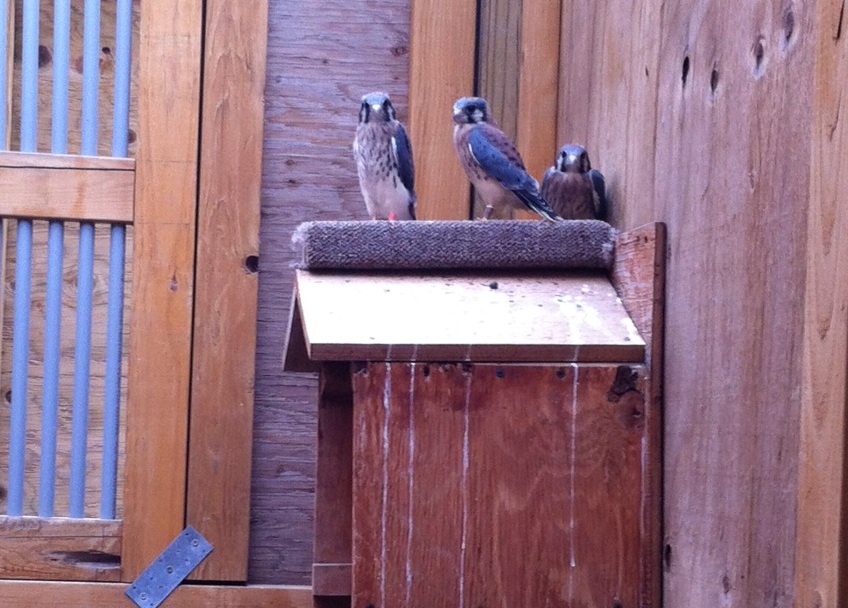
The Humans are up to their ears in baby American Kestrels.  Every day they admit new ones, move the last arrivals out to the rehab cages, move the rehab-cage birds to the large flight cages, and start the large-flight birds on live prey testing.  Whew!  There are dozens of the little falcons to keep track of, all with different colored leg bands on to help ID them.  Thank goodness American Kestrels are sexually dimorphic (males have blue backs, females are all brown), or there wouldn't be enough color combinations on leg bands to give them all a unique identifier! 

Young male American Kestrels
Other recent arrivals include a young Red-Tailed Hawk, a hit-by-car (HBC) Swainson's Hawk, and a high voltage trauma (HVT) Peregrine Falcon.  The Peregrine's injury is old, so he probably won't die from the injuries, but it's unsure whether or not he'll be a releasable bird. Stay tuned: the Humans are trying their best.  He's young, just a second-year bird, and he's very handsome:

Peregrin falcon in a critical care cage
Here's a pic of the HBC Swainson's Hawk.  He's a striking bird, with very pale undersides and a very stark bib.  He's also a fighter (even being hit by a car on I-25 didn't break any bones!), and he's a good reminder that not all Swainson's Hawks are "young and dumb".

Swainson's Hawk in a rehabilitation cage
The Mississippi Kite the with fractured wing has had her bandage removed and is trying it out in a larger cage this week.  So far she's holding it straight and using it well, so feathers crossed that it's perfectly healed!  The RMRP rarely admits adult Mississippi Kites, and usually they're broken beyond repair.  It would be a wonderful thing to give a second chance at freedom to this amazing bird.

Mississippi Kite, holding wings well
Perhaps the best news of all is about the two remaining Bald Eagles.  One was a power line victim, and she had a tough time healing the wound the shock left on her wing.  But the Humans were very determined and creative with her medical care, and the wound is now completely healed.  Soon it will be time for flight training!

And the other Bald Eagle is the one who came in at the end of 2011 scarcely able to walk or stand on her own.  It took weeks to get her to move around flat ground, then weeks to get her to perch on low perches.  It seemed like she was making good progress--slow but steady--when she hit a plateau.  For a few months she made no improvements.  The Humans were almost certain she would never be released, but decided to give her a little more time.  Well, whatever needed to click finally did so a few weeks ago, and all of the sudden she's flying and landing and moving around a double-length flight cage with ease!  Every day a Human goes into her cage to encourage her to fly laps so she'll build up strength, stamina and agility.  She's still a little tentative with her feet, so she's not 100% done with rehabilitation yet, but the progress she's made recently is an inspiration to us all.  Here's a photo montage from today, showing her spread her wings and launch from a high perch in her cage:

Here's hoping she continues making progress and gets out of here soon!  Not only do we want her to fly free again, but she eats a lot of food.

Stay tuned for another update: the RMRP has been receiving a lot of phone calls and emails about the High Park Fire and its effect on the RMRP, and I'll be writing about that soon.  But until next time, wish us luck in rehabilitating and releasing my awesome feathered brethren! 

Wednesday, May 16, 2012

General summary and Open House wrap-up!

Good morning to you all!  With the hubbub of the annual Mother's Day Open House last weekend, I got a little distracted from updating my blog, so this entry will be full of information for you.

First off, we released another bird!  The Great Horned Owl with the luxated elbow flew out of here on Monday, so big congratulations to him and to the Humans who helped him (both medically and financially)!  When he was released, he flew up to a tall tree, perched on the tiniest branch available, and was promptly greeted by a very displeased and noisy American Kestrel.

As for the other birds in rehabilitation, there are still four Bald Eagles in house!  And they're still eating like pigs, so if you have a surplus of trout to donate to us, we'd love to have it!  Whole and frozen is best. Call the RMRP for details.

There are also the three accipiters (forest-dwelling bird-eating hawks) going through rehab.  All three of them were likely window strikes, with the Sharp-Shinned Hawk being caught by a cat afterward (talk about a bad day).  All three are doing well, destroying button quail with no regard for the mess they're making, and steadily healing their injuries. I hope they get out of here soon because their energy level is waaay higher than mine, and I can almost feel the air humming around them while they're here!  Makes it hard to sleep, grumble, grumble....

On a sadder note, the Humans admitted an American Kestrel the other day that had been caught in a woodpecker trap.  I'd never heard of a woodpecker trap, so I looked them up and found out some interesting information: live traps are generally ineffective, so the kind of "trap" that is more commonly used is a snap-type rat trap mounted on the side of a house or placed in a nest box (which is where the Kestrel ran into one--"Ooh, look, a nice home for me to raise a family in!"...not).  They're allowed as a last resort for woodpecker removal, but require a permit from the US Fish and Wildlife Service.  To any Humans out there with a woodpecker problem, please do your research and try to find more humane ways of getting rid of woodpeckers before resorting to lethal trapping (there are plenty of humane methods to try).  For the record, the American Kestrel caught in the woodpecker trap didn't make it.

Now, onto some good news!  The Open House was a huge success!  Enormous thanks to everyone who came by to check out where I live, meet my neighbors and friends, purchase items in the gift shop, and donate generously!  I was resting in my cage for the day, but the birds who did come out say they had a good time, and the Humans were in high spirits! Thanks again!


Hm, there are Humans coming into my cage!  I have to put away my computer and act owlish!  Bye!

Thursday, April 26, 2012

General Update

Still not a whole lot going on at the RMRP, but certainly some interesting cases coming through the cages.  Here's the quick-and-dirty:

--First off, I can't remember if I told everyone that the Humans released the grill-head Red-Tailed Hawk! Remember him? He was found with his head stuck in the grill of a truck, and came in looking like this:
Very sick Red-Tailed Hawk after colliding with car
Well, he was released last week! Despite a fractured skull and awful head trauma, he's out there striking fear into the hearts of small rodents again. Congratulations to the RMRP for a job well done!

--Onto more current cases, a few days ago the Humans admitted a Cooper's Hawk that hit a house window...and shattered it. Can someone who's better at physics than an Owl please explain how a soft, feathery bird that weighs about half a pound can shatter a house window? Unfortunately, the outlook for this bird isn't hopeful, but it is a good reminder to keep your bird feeders away from windows, and apply decals to your windows if you have lots of birds zooming around.

--Admitted two baby Great-Horned Owls last week! Same nest, different days!  The first kid to come in was still very young. He was found at the base of the tree in fine health, but pretty vulnerable.  The Humans were able to put him back in the nest with his younger sibling.  Then, the very next day, the Humans had to rescue another young Owl from that same nest.  This one had gone out on his maiden flight and ended up standing in the middle of the road.  The Humans couldn't put that bird back in the nest because he was more flighted than his younger sibling. If they tried, the Humans would place him in the tree near the nest, he'd instantly fly away again because of the Human in his face, he'd end up on the ground, and the cycle would begin again.  Therefore, when the RMRP gets in mostly-flighted babies, they have to keep the baby until it's fully-flighted. So the mostly-flighted baby is here at the RMRP, finishing growing in feathers and learning how to be a fearsome creature.  Hm, I wonder where they put him?

Poor wing position, but excellent flight! Can't judge a book by it's cover...
--The Great Horned Owl with the luxated (dislocated) elbow is doing surprisingly well.  Despite the fact that he holds his wing out at an awkward angle, he's doing laps around his cage like nobody's business.  Soon he'll graduate to a cage with fewer perches to depend on.  Then he'll attend mouse school, and if he passes that he'll be released!

--The Red-Tailed Hawk with the broken foot is out of his splint and beginning to use the foot to grab the perch. That's excellent news because while wings need to be perfect for release, feet only need to be functional enough to grab perches and food, and this guy is well on the way to two functional feet.

--There are still FOUR Bald Eagles in house. Enough said.


SWHA's nest-building skills at work
--As for Educational Ambassadors, the female Common Barn Owl is busy rolling and tending her fake eggs, and the female Swainson's Hawk is contentedly arranging sticks in her cage.

And that's all the news for this week!  Time for me to get back to my baby.

Tuesday, February 14, 2012

Glue-Trapped Owl Update

I have big news! The Eastern Screech Owl I mentioned the other day, the one who was stuck to a glue trap in someone's yard: he has been released!! After passing mouse-school like a pro and waiting for a storm to pass, he took to the air, never to see this place again.

To the lucky Owl: may you remain glue-trap free for the rest of your days!