Pages

Showing posts with label Bald Eagle. Show all posts

Wednesday, January 23, 2013

Welcome back!

Really, I'm welcoming myself back.

As you may have noticed, I haven't been posting for the past month!  It's not that there's been nothing to report, but rather than I was taking a well-earned vacation from being an educator.  For one month I took a break from school visits, tours, blogging, and tweeting (still plenty of hooting, though).  I watched the Humans celebrate the holidays with funny hats and lots of food.  I saw fireworks over the city usher in the new year.  I saw the final bird for 2012 be carried through the doors, and the first bird of 2013.  I saw volunteers travel away from the RMRP to visit their other family and friends, and I saw them come back, eager again to brave the cold, early mornings, and long, frigid days for the sake of us birds.

Now the weather is warmer, my vacation is over, and I'm ready again to regale you with tales of the RMRP. First off, a summary of the holidays:

Our final number of admissions for 2012 was 265 birds.  Not the most ever, but certainly a high caseload, and a particularly challenging range of species and injuries.  More details and stats on the 2012 cases (species composition, injuries breakdown, release rate, etc) coming sometime in the next few weeks, so stay tuned.

Bald eagle with lead poisoning and a wing injury
The first admission for 2012 was a Bald Eagle, and the last admission was a Northern Harrier.  For 2013, the first admission was, again, a Bald Eagle.  He's probably a fourth year male bird, suffering from lead poisoning, an eye injury, and a wing droop.  The Humans treat lead poisoning with chelation, a process which uses Calcium-EDTA to draw the lead out of the bloodstream.  He's finished with his first round of chelation, is taking a break for a few days to allow remaining lead to come out of the woodwork, so to speak, and he'll move on to a second round soon.  Lead poisoning often comes with neurological side effects, which could be causing the wing droop, so hopefully that will resolve as the lead is cleared out of his system.

If you remember, January 2012 had us taking care of four sick and injured Bald Eagles at one time, a scenario the Humans hope to not repeat this January.  Here's hoping these amazing creatures stay happy and healthy in the wild, and don't have to visit the RMRP for care.

Weighing the Merlin on a cold day - see her breath as she vocalizes? 
The cold temperatures over the past few weeks proved very challenging for birds and Humans alike.  In cold weather like that, Humans have to think about a wide range of care-related issues that aren't usually so critical.  Can we avoid disturbing the bird, so the bird can conserve its heat and energy?  Is the bird's food going to freeze before it has a chance to eat?  Can we clean with water today, or will it instantly freeze and create hazards for birds and volunteers?  Are the little birds with high metabolisms maintaining their weight in these cold temps?  Fortunately, the Humans at the RMRP have plenty of experience with conditions like these, and the birds were extremely well cared for, as usual.  As for the Humans themselves, they dealt with the cold with many layers of thermals and Carhartts, hand warmers, insulated boots, hot water bottles, and good attitudes despite the frigidity of their work.

At last, here we are, experiencing some warmer temps and sunny days as a reward for the past few weeks.  The warm weather has provided an opportunity to deep clean the cages, use the hoses again instead of just buckets, and de-ice the pathways and parking lots.  In the past couple of weeks, the Humans have admitted the Bald Eagle mentioned above, a Cooper's Hawk, and an American Kestrel.  In exchange, they've released a female Merlin that recovered from a broken wing, a very handsome male Great Horned Owl that came in emaciated, and a Red-Tailed Hawk that was admitted with a skull fracture and massive head trauma.

That last case, the Red-Tailed Hawk, is truly amazing.  You may remember her from this picture:
Red-Tailed Hawk with skull fracture and damaged eye
The head trauma rendered her right eye useless and problematic.  After prey-testing her to be sure she could hunt with just one good eye, she was brought to the Vet Teaching Hospital to have her eye removed.  She recovered well from the surgery, and went back to hunting live prey like she still had two good eyes.  Seriously, that bird was a killing machine, and she often tried to use her skills on the Humans taking care of her.  She was released last week, and, true to form, she spun around and tried to attack her releaser one last time before flying away to go kill more appropriately-sized prey.

One-eyed Red-Tailed Hawk after release! 
Everything else at the RMRP is tripping along nicely.  As always this time of year, the Humans are busy, busy, busy planning and preparing for the annual Gala and Auction event.  Auction items are coming in daily, so be sure to come to the event to snag the best of it!  Details on our website here, including information on Early Bird tickets, which are only available for a few more days.

I'll be writing again soon to post more pictures of birds and other goings-on, so be sure to check back soon! Also, I'll be creating a new page on this blog with profiles of all us Educational Ambassadors for the RMRP, so stay tuned for those as well.

Monday, August 27, 2012

Raptor vocalizations

I don't know if you remember, but last week when I wrote about Red-Tailed Hawks, I promised a blog entry dedicated to the Red-Tailed Hawk's notable scream and how it's used in Human media.  Well, I couldn't find any actual examples of the misusages, but you all know what I'm talking about:  the Wild Western movie focuses in on a desolate cabin in the hills....something isn't right, death is in the air...overhead the vultures are circling, and one of them calls out, "Kreeeee-aaaaaaa!"  Or the truck commercial that ends with a waving American flag and the majestic call of a Bald Eagle, "Kreeeeee-aaaaaaaa!" 

Yeah, right.  Bald Eagles sound about as majestic as mourning doves sound dangerous.  It simply isn't true.  The call you're most often hearing in the movies, the one that's attributed to almost any large bird except seagulls (thank goodness) is actually a Red-Tailed Hawk.  Does this sound familiar? 


So, you may be asking yourself, if that sound in the movie isn't actually what an Eagle or a Vulture sounds like, what do they sound like?  Well, I sorted through all the horrible YouTube videos out there to give you the best-available video clips of raptor calls.  Here, for instance, is the majestic Bald Eagle...clucking:

It's a wonderful sound, isn't it?  But it's just not what the Hollywood producers are looking for.  It doesn't strike fear or awe into the hearts of many the way the Red-Tailed Hawk does.  How about the Golden Eagle?  Any more majestic?  Not really.  Here's a pretty common sound from one:

Again, really interesting, but not awe-inspiring.  Then again, does an Eagle need to be any more awe-inspiring?  They're pretty darn impressive to begin with. 

Finally, what's with the Red-Tailed Hawk call being played when Vultures are circling?  As a critic of Human movies, I'm always noticing this error.  Turkey Vultures are mostly silent birds.  The only time you'll hear one vocalize is if you really disturb it, which, of course, is something you shouldn't do.  And when they vocalize, it is the farthest thing from a scream that you can imagine.  It's more of a hissing roar.  Honestly, I think Humans should use Turkey Vulture vocalizations in movies about dragons!  Here's an example:  

So there you have it.  Next time you hear an impressive, piercing call from a bird in a movie, be it an Eagle, a Vulture, a Hawk, or any other bird, maybe you'll notice it's the wrong bird entirely, then laugh at the ridiculousness of it.  And, on that note, I leave you with the chattering call of an American Kestrel.  This bird is not often depicted in movies, but it certainly has the voice and attitude for the silver screen! 


Please note: all these videos were found on YouTube and are not the property or responsibility of the Rocky Mountain Raptor Program. 

Wednesday, June 27, 2012

General Update: 6/27/12


First of all, congrats to the little cat-caught Eastern Screech Owl! He passes mouse school with flying colors (flying fur?) and was released yesterday!

And in other big news, the Humans have officially caught up to and surpassed last year's admissions for this time of year.  They have admitted 93 birds for the year, and it seems like half of those came in just these last few weeks!
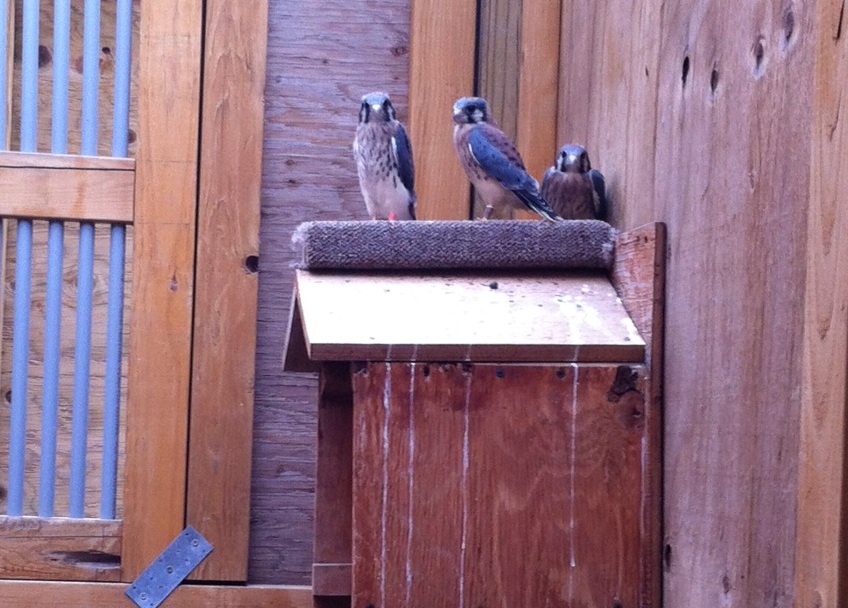
Young female American Kestrels
The Humans are up to their ears in baby American Kestrels.  Every day they admit new ones, move the last arrivals out to the rehab cages, move the rehab-cage birds to the large flight cages, and start the large-flight birds on live prey testing.  Whew!  There are dozens of the little falcons to keep track of, all with different colored leg bands on to help ID them.  Thank goodness American Kestrels are sexually dimorphic (males have blue backs, females are all brown), or there wouldn't be enough color combinations on leg bands to give them all a unique identifier! 

Young male American Kestrels
Other recent arrivals include a young Red-Tailed Hawk, a hit-by-car (HBC) Swainson's Hawk, and a high voltage trauma (HVT) Peregrine Falcon.  The Peregrine's injury is old, so he probably won't die from the injuries, but it's unsure whether or not he'll be a releasable bird. Stay tuned: the Humans are trying their best.  He's young, just a second-year bird, and he's very handsome:

Peregrin falcon in a critical care cage
Here's a pic of the HBC Swainson's Hawk.  He's a striking bird, with very pale undersides and a very stark bib.  He's also a fighter (even being hit by a car on I-25 didn't break any bones!), and he's a good reminder that not all Swainson's Hawks are "young and dumb".

Swainson's Hawk in a rehabilitation cage
The Mississippi Kite the with fractured wing has had her bandage removed and is trying it out in a larger cage this week.  So far she's holding it straight and using it well, so feathers crossed that it's perfectly healed!  The RMRP rarely admits adult Mississippi Kites, and usually they're broken beyond repair.  It would be a wonderful thing to give a second chance at freedom to this amazing bird.

Mississippi Kite, holding wings well
Perhaps the best news of all is about the two remaining Bald Eagles.  One was a power line victim, and she had a tough time healing the wound the shock left on her wing.  But the Humans were very determined and creative with her medical care, and the wound is now completely healed.  Soon it will be time for flight training!

And the other Bald Eagle is the one who came in at the end of 2011 scarcely able to walk or stand on her own.  It took weeks to get her to move around flat ground, then weeks to get her to perch on low perches.  It seemed like she was making good progress--slow but steady--when she hit a plateau.  For a few months she made no improvements.  The Humans were almost certain she would never be released, but decided to give her a little more time.  Well, whatever needed to click finally did so a few weeks ago, and all of the sudden she's flying and landing and moving around a double-length flight cage with ease!  Every day a Human goes into her cage to encourage her to fly laps so she'll build up strength, stamina and agility.  She's still a little tentative with her feet, so she's not 100% done with rehabilitation yet, but the progress she's made recently is an inspiration to us all.  Here's a photo montage from today, showing her spread her wings and launch from a high perch in her cage:

Here's hoping she continues making progress and gets out of here soon!  Not only do we want her to fly free again, but she eats a lot of food.

Stay tuned for another update: the RMRP has been receiving a lot of phone calls and emails about the High Park Fire and its effect on the RMRP, and I'll be writing about that soon.  But until next time, wish us luck in rehabilitating and releasing my awesome feathered brethren! 

Thursday, June 21, 2012

General update 6/21/12

Busy season is in full swing at the RMRP.  The Humans admitted 25 birds in the past two weeks, and most of them have come in clusters: five birds one day, none the next, etc.  The majority of the newcomers are American Kestrel chicks: there are currently 18 Kestrels at the center, and 14 of those are this year's young.  Some of the more interesting of the baby Kestrels include the nest of five chicks that arrived in the same box as a nest of baby Flickers--I don't know which family was more scared!  Both of their nests were accidentally knocked down by construction workers, who then boxed the kids up and brought them in.  The Flickers went to WildKind at the Larimer County Humane Society, and the Kestrels are doing well in our flight cages.  The other interesting Kestrel kid is one that was found fending off the advances of a curious Rottweiler.  The bird was on his back, feet lashing out, keeping the mighty beast at bay.

Aside from young American Kestrels, the only other kid admitted this past week was a cat-caught baby Screech Owl (the third Screech Owl brought home by this one cat!).  The unfortunate thing about cats and baby birds is that a bell on the collar doesn't do any good when the bird can't fly.  The chick is fine, but all cat-caught birds are treated with a round of antibiotics because raptor chicks are particularly susceptible to a bacteria in cat saliva.

As for the rest of the birds, the Mississippi Kite with the fractured and traumatized wing is due to get his bandage off at the end of the week: feathers crossed that it healed well enough for him to fly!  The Great Horned Owl with the deep puncture wound in her face is now maggot free and proud to be!  She'll be moving into a cage with the immature Great Horned Owls soon so she can be a role model for the kiddos and show them what to do with those furry things running around on the ground below them.

And, finally, there are the two remaining Bald Eagles.  One was a high-voltage trauma victim (read: shocked by a power line).  She was having issues with the exit wound on her wing, and was unable to heal over the exposed and necrotic bone.  But the vets at the CSU Vet Teaching Hospital were able to scrape away enough of the dead bone to allow new growth to start, and now only the tiniest remnant of the wound remains!  She'll be heading into a large flight cage to build up her stamina soon.

The last eagle is the one who came in unable to use her legs.  For a couple of months she made slow progress in regaining strength and agility, but then she plateaued for a long time...long enough that no one thought she would get any better.  Still, the Humans gave her a chance, and in the past couple weeks she's made huge progress, enough that the Humans are once again hopeful that she might be saved!  She's started flying around and making good landing, something she didn't have the confidence/ability to do for the past couple months.  Her prognosis is still guarded, but everyone is pulling for her!

So, all in all it's business as usual for the birds and Humans at the Rocky Mountain Raptor Program.  The smoke has thinned out, booth and festival season is ramping up, and everyone is excited to be helping the birds!  As always, I'll be sure to keep you updated as these amazing animals are admitted, fixed up and released!  Oh, and I'm sorry about the lack of pictures in this update--I promise I'll post more soon!

*** Is there anything you would like to read about that I've not touched on?  Like West Nile Virus in raptors?  Or maybe raptor anatomy or diet?  Have questions about that strange bird in your back yard, or want to know why raptors can turn their heads so far around?  Want to know more about what some of the injuries really mean, like what "high voltage trauma" actually does to a bird?  I'm here for you, so let me know what you'd like to read!  Leave a comment below, or email me at talonsofdoom@gmail.com! ***

Friday, June 15, 2012

Why Bald Eagles Are Amazing!

fellowshipofminds.wordpress.com
The Bald Eagle!  Proud symbol of America!  A regal and beautiful beast, with a bit of a temper and a lot of power to back it up!  Now that we're down to just two Bald Eagles at the RMRP, this entry isn't as timely as I had hoped it would be (not that I'm complaining: two Bald Eagles is much better than five).  But here we go anyways, an article dedicated to the awesome Eagle.
justanimal.org
Identifying a Bald Eagle is usually a pretty easy task.  First of all, they're enormous, making most other American birds look positively diminutive.  Also, they're strikingly colored: the solid white head and tail contrast starkly with a dark brown body, a color combination that's easy to pick out whether they're perching on a tree or soaring hundreds of feet overhead.  Finally, they have a giant yellow schnoz that stands out like a beacon.
thegeminiweb.com
Despite all those obvious markings, there are times when Bald Eagles are not quite so easy to identify...mostly when they're young and look just like Golden Eagles.  An immature (age 0-5 years) Bald Eagle doesn't have the white head and tail, or the solid brown body, and they end up looking almost identical to immature Golden Eagles, which is why both are protected under Federal law.

Bald Eagles live all across the US, but are mostly found in areas with water (salt water or fresh).  While they don't need to eat fish exclusively, they are darn good at catching fish and it makes up a large portion of their diet.  Unlike Osprey, which submerge themselves completely when they dive for fish, Bald Eagle reach in with their feet and pluck fish out of the water.  Also found on the menu are prairie dogs, large animal carcasses, and aquatic birds like geese and ducks.
birdcapemapy.org
Bald Eagles reach sexual maturity between ages four and five, and then they mate for life...unless the worst should happen.  Then they will find a new mate and start over.  Courtship displays are something to behold: the eagles lock talons and spiral down towards the earth in a death-defying show. Here are two video clips of the action.
The first is pretty old, but impressive: 

And this one is newer, but further away:

Bald Eagles, along with Peregrine Falcons, really hit the spotlight in the 1940's and 1950's when DDT was wreaking havoc on the population.  In the mid-1950's, there were only ~400 pairs in the lower 48.  Since then, a combination of banning DDT and enacting laws to protect eagles has brought their population back up to normal.  In 2007 they were delisted entirely, and are considered a Species of Least Concern!

In terms of personality, Bald Eagles are timid, easily stressed, high-maintenance and unpredictable.  Only a few Humans at the RMRP are qualified to work with these birds, which is why is was soooo difficult to manage FIVE Bald Eagles all at once.

Okay, now that you know what Bald Eagles are, let's clear up some myths about what Eagles are not.  

First of all, they're not the biggest bird in the US. The Golden Eagle and the Bald Eagle overlap a lot, with both of them checking in at 9-14 lbs (some Bald Eagles can weigh a mere 5 lbs), and with wingspans of 6-8 ft. The California Condor blows them both out of the water with an average weight of 18-20 lbs, and a typical wingspan of 8-10 ft.  And for the record, some Trumpeter Swans are even bigger than that.
California Condor (sandiegozoo.org)

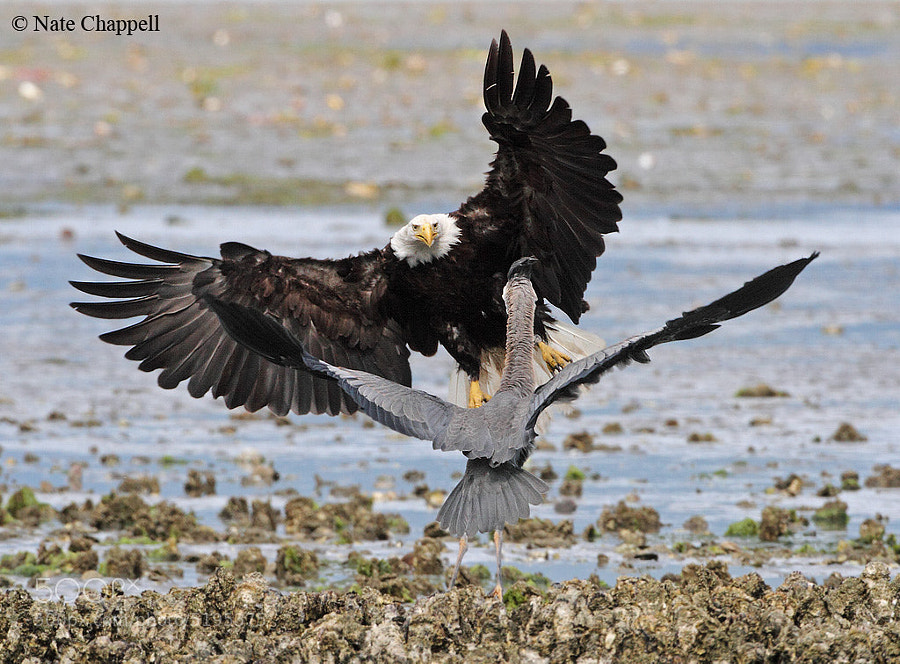
Second, they're not just the mighty hunter people believe they are.  Bald Eagles are notorious scavengers of carcasses and dumps, and not just scavengers but thieves!  Bald Eagles exhibit a behavior known as kleptoparasitism, or, in plain English, they steal food that other animals have caught.  For instance, if an Osprey dives into the water and comes out with a large, delicious fish, a Bald Eagle will come along and try to bully it away from the Osprey--and being bigger and badder, the Eagle will usually succeed.  The beautiful picture below shows an Eagle trying to steal a fish from a Great Blue Heron.  They also steal from each other, especially adults from juveniles.
natechappell.500px.com

And third, you know that regal screeching sound you hear in the movies whenever a Bald Eagle (or any other bird for that matter) comes into view?  That's not what Bald Eagles sound like.  That's a Red-Tailed Hawk.  Bald Eagles sound like this:
No wonder Humans use a Red-Tailed Hawk screech in the movies! 

That's all I've got on Bald Eagles!  I hope you learned something new, and if you have any questions feel free to leave a comment below or send me an email at talonsofdoom@gmail.com. 


Wednesday, June 13, 2012

General update: 6/12/12

The Humans have had another busy week taking care of sick and injured raptors at the RMRP.  Not only are there bird cases coming in daily, but there's smoke from the nearby forest fire to contend with (more on that later). 

Since last week, 11 injured and orphaned raptors have come through the critical care unit.  The majority of these are immature American Kestrels.  The Humans refer to these uninjured birds as "young-and-dumb", because there's nothing wrong with them other than making bad decisions during their first flight.  


When the Humans receive a call about an immature bird, the first question they ask the good Samaritan is "Can you find the nest?"  Often times the nest is nearby, and can be found by following either the peeps and screeches of other babies in the nest, or the aggravated screams of mom and dad as they watch over their grounded offspring.  If there's a nest nearby, the good Samaritan on the phone, or one of the RMRP Humans, will move the bird back near its nest, setting the bird on a branch that's off the ground and out of reach of lazy house cats, curious dogs, and hungry foxes. The addled kid will figure out how to get back up to the nest from its safe new perch.  Contrary to popular belief, parents have no problems accepting Human-contaminated chicks back into the nest.  They can't "smell" the Humans on the bird.  In fact, most of us can't smell at all. 


 If there' no nest in the area, the RMRP gets the bird, which is how we ended up with five American Kestrel kids (all from different nests), another immature Great Horned Owl (currently cozied up next to me), and our first immature Red-Tailed Hawk of the season.  They're all completely fine--just young-and-dumb...and hungry. 


Aside from immature birds, the Humans also admitted an adult Red-Tailed Hawk with a broken wing, and an adult Mississippi Kite from Sterling.  The prognosis on the Mississippi Kite (we call them Miki's around here) is very guarded.  We hardly ever see Miki's here, and when we do they're usually immatures.  When an adult comes in, it's usually because they're very injured.  Fingers crossed for the new guy. For those who've never seen one, this is what an adult Mississippi Kite looks like: 
oklahomabirdsandbutterflies.com
In other news, we only have two Bald Eagles!  Unfortunately, one of the original four passed away.  But the other one was a gunshot bird transferred from Wyoming to our large and excellent cage system for flight training and molting.  He soared out of here last weekend.  I'm hoping to nab some pics from a Human who was at the release so I can show you what it was like.  The two Bald Eagles that remain are the long-shot adult with the leg problems and confidence issues, and the high voltage trauma adult with a healing wing wound from a power line.  I'll keep you updated! 

We also kicked out the Turkey Vulture that had been here since last summer.  He flew away to join a kettle (group) of Vultures living in La Porte.  


As for other birds, a lot of the kids (including some of the Kestrels and the one young Screech Owl) are ready to attend mouse school.  As soon as they prove that they know what to do with a mouse [read: catch it, kill it, eat it], they'll be released to the wild.  The Great Horned Owl with the hole in her face is gaining weight (and attitude and strength), and the wound is slowly healing.  The Swainson's Hawks are waiting to finish a molt so they can be released.

Okay, that's enough about birds, how about that enormous wildfire burning just west of here?  For those of you who don't know, a very large forest fire is raging away in the foothills outside Fort Collins.  It's called the High Park Fire, and as of today it's 46,000 acres and 10% contained.  It was started naturally by a lightning strike.  Thousands of Humans have been evacuated, one life has been lost, and well over 100 homes have burned to the ground.  The RMRP has not received any birds from the burn area, but the smoke here in town is a hazard that the Humans are dealing with.  Birds have much more sensitive respiratory systems than Humans (remember the canary in the coal mine?), so the Humans are making sure we're not being disturbed so we won't start breathing fast or heavy.  A lot of the Human staff and volunteers are involved in either fighting the fire, or evacuating from it.  So far no one has suffered any losses.  Here are some pictures from the fire, all taken at or from the RMRP. 

Day 1 (June 9, 2012)

Today (June 13, 2012). The sky would be blue if it weren't so smoky.

Today. The view of the mountains is completely gone. 

Today. Sunbeams shining down through the smoke in the cages. 

On a final note, the Renaissance Festival in Larkspur, Colorado is in full swing.  The RMRP is there every Saturday and Sunday all summer long as "Ye Royal Birds of Prey".  This weekend's theme is Ale Fest!  I can't imagine a better time to visit.  Hope to see you there!

Monday, June 11, 2012

Re-nesting the baby Bald Eagle

Here are a few photos from that young Bald Eagle the Humans returned to the nest a few days ago!
CDOPW gearing up to climb the tree

Bald Eagle chick is in the bag!  No, it's not a pinata...

Mission accomplished! Now the chick and his sibling are ready to defend the nest!


Another successful release.  Thanks for your support for the RMRP! 

Wednesday, June 6, 2012

General update: 6/6/12

Things are picking up for the Humans at the RMRP.  More birds are coming in daily, and cages are steadily filling up.

The RMRP has admitted 55 birds so far this year, 23 of whom are currently in house.  Five of those birds came in this past week: an immature Screech Owl, two immature American Kestrels, an adult American Kestrel, and a Great Horned Owl.
Kestrel family
Of those birds, only the adult Kestrel is not still with us.  She came in covered in food-grade oil, and then was picked up by a dog.  How she encountered a vat of cooking oil in a person's back yard is unknown, but it does create a public service announcement opportunity: if you have old oil laying around (from deep frying or changing the oil in your car), please don't leave it uncovered.  Animals like me think it's water and we try to drink it (we're not very smart), and the results aren't pretty.  This particular Kestrel, aside from being coated head to toe in oil and unable to fly, had aspirated and ingested  a lot of oil.  There was no saving her.

The Great Horned Owl that came in is this one here:

She's an interesting case.  She was found on the ground and very emaciated, which means she'd been on the ground for a long time.  Even though it's dangerous on the ground, and hunting opportunities are scarce, somehow downed raptors manage to plug along for many days, getting skinnier and more dehydrated.  The really lucky birds (like this girl) are found by a wandering and caring Human, and brought into the center.  The Humans don't actually know if she's a girl, but she has enormous feet, and even horribly emaciated she's tipping the scale at 900 grams. When she fattens up she'll be a beast.  In the meantime, the Humans are trying to get her weight and hydration up, and are treating a nasty, deep hole/wound near her mouth.  The wound was full of maggots (ew), and the bird is receiving treatment for those.  Miraculously, whatever it is that gouged a hole out of her face missed her big, beautiful eyes. Feathers crossed that she'll be okay soon!

As for the old-news birds, I am happy to announce that one of the Bald Eagles has gone home.  The baby eagle that fell from his nest last week was returned over the weekend by a crew of professional tree climbers, wildlife biologists and RMRP Humans.  The [rather large and angry] Bald Eagle chick that didn't fall out of the nest was there to greet the tree climber, but everyone escaped unscathed, and the kid is back with his parents, just how it should be.  So, that means we're back down to an entirely reasonable and manageable FOUR Bald Eagles (by the way, that was sarcasm).  One of those will hopefully be kicked out this week as he is zooming around the cage at top speed, aching to hit the skies again.

The adult from Wyoming that was admitted back in January, the one with leg problems and subsequent confidence issues, had hit a plateau about a month ago, and the Humans were beginning to look for placement for her as a display bird at other facilities. However, this last week she started showing a renewed interest in walking/jumping/flying/perching!  So they're going to give her even more time and more space and more perches, and see what happens.  As the Humans say, "her prognosis is guarded".  Still, feathers crossed...

The Swainson's Hawk that encountered a methane burner and scorched off his beak, talons and feathers last year is finally molting feathers.  See how messed up they are?  Even the body feathers were torched:


The tweaked-out conspiracy theorist Cooper's Hawk was released a few days ago!  Thank goodness for that--it's much calmer in the cages now.  He flew out of his carrier so fast it was hard to tell there had been a Cooper's Hawk in the box to begin with.

The education birds have been making the Humans work hard recently, too, but egg laying season is close to an end.  The female Swainson's Hawk, the ancient 21 y/o matron of us all, managed to squeeze out another egg this year, but she grew bored of sitting on it pretty quickly.  Now that her egg is gone she's feeling much better, and she's back to being in everyone's business:


One of the female American Kestrels popped out FIVE eggs this year, and even though she doesn't care enough to sit on the eggs (her original injury was head trauma, so don't judge her too harshly), the instinct to protect her nest is very much present--she makes a point to fly, posture and leap at anyone who enters her cage.
Fluffy is not cute, fluffy is angry (eggs are in the house on the ground)
Well, that's it for the weekly bird update!  Upcoming articles: Identifying Raptors at Your Bird Feeder, and Why Bald Eagles Are Awesome!  Thanks for reading!  And don't forget, you can get notifications of new posts sent right to your inbox if you subscribe (look for the box in the right sidebar).

Thursday, May 31, 2012

General update: 5/31/12

Well, it seems like slow season has come to a close.  Yesterday there were two calls for bird rescues (a downed Eagle and a baby Kestrel) before the Humans opened their doors for the morning!  Before 9:00 they received two more calls (another Kestrel and a baby Screech Owl), and later in the day the Humans picked up a Kestrel that had been both oiled and caught by a dog. Whew!  That means my weekly updates may be a little more interesting from here on out (although I can always hire a Cooper's Hawk to write for me--that was entertaining!).

Anyways, here's what's going on at the RMRP:

There are now FIVE Bald Eagles in rehabilitation!! 


 Yeah, that's right, five insatiable and difficult Bald Eagles, a mix of immatures and adults.  The newest arrival is this year's kid, still growing in feathers. He fell out of his nest but didn't damage himself too much, so the Humans are going to try their best to get him back into his next as soon as possible.  If there's a chance for a kid to be raised in the wild like they should be, the Humans try to make that happen. Even with the kid hopefully leaving soon, that leaves four Eagle-sized appetites to feed, and four Eagle-sized doses of medications, bandaging materials, vet consults, and cleaning materials. If you can help by throwing some money or fish our way, the Humans would really appreciate it. Click the "donate" link to the right!

We got in an Eagle, but kicked out a Sharp-Shinned Hawk, the one with head trauma and a fractured metacarpus (wing).  Of course, a Sharpie eats next to nothing compared to an Eagle, but a trade is a trade, and the Humans aren't complaining.  He flew out of sight faster than you can blink, and hopefully he'll steer clear of windows in the future.


Another baby Great Horned came in with mild abrasions. He's hanging out with me right now, until he can fly well enough to join the others.  This one is particularly cute, and he spends a lot of time cozied up next to me.


All the other birds are status quo, nothing to report except general improvements overall!

Oh yeah, almost forgot to mention that the Cooper's Hawk is getting pretty close to release.  He's still convinced that he's been "captured" and is being "held against his will", but he's healing well and should finally be leaving me alone soon.

Alright, that's all for now. I'll be sure to let you know how the new admissions are doing!

Wednesday, May 23, 2012

Guest writer for the weekly update: Cooper's Hawk

So, we still have injured accipiters in house here at the Rocky Mountain Raptor Program.  All accipiters are extremely high-energy, and there's one in particular--a Cooper's Hawk--who's getting on my nerves.  It's like someone gave him a triple shot of espresso and asked him to sit still in a corner.  Forget about it.  So in an effort to keep my manic neighbor calm and quiet for an hour or so while I catch some daytime shuteye, I offered him the job of writing this week's update.  Good night, and good luck!
~  ~  ~  ~  ~  ~  ~  ~  ~  ~  ~  ~  ~  ~  ~  ~  ~  ~  ~  ~  ~  ~  ~   ~  ~  ~  ~  ~  ~  ~  ~  ~  ~  ~  ~  ~   


It appears that the evil animals that walk upright and poke me with very sharp, tiny, pointy things (the Owl calls these creatures "Humans") all gather together once a week and talk about us Raptors. They call it "Rounds", but I call it "plotting my demise". So they plotted my demise last night, and this is what they said:

First, they talked about the other Cooper's Hawk that was here, the big gorgeous female who could have squashed me like a bug.  So hot.  She came in about one moon before me, after hitting a window in a Human house and shattering it.  She broke her skull, too, but she never let that get her down, and she was always trying to kill the Humans.  She was awesome.  So, she's been missing for two days, right, and I'm thinking the worst has happened, that the Humans plotted her demise, and followed through on it!  And I'm listening in on this meeting of theirs hoping to hear what they did to her, right, so I could be ready to kill the next Human to come near me, but then they said they released her.  In an "area with fewer windows" they said, and then they all laughed.  Huh.  I wasn't expecting that.  What did she do to them to make them let her go?  I hope I figure it out soon so I can get them to release me as well.  My wing is almost completely better, and I was spending all my time flying in tight circle in this little cage they had me in, and almost escaping every time the Humans tried to catch me, and I guess the Humans didn't like that because this morning they moved me to a much larger cage.  Now I can really begin strengthening my wing and preparing for the day I manage to escape.

Anyways, they also talked about a Sharp Shinned Hawk (he hit a window, too, like me and the other Cooper's), and how he's in a really big cage and how he's flying so fast that no one can seem him long enough to judge how his wing is healing.  They all laughed at that, too.  Then they started talking about releasing him! I have to figure this out!

After the Sharpie, they talked about an American Kestrel that's in the small medical room where the Humans use the pointy things.  She was my neighbor until I moved out today. She got here after I did, and she says she was hit by something (like a car) that messed up her head and her balance, and then she was chewed on by a cat for awhile.  She's been having a really rough time standing up and holding her head straight and eating and everything, but yesterday she started eating on her own, and now she can stand sometimes, and she holds her head the right way more often than she holds it the wrong way, so I think she's getting better, too.

Then the Humans talked about the Bald Eagles.  There are four of them, and I can't keep them straight, but I know that there are at least two that are doing well and getting stronger and healthier. I hope they leave soon because their fish stinks and they poop everywhere. Bald eagles are so gross.

There's also a Red-Tailed Hawk that they call the Undead Red-Tail because he's been sick with a mystery illness for two moons now, and he just won't get better, and because he has no blood in his veins, and because he had this weird lesion thingy in his throat for a long time. He's only a kid, but he's really mean and vicious, but he's still a little subdued because he's trying to fight off whatever infection he has, so he hasn't had a chance to unleash his fury. The Humans don't know this, but when he's finally feeling well they'd better watch out!

After that the Humans starting talking about something called "Renaissance Festival" and started walking around in these really weird clothes, and I lost interest and left, so then I went back to my...OOH, QUAIL!!!  KILL IT!!! OH, IT'S ALREADY DEAD...EAT IT!!!
~  ~  ~  ~  ~  ~  ~  ~  ~  ~  ~  ~   ~  ~  ~  ~  ~  ~  ~  ~  ~  ~  ~  ~  ~   ~  ~  ~  ~  ~  ~  ~  ~   ~
...Wow, accipiters have short attention spans.  Thanks for reading, I'll be back on board tomorrow! 

Wednesday, April 11, 2012

Spring is in the air

I apologize for my lack of posting recently. There has not been all that much happening at the RMRP these past few weeks, so I've just been perching by the window and enjoying the spring air.

Lots of other birds here at the center are also feeling the effects of spring. For some birds, like the pair of educational Common Barn Owls, that means laying eggs. The female has popped out six of the suckers already--I don't know how she does it!

The female Swainson's Hawk, now 21 years old, is not letting age get in the way of egg-laying season.  She's been over in the her cage twittering away to herself. She's spending most of her days taking sticks and rearranging them, a sure sign that she's feeling broody.

On the rehabilitation side of things, the Humans are still anxiously watching the door and waiting for the flood of babies.  We Great Horned Owls got around to things a little late this year, so now it looks like orphaned Great Horned Owls and orphaned American Kestrels could be arriving all at the same time, a prospect which has the Humans on tenterhooks.


Remember the Red-Tailed Hawk that was found with his head wedged in the grill of a truck after being hit? Well, he survived his massive head trauma and skull fracture and flew away on Monday! It's always good to see such a success story as that one.

Also, the Swainson's Hawk that had all his feathers burned off in a methane burner has finally begun to molt. Once he has a new set of feathers, the Humans will be more able to assess his prospects.

The only other news is that the RMRP is now the cool place for Bald Eagles to come hang out, like Camp David or something. There are three of them at the center right now! That's a lot of Eagles to feed. Interested in helping the Humans buy food and medical supplies for the injured birds? Check out the "wishlist" page at the top of my blog, or the "donation" link on the right sidebar.

Alright, I'm going to go back to my window now and watch the spring evening steal over the meadows.

Thursday, March 22, 2012

Quick bird update


  • The adult Bald Eagle with the spinal trauma and confidence problems was put out in a large flight with the immature eagle for a week to help the immature calm down. It worked well, so now the adult is back in a smaller cage where she can continue working on attaining higher perches. See how tall she's getting?
  • The American Kestrel that came in with a fractured ulna is flying perfectly and should be released as soon as the wind dies down!
  • The Red Tailed Hawk that was found with its head stuck in the grill of a truck is doing really well. His skull fracture is healed and he's flying around his cage really well, despite having reduced vision in one eye. Next step: rat school, where the hawk is moved to a large flight and given live rats to kill. If his vision and flight are good enough to hunt and kill, he can be released! 


All the other birds at the RMRP are doing well, too. The case load is slowly climbing as we approach summer. I'll let you know when more interesting cases come through the door!

Wednesday, March 14, 2012

Tuesday, March 13, 2012

Raptors in the news: eagles vs turbines research

Looks like the frequency of eagles colliding with wind turbines has spurred some research by the USDA. I like the idea of "tiny bird backpacks" to monitor them!

Tuesday, March 6, 2012

Rehab gossip

I just got back from eavesdropping on this week's Rounds meeting. Once a week, all the Humans who work and volunteer at the RMRP gather together in the warehouse to ensure there are enough minions on every shift to take care of all of us Raptors, to make announcements, hand out awards and certificates, and go over the ever-changing status of all the rehab cases in the facility. Tonight's updates had me making notes in my iPhone because, for the first time in a couple of months, there are enough birds in-house to cause information-overload while listening in. Here's the quick and dirty of some of the more interesting cases:

  • Remember the Bald Eagles I mentioned a few posts ago? The slow-but-steady spinal trauma adult, and the reckless youngin' determined to knock himself senseless by forgetting to put on the brakes? Well, the  youngin' had to take a breather from the large flight cage when his lead poisoning flared up again, but he's back in a large flight cage again...and guess who's there with him? The slow-and-steady adult! Her progress has been really positive recently, so she was moved into the large flight cage with the reckless kid in the hope that she'll help him chill out a little. They're also helping each other with physical therapy: he always wants to be next to her, and she always wants to be left alone. So when she moves to a perch and he follows her there, she moves to another perch in an effort to get away...and so they're always moving and always giving themselves physical therapy. Don't worry: even though she doesn't want to be buddy-buddy shoulder-to-shoulder with him, they're actually getting along just fine. 
  • A Great Horned Owl came in a couple of weeks ago with a fractured humerus. That can be a very bad thing, but this was the kind of break that made the Humans happy: a clean, simple, middle of the bone fracture. He has a fixator on it for support, and he's confined to a critical care cage until the bone heals. Since the fracture was an easy one to deal with, this Owl is making up for it in other ways. One, he's a chewer, and the Humans are spending a lot of energy creating chew-tabs out of tape for him to gnaw on instead of the fixator. Two, he's a handful. Now, all Great Horned Owls are angry, disagreeable handfuls (and we're very proud of this), but apparently this guy is angry above and beyond the norms. I can't wait until he moves to the outside cages and I get a chance to chat with him! 
  • A Red-Tailed Hawk, hit by a car, came in a week ago in really bad shape. Of course you expect a hawk hit by a car to be in bad shape, but this hawk was stuck in the grill of a truck. By his head. And did he give up an die in the grill of that truck? Heck no. He's a Red-Tailed Hawk. They fight. This guy has massive head trauma (no surprise there) and a fractured skull. Recently he's regained enough coordination to eat on his own (I remember how hard that was for me back when I was admitted for head trauma, and I didn't have a fractured skull!) and the vision in his left eye is slowly improving. The outlook on this hawk is still guarded, but I'm really pulling for him. What a fighter!
  • A few weeks ago a female American Kestrel was admitted with a fractured ulna. Again, this was a break that was cheerfully received by the Humans because it appeared to be fixable. When the ulna breaks, it can often be stabilized by the radius alongside it, which is exactly what happened in this case. She moved out to a small outside cage this week, and will be moving to a larger flight cage soon. The resident educational Kestrel with the Twitter account will be bummed to see her move--he's pretty smitten with his new neighbor! 
Well, that's it for now. I'll try my best to sneak some pictures soon so you can see these birds I'm writing about! Of course, stay tuned for more updates, and I'll be sure to let you know when any of these brave birds get released.

Thursday, February 16, 2012

Two Bald Eagles = Double the Fun

Not many new neighbors have been coming through the cages recently. Like I said, it's winter, and, everyone is grateful to be experiencing a "slow season". But of the few birds who have been passing through, two (!!) of them are Bald Eagles, and they're both handfuls, but for different reasons.

Bald Eagle #1: In for the long haul

Just down the hall from me is an adult Bald Eagle that came in barely able to use her legs and feet. The Humans have determined that she had spinal trauma that left her out of touch with her extremities. Their solution: physical therapy. For a couple of weeks they were catching her regularly to work her legs and feet through something they call "PROM", or "passive range of motion." That means the Humans are holding on to her legs/feet and moving them through their normal range of motion, one joint at a time, then the whole shebang at once. The idea is that the nerves and muscles in the legs/feet have "forgotten" how to do what they're supposed to, and PROM will help them "remember" more easily. 

Then, in recent weeks, they've moved her to "AROM", or "active range of motion." That means they're setting things up in her cage in such a way that she's putting herself through physical therapy. Naturally, both Humans and Eagle are enjoying the reduced interaction. The way the Humans have her doing AROM is by providing her with numerous perches in a wide range of shapes, heights and styles. In order to get to her food, she needs to negotiate some of these perches. This makes her use her legs and feet on her own, in little baby steps, with a food reward at the end. Excellent. 

What's most interesting about her case, in my opinion, is that the Humans are spending a lot of time right now rebuilding her confidence. She would eat me if she knew I were writing this, but the truth is, she's lost all confidence in her ability to use her legs and feet! Even though you don't imagine an animal as majestic and indomitable as a Bald Eagle having confidence issues, it makes sense when you think about it: she must have pushed herself hard when she first lost her ability to use her legs and feet, refusing to believe that she couldn't move like an Eagle anymore, and her reward was probably some harsh face-plants and deep bruises. We Raptors aren't dumb--we're quick learners. And if we crash and burn a few times, and it hurts, we stop trying. 

 So in addition to providing AROM physical therapy for her, the perches in her cage are also baby-stepping her back up to her old Eagle-level of confidence, allowing her to progressively jump higher and land more solidly as her body heals. I often overhear the Humans talking about her, and they say she's making slow-but-steady progress, and there's hope that she'll make a full recovery. But it's going to take a long time. 

I tell you what: the day she achieves her old level of strength and confidence, and remembers how to use it...well, I wouldn't want to be the one in the cage with her. Those feet are big. 


Bald Eagle #2: Kamikaze Knucklehead

Well, that's not what I call him, but I've overheard the Humans referring to him this way. This immature Bald Eagle came in with a whole bunch of injuries: a fractured coracoid, an injured leg, and some pretty severe lead poisoning. The coracoid is one of those specialized bones we birds have in the shoulder-region, and it allows us to beat our wings strongly enough to fly. In other words, it's pretty essential. It's also difficult to fix a fractured one because it's located deep within the shoulder muscles. Pretty much the only thing the Humans can do to fix a fractured coracoid is keep the bird calm and quiet for a couple of weeks until it heals on its own.

Well, thank goodness for leg injuries and lead poisoning, or this Eagle would never have healed! I wouldn't normally wish those things on anybird, but the combination of illness and pain is the only thing that kept this "knucklehead" quiet enough for his coracoid to heal reasonably well. As soon as he started feeling better he put up a fight at every turn, most notably by heedlessly smashing into anything around him while trying to get away. Solid wall? So what. He'd try to go through it. 

As soon as he was deemed fit enough, he was moved into a larger cage--maybe he wouldn't bash around so much? No such luck--he still thought he could break through wooden slats with his 6-pound body. All last week the other birds and I tried to tell him to chill the heck out, but he wouldn't listen. Some birds are just born with more determination than others. Gotta give him props for trying, though! 

It didn't take long for the Humans to decide he was fit enough for one of the large flight cages, a place where he can really stretch his wings and practice using that damaged coracoid. He was moved out there today (finally, some quiet around here). Did he stop running into walls in the bigger cage? Hardly. Here's what I overheard one of the Humans saying about him today:  "As soon as I released him into the cage, he flew straight at the far wall in a straight line, and I cringed expecting the crash...but at the last second he changed directions and flew straight up---and crashed into the ceiling instead. Then he came tumbling down and landed on a perch, exactly like that was what he meant to do all along. Knucklehead." 

So, he may not be the most graceful bird around, but all us Educational Birds are cheering right now because the Eagle flew straight up. That requires lift, and lift requires a fully-functional and strong coracoid!

In case you were wondering, each of those Eagles tears through nearly a pound of fish and meat every day. Want to help provide them with lunch? Click here! 

I'll be sure to keep you updated on the progress of my amazing neighbors. Check back often!