Pages

Showing posts with label Red-Tailed Hawk. Show all posts

Thursday, February 14, 2013

Happy/Sad Story

I have uplifting news and I have sad news.

The sad news first:
Earlier this week the Humans admitted a critically injured Red-Tailed Hawk.  The bird had been rescued in Berthoud after being hit by a car.  Unfortunately, its injuries were too severe, and the bird died the same afternoon it was admitted to the RMRP.

The uplifting news:
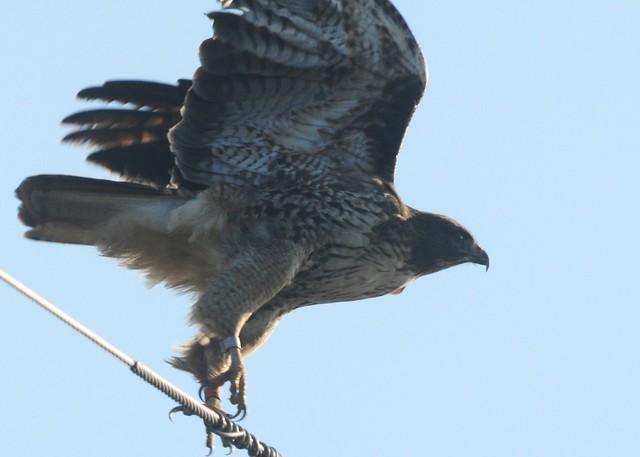
Whenever a bird is released from the RMRP, the Humans band one leg with a numbered US Fish and Wildlife Service band.  That way, if anyone ever comes across the bird again, the Humans can look up the band number and find out the bird's history.
Red-Tailed Hawk with a banded leg
The Red-Tailed Hawk that died was already banded.  Given the activity of the RMRP in the area, odds were good that it was one of our bands.  Sure enough, our Medical Director looked back in the records...and looked back further...and a little bit further...and found the history of this bird in our own facility's records.

The hawk had originally been admitted in late 2007 with head trauma, probably from another car strike, and was released in 2008 as a fully healthy bird.  When admitted in 2007, the bird was already an adult.

Why do I think this news is so good?

Because it means the RMRP took in an injured raptor, gave it everything it needed to heal up, and sent it back out to the wild for a Second Chance at Freedom.

Because the already-adult hawk lived another five full years instead of dying that day in 2007.

Because during those five years, the hawk was able to live a wild existence, rich with hunting and soaring and raising nests of new Red-Tailed Hawks each spring.

And I don't know about you, but I think that is something beautiful, something special, and something worth being happy about.


---------
To donate to the RMRP, click here
Our website
Our Facebook page
Our Twitter feed
The 20th Annual Gala is just over a week away!  Get your tickets here

Wednesday, January 23, 2013

Welcome back!

Really, I'm welcoming myself back.

As you may have noticed, I haven't been posting for the past month!  It's not that there's been nothing to report, but rather than I was taking a well-earned vacation from being an educator.  For one month I took a break from school visits, tours, blogging, and tweeting (still plenty of hooting, though).  I watched the Humans celebrate the holidays with funny hats and lots of food.  I saw fireworks over the city usher in the new year.  I saw the final bird for 2012 be carried through the doors, and the first bird of 2013.  I saw volunteers travel away from the RMRP to visit their other family and friends, and I saw them come back, eager again to brave the cold, early mornings, and long, frigid days for the sake of us birds.

Now the weather is warmer, my vacation is over, and I'm ready again to regale you with tales of the RMRP. First off, a summary of the holidays:

Our final number of admissions for 2012 was 265 birds.  Not the most ever, but certainly a high caseload, and a particularly challenging range of species and injuries.  More details and stats on the 2012 cases (species composition, injuries breakdown, release rate, etc) coming sometime in the next few weeks, so stay tuned.

Bald eagle with lead poisoning and a wing injury
The first admission for 2012 was a Bald Eagle, and the last admission was a Northern Harrier.  For 2013, the first admission was, again, a Bald Eagle.  He's probably a fourth year male bird, suffering from lead poisoning, an eye injury, and a wing droop.  The Humans treat lead poisoning with chelation, a process which uses Calcium-EDTA to draw the lead out of the bloodstream.  He's finished with his first round of chelation, is taking a break for a few days to allow remaining lead to come out of the woodwork, so to speak, and he'll move on to a second round soon.  Lead poisoning often comes with neurological side effects, which could be causing the wing droop, so hopefully that will resolve as the lead is cleared out of his system.

If you remember, January 2012 had us taking care of four sick and injured Bald Eagles at one time, a scenario the Humans hope to not repeat this January.  Here's hoping these amazing creatures stay happy and healthy in the wild, and don't have to visit the RMRP for care.

Weighing the Merlin on a cold day - see her breath as she vocalizes? 
The cold temperatures over the past few weeks proved very challenging for birds and Humans alike.  In cold weather like that, Humans have to think about a wide range of care-related issues that aren't usually so critical.  Can we avoid disturbing the bird, so the bird can conserve its heat and energy?  Is the bird's food going to freeze before it has a chance to eat?  Can we clean with water today, or will it instantly freeze and create hazards for birds and volunteers?  Are the little birds with high metabolisms maintaining their weight in these cold temps?  Fortunately, the Humans at the RMRP have plenty of experience with conditions like these, and the birds were extremely well cared for, as usual.  As for the Humans themselves, they dealt with the cold with many layers of thermals and Carhartts, hand warmers, insulated boots, hot water bottles, and good attitudes despite the frigidity of their work.

At last, here we are, experiencing some warmer temps and sunny days as a reward for the past few weeks.  The warm weather has provided an opportunity to deep clean the cages, use the hoses again instead of just buckets, and de-ice the pathways and parking lots.  In the past couple of weeks, the Humans have admitted the Bald Eagle mentioned above, a Cooper's Hawk, and an American Kestrel.  In exchange, they've released a female Merlin that recovered from a broken wing, a very handsome male Great Horned Owl that came in emaciated, and a Red-Tailed Hawk that was admitted with a skull fracture and massive head trauma.

That last case, the Red-Tailed Hawk, is truly amazing.  You may remember her from this picture:
Red-Tailed Hawk with skull fracture and damaged eye
The head trauma rendered her right eye useless and problematic.  After prey-testing her to be sure she could hunt with just one good eye, she was brought to the Vet Teaching Hospital to have her eye removed.  She recovered well from the surgery, and went back to hunting live prey like she still had two good eyes.  Seriously, that bird was a killing machine, and she often tried to use her skills on the Humans taking care of her.  She was released last week, and, true to form, she spun around and tried to attack her releaser one last time before flying away to go kill more appropriately-sized prey.

One-eyed Red-Tailed Hawk after release! 
Everything else at the RMRP is tripping along nicely.  As always this time of year, the Humans are busy, busy, busy planning and preparing for the annual Gala and Auction event.  Auction items are coming in daily, so be sure to come to the event to snag the best of it!  Details on our website here, including information on Early Bird tickets, which are only available for a few more days.

I'll be writing again soon to post more pictures of birds and other goings-on, so be sure to check back soon! Also, I'll be creating a new page on this blog with profiles of all us Educational Ambassadors for the RMRP, so stay tuned for those as well.

Monday, August 27, 2012

Raptor vocalizations

I don't know if you remember, but last week when I wrote about Red-Tailed Hawks, I promised a blog entry dedicated to the Red-Tailed Hawk's notable scream and how it's used in Human media.  Well, I couldn't find any actual examples of the misusages, but you all know what I'm talking about:  the Wild Western movie focuses in on a desolate cabin in the hills....something isn't right, death is in the air...overhead the vultures are circling, and one of them calls out, "Kreeeee-aaaaaaa!"  Or the truck commercial that ends with a waving American flag and the majestic call of a Bald Eagle, "Kreeeeee-aaaaaaaa!" 

Yeah, right.  Bald Eagles sound about as majestic as mourning doves sound dangerous.  It simply isn't true.  The call you're most often hearing in the movies, the one that's attributed to almost any large bird except seagulls (thank goodness) is actually a Red-Tailed Hawk.  Does this sound familiar? 


So, you may be asking yourself, if that sound in the movie isn't actually what an Eagle or a Vulture sounds like, what do they sound like?  Well, I sorted through all the horrible YouTube videos out there to give you the best-available video clips of raptor calls.  Here, for instance, is the majestic Bald Eagle...clucking:

It's a wonderful sound, isn't it?  But it's just not what the Hollywood producers are looking for.  It doesn't strike fear or awe into the hearts of many the way the Red-Tailed Hawk does.  How about the Golden Eagle?  Any more majestic?  Not really.  Here's a pretty common sound from one:

Again, really interesting, but not awe-inspiring.  Then again, does an Eagle need to be any more awe-inspiring?  They're pretty darn impressive to begin with. 

Finally, what's with the Red-Tailed Hawk call being played when Vultures are circling?  As a critic of Human movies, I'm always noticing this error.  Turkey Vultures are mostly silent birds.  The only time you'll hear one vocalize is if you really disturb it, which, of course, is something you shouldn't do.  And when they vocalize, it is the farthest thing from a scream that you can imagine.  It's more of a hissing roar.  Honestly, I think Humans should use Turkey Vulture vocalizations in movies about dragons!  Here's an example:  

So there you have it.  Next time you hear an impressive, piercing call from a bird in a movie, be it an Eagle, a Vulture, a Hawk, or any other bird, maybe you'll notice it's the wrong bird entirely, then laugh at the ridiculousness of it.  And, on that note, I leave you with the chattering call of an American Kestrel.  This bird is not often depicted in movies, but it certainly has the voice and attitude for the silver screen! 


Please note: all these videos were found on YouTube and are not the property or responsibility of the Rocky Mountain Raptor Program. 

Friday, August 17, 2012

Why Red-Tailed Hawks Are Awesome!


With the critical care cages at the Rocky Mountain Raptor Program steadily filling with sick and injured birds (it is the peak of busy season, after all) it's hard not to notice that a large portion of the newcomers are Red-Tailed Hawks.  This year's kids are all fledged and living life on their own, but not all of them are proving successful.  The summer's early drought in combination with the High Park Fire effects and the perfect climatic conditions for mosquitoes carrying West Nile Virus have created a difficult first year for a lot of birds.  Along with Swainson's Hawks, American Kestrels, and Great Horned Owls, the Red-Tailed Hawks are having a noticeably hard time of it.  So, with cages of sick Red-Tailed Hawks in the RMRP's care, what better time to write about how amazing they are?  Maybe the extra attention to their awesomeness will help bolster their spirits and make them well again.

You know what a Red-Tailed Hawk looks like, even if you don't realize it.  They're the hawks that you see soaring high above fields and hills while looking for lunch, or perched on a telephone pole scanning the ground for dinner.  Admittedly, there are many species of hawks that soar and perch on power poles, but Red-Tails are among the most common.

fpcs.edu
www.birdphotography.com
You've probably also noticed their namesake red tail at some point as it catches the sun mid-flight.  But did you know that immature Red-Tailed Hawks don't have a red tail until they're adults?  Until the bird is in its second year, the tail is gray with dark brown bars.  And because raptors don't drop all their feathers at once when they molt, the new red tail comes in one or two feathers at a time, so sometimes their tails look like this:

10000birds.com
Harlan's Hawk from schmoker.org
There are many variants of the Red-Tailed Hawk, including the Harlan's Hawk, which is such a strikingly different variant that some Humans consider it a separate species altogether.  Harlan's Hawks have blackish and white patterned feathers, variations in their tail coloration, and even have shorter primary flight feathers than other Red-Tailed Hawks.  For more pictures of Harlan's Hawks in Colorado click here.

Another famous thing about Red-Tailed Hawks is their call, but you may not have known who you were listening to.  The most common raptor noise in movies and on TV is the call of the Red-Tailed Hawk, but it's usually played in the movie when a Bald Eagle is on screen, or when a Turkey Vulture is seen hovering over a dying cowboy (also inaccurate).  In fact, there are so many comical misuses of the Red-Tailed Hawk's call that I have decided right now to write an entire separate article about it, so stay tuned!  I promise it will be funny and educational.

Educational Red-Tailed Hawk at the RMRP
Red-Tailed Hawks are not as big as Ferruginous Hawks, but they are still pretty big, and like most raptors the females are about 30% bigger than males.  Generally speaking, Red-Tailed Hawks weigh 2-4 pounds, and have a wingspan of about 4 feet.

Another reason they're pretty well-known is because they live all over North America.  Seriously.  You'd be hard pressed to travel anywhere on this continent and not find Red-Tailed Hawks.  They're almost as ubiquitous in North America as the Peregrine Falcon, but not quite.  Red-Tails live in every sort of ecosystem except continuous forest (they leave that to forest-dwellers like Goshawks) and the Arctic.  But everywhere else, from tropical islands to the Grand Canyon, you can find Red-Tails.  In fact, the densest population of these birds is in El Yunque National Forest in Puerto Rico.

Red-Tailed Hawks primarily eat rodents and other small mammals, but they'll also snack on birds (especially pigeons in cities) and snakes.  In fact, the Red-Tailed Hawk has a super-cool way of hunting poisonous rattlesnakes.  They spread their wings and tempt the snake with their feathers, kind of like a matador taunting a bull with a red cape.  When the snake strikes at the wing feathers, the bird reaches in with a foot and grabs the snake.  The National Geographic video below shows the matador move, and although they missed any footage of the snake striking at the wings, it's still cool to watch.


A few other facts that don't require an entire paragraph:

  • They're monogamous, only finding a new mate when their previous mate dies.  
  • Great Horned Owls like me are occasional predators of Red-Tailed Hawks, but not the other way around (that's right, I'm the top of the food chain).  
  • They're also known as chickenhawks, even though they're not very well known for hunting chickens.

Although nothing much is happening these days, the Cornell Red-Tailed Hawk Webcam is an excellent way to get a closer look at these birds.  Cornell installed two HD webcams at the Red-Tail nest on their campus, and you can tune in any time during breeding season to watch the male and female hawks build their nest, lay the eggs, incubate them, hatch them, and then raise and fledge the chicks.  Be sure to check it out next season!

The Humans at the RMRP admit dozens of Red-Tailed Hawks every year.  Many of them come in hit by cars, shocked on power lines, or [this year] sick with West Nile Virus.  Please send healing thoughts to those birds currently in the RMRP's care!  If you would like to support the care of these incredible birds, click the "Donate Now" link on the right side-bar!
Educational Red-Tailed Hawk for the RMRP
Don't forget you can subscribe to this blog in the sidebar to the right, and feel free to leave questions or comments below, or send them to talonsofdoom@gmail.com

Wednesday, May 9, 2012

This week's general update

The biggest news (to me, at least) is that my baby has become a good enough flier to graduate to another cage. After all, a mom with a bum wing isn't very good at teaching a kid how to fly. However, thanks to me, that kid was sent over to his new mom with a healthy Great Horned Owl attitude (if he took the "Which Raptor Are You?" quiz, he would definitely get "Great Horned Owl"). Still, I sneaked into his new cage to see how he's doing, and it's clear to me that while he may be able to fly with his new mom, he obviously liked me more:


In other news, the Undead Red-Tail likes to perch with his foot outstretched like a total goofball. He's still under the weather and fighting off an illness/infection, but he's improving daily.

He spends most of his time like this
The Swainson's Hawk that survived a run-in with a methane burner last year is molting out his feathers, and the Humans are hopeful that his new set will be high-quality so he can be kicked out of here this year. Here's a pic of what a feather molted from a hawk that caught on fire looks like:


Amazing that he's okay, isn't it?

There are still four Bald Eagles in house, all plodding their high-maintenance way through the rehabilitation process. And we also have three accipiters (two Cooper's Hawks and a Sharp-Shinned Hawk) at the center, which is a pretty high number for them, too. All three were admitted with impact injuries, probably from hitting windows. This includes the Cooper's Hawk shown below, the one that actually shattered the house window she ran into.

After demolishing a button quail for lunch
The Turkey Vulture that was going to be released now-ish is instead molting in a new set of flight feathers. I think he's doing on purpose so he can keep room service as long as possible. But when he's done growing in new feathers (a couple of weeks), he'll be out of here, too.

And, finally, the Great Horned Owl with the luxated elbow flies great despite the wing droop, and started on Rat School yesterday. Rat School (or Mouse School, depending on the size of the bird) is when the Humans put the about-to-be-released bird in a large flight cage, and give the bird live prey for a few days. Instead of simply flying down to a perch to eat pre-killed rabbit, the bird has to catch and kill the prey itself. Happily, the Great Horned Owl killed his rat. Killed it dead. Full marks for the Great Horned Owl!

That's all for now!

Thursday, April 26, 2012

General Update

Still not a whole lot going on at the RMRP, but certainly some interesting cases coming through the cages.  Here's the quick-and-dirty:

--First off, I can't remember if I told everyone that the Humans released the grill-head Red-Tailed Hawk! Remember him? He was found with his head stuck in the grill of a truck, and came in looking like this:
Very sick Red-Tailed Hawk after colliding with car
Well, he was released last week! Despite a fractured skull and awful head trauma, he's out there striking fear into the hearts of small rodents again. Congratulations to the RMRP for a job well done!

--Onto more current cases, a few days ago the Humans admitted a Cooper's Hawk that hit a house window...and shattered it. Can someone who's better at physics than an Owl please explain how a soft, feathery bird that weighs about half a pound can shatter a house window? Unfortunately, the outlook for this bird isn't hopeful, but it is a good reminder to keep your bird feeders away from windows, and apply decals to your windows if you have lots of birds zooming around.

--Admitted two baby Great-Horned Owls last week! Same nest, different days!  The first kid to come in was still very young. He was found at the base of the tree in fine health, but pretty vulnerable.  The Humans were able to put him back in the nest with his younger sibling.  Then, the very next day, the Humans had to rescue another young Owl from that same nest.  This one had gone out on his maiden flight and ended up standing in the middle of the road.  The Humans couldn't put that bird back in the nest because he was more flighted than his younger sibling. If they tried, the Humans would place him in the tree near the nest, he'd instantly fly away again because of the Human in his face, he'd end up on the ground, and the cycle would begin again.  Therefore, when the RMRP gets in mostly-flighted babies, they have to keep the baby until it's fully-flighted. So the mostly-flighted baby is here at the RMRP, finishing growing in feathers and learning how to be a fearsome creature.  Hm, I wonder where they put him?

Poor wing position, but excellent flight! Can't judge a book by it's cover...
--The Great Horned Owl with the luxated (dislocated) elbow is doing surprisingly well.  Despite the fact that he holds his wing out at an awkward angle, he's doing laps around his cage like nobody's business.  Soon he'll graduate to a cage with fewer perches to depend on.  Then he'll attend mouse school, and if he passes that he'll be released!

--The Red-Tailed Hawk with the broken foot is out of his splint and beginning to use the foot to grab the perch. That's excellent news because while wings need to be perfect for release, feet only need to be functional enough to grab perches and food, and this guy is well on the way to two functional feet.

--There are still FOUR Bald Eagles in house. Enough said.


SWHA's nest-building skills at work
--As for Educational Ambassadors, the female Common Barn Owl is busy rolling and tending her fake eggs, and the female Swainson's Hawk is contentedly arranging sticks in her cage.

And that's all the news for this week!  Time for me to get back to my baby.

Monday, April 23, 2012

Interview with an Educational Ambassador Red-Tailed Hawk

This past weekend, a friend of mine went to his first outdoor exhibit here in Fort Collins.  He's a Red-Tailed hawk who came to the RMRP in 2010 with multiple fractures in one wing. The wing didn't heal correctly, so, like many of us educational ambassadors for the RMRP, he can't fly well enough to be released. But he did have the right personality to become an educational bird, and he progressed through his training well, and over the past few months he went out to numerous small educational programs, like hour-long programs at libraries and schools. Saturday's exhibit was a much bigger accomplishment for him because exhibits are long, outdoors, and full of all sorts of colors, sounds, sights and people.  Seeing as I'm an old hand at the exhibit thing (not much surprises me anymore when I'm out in public), I figured I'd interview the new kid and see what he thought of the whole thing!

Great Horned Owl (GHOW): How did the day begin?
Red-Tailed Hawk (RTHA): It started very normally, except that my handler was talking to me more than usual, using soft, encouraging tones to tell me I would "do great today". Well, of course I'd do great--I'm a Red-Tailed Hawk, I'm great at everything. I didn't realize then how much I was going to see that day! It started by being jessed in the cage, then weighed on the scale, then getting into my travel box like I was going to a program. The car ride was pretty short, although I don't really care how long car rides are when I'm in my travel box--it's so calm and quiet in there. And when I came out of my box, I was smack dab in the middle of town! Surprise!


GHOW: What was your first impression of the exhibit?
RTHA: There was so much going on! Cars and people and tents and trees...I had a hard time keeping an eye on all of it all the time, but I tried my best. I just looked and watched and took stock of the whole world around me, and pretty soon it became more understandable and less scary. Nothing bad happened to me, of course--the Humans would never let that happen! But there was a lot to take in.

GHOW: Describe the place you were perched.
RTHA: I was standing on a low perch, just about one wing-length off the ground, and my leash was attached to the perch (I tested the leash out right away, and found it was two wing-lengths long, and that I could easily fly to the end of it, stand in the grass for a second, then jump back up to the perch, no problem). Above me and behind me was a white tent, so I was in the shade all day. Around the three open sides of the tent was a thin red rope. I think the red rope holds great power over the Humans because no one crossed it except my Humans from the RMRP. Beyond the tent was a large grassy area, lots more tents, and a lot of people. To one side there was a road and a sidewalk.


GHOW:  I'm sure you learned a lot throughout the day, so let's break it all down individually: what did you learn about vehicles?
RTHA:  There are a lot of different kinds and they make a lot of different sounds! There were regular-sized ones that the Humans called "cars", but some of them made really loud noises that rumbled and roared like a thunder storm, and others made loud but whiny noises that were very surprising. And they all moved so fast! No wonder we birds have a hard time with cars. There were smaller two-wheeled things that the Humans called "motorcycles", and a lot of those were even louder than the cars. Then there was a train, like the one that passes by the RMRP, but this one as closer and much louder. Oh, and then there were "bicycles", which are kind of like motorcycles, but much quieter. The bicycles came really close to me sometimes, but they never tried to hurt me. I stopped noticing all the vehicles after awhile because I learned they weren't going to hurt me while I was with my Humans.


GHOW: What did you learn about dogs?
RTHA: There are lots of different sizes of dogs, too! All of them were attached to Humans by leashes, kind of like mine but longer and thicker. Some Humans kept their dogs really close, and other Humans had to be asked to reel in their dogs so they wouldn't come over and scare me. At first the dogs were scary, but when I realized that my Humans were making sure none of them could get near me, I relaxed and started noticing how funny looking they are! Some had spots, some had stripes, some were huge and others small, some were really excited to see me, others didn't care about me, and others were so oblivious they never knew I was there. Silly dogs.


GHOW: What did you learn about children?
RTHA: Children, also called "kids" and "Hey!", are highly revered by Humans. They're escorted around in colorful wheeled objects called "strollers", and the big Humans push the kids around in these all day. And whenever a kid wants to do something, the big Humans help the kid do it. I also learned that kids are very noisy. But even though the kids were noisy, they were also really interested in me and asked the Humans lots of good questions about how cool I am. Some of them were small enough to walk right under the red rope, but even they stayed on the far side of it! My favorite kids were the ones who sat down in the grass by the rope and spent a lot of time talking to the Humans about me. I think kids are okay!


GHOW: What did you learn about noise?
RTHA: I think I learned that Humans really like noise. I prefer quiet so I can hear bird sounds and listen for mice in the grass, but Humans prefer constant music and lots of talking. Once I got used the constant noise, it didn't bother me much.


GHOW: What questions did people most often ask?
RTHA: Everyone asked what kind of bird I was, and a lot of people asked if I was an Eagle, which made me laugh inside. Wouldn't the Golden Eagle get a kick out of that question? After that, most people wanted to know how I hurt my wing. Then there were a lot of different questions, like how can I turn my head so far? When does my tail turn red? How old am I? What so I like to eat? Those questions were great. I think my favorite question is when the Humans ask "How much does he weigh?" and my Humans ask back, "How much do you think he weighs?"  The Humans on the other side of the rope almost always say something like "Twenty pounds", and when my Humans say, "Nope, two and a half!" I like to watch the surprised reactions. Gets them every time!


GHOW: What was your favorite part of the exhibit?
RTHA: It was really fun getting out there and seeing all those different things! Humans have such odd habits. I was tired when I went home, but next time will be even easier, and I'm really looking forward to it!

So there you go, straight from the beak of a new educational bird! Hope to see you at our next exhibit!



Thursday, March 22, 2012

Quick bird update


  • The adult Bald Eagle with the spinal trauma and confidence problems was put out in a large flight with the immature eagle for a week to help the immature calm down. It worked well, so now the adult is back in a smaller cage where she can continue working on attaining higher perches. See how tall she's getting?
  • The American Kestrel that came in with a fractured ulna is flying perfectly and should be released as soon as the wind dies down!
  • The Red Tailed Hawk that was found with its head stuck in the grill of a truck is doing really well. His skull fracture is healed and he's flying around his cage really well, despite having reduced vision in one eye. Next step: rat school, where the hawk is moved to a large flight and given live rats to kill. If his vision and flight are good enough to hunt and kill, he can be released! 


All the other birds at the RMRP are doing well, too. The case load is slowly climbing as we approach summer. I'll let you know when more interesting cases come through the door!

Saturday, March 10, 2012

As promised

Here are photos of some of the birds I wrote about the other day:


One week later, doing much better!

The Red-Tailed Hawk who was found with its head stuck in the grill of a truck:
In the O2 cage after admission


The Great Horned Owl with the healing fracture, the one who is very angry and fierce:


The female American Kestrel with the healing fracture (she likes to hang out in the highest corners of her cage):


Sorry, I didn't have time to snap a pic of the Bald Eagles, but I'll try to get one soon!  I'll keep you posted on everyone's progress! 

Tuesday, March 6, 2012

Rehab gossip

I just got back from eavesdropping on this week's Rounds meeting. Once a week, all the Humans who work and volunteer at the RMRP gather together in the warehouse to ensure there are enough minions on every shift to take care of all of us Raptors, to make announcements, hand out awards and certificates, and go over the ever-changing status of all the rehab cases in the facility. Tonight's updates had me making notes in my iPhone because, for the first time in a couple of months, there are enough birds in-house to cause information-overload while listening in. Here's the quick and dirty of some of the more interesting cases:

  • Remember the Bald Eagles I mentioned a few posts ago? The slow-but-steady spinal trauma adult, and the reckless youngin' determined to knock himself senseless by forgetting to put on the brakes? Well, the  youngin' had to take a breather from the large flight cage when his lead poisoning flared up again, but he's back in a large flight cage again...and guess who's there with him? The slow-and-steady adult! Her progress has been really positive recently, so she was moved into the large flight cage with the reckless kid in the hope that she'll help him chill out a little. They're also helping each other with physical therapy: he always wants to be next to her, and she always wants to be left alone. So when she moves to a perch and he follows her there, she moves to another perch in an effort to get away...and so they're always moving and always giving themselves physical therapy. Don't worry: even though she doesn't want to be buddy-buddy shoulder-to-shoulder with him, they're actually getting along just fine. 
  • A Great Horned Owl came in a couple of weeks ago with a fractured humerus. That can be a very bad thing, but this was the kind of break that made the Humans happy: a clean, simple, middle of the bone fracture. He has a fixator on it for support, and he's confined to a critical care cage until the bone heals. Since the fracture was an easy one to deal with, this Owl is making up for it in other ways. One, he's a chewer, and the Humans are spending a lot of energy creating chew-tabs out of tape for him to gnaw on instead of the fixator. Two, he's a handful. Now, all Great Horned Owls are angry, disagreeable handfuls (and we're very proud of this), but apparently this guy is angry above and beyond the norms. I can't wait until he moves to the outside cages and I get a chance to chat with him! 
  • A Red-Tailed Hawk, hit by a car, came in a week ago in really bad shape. Of course you expect a hawk hit by a car to be in bad shape, but this hawk was stuck in the grill of a truck. By his head. And did he give up an die in the grill of that truck? Heck no. He's a Red-Tailed Hawk. They fight. This guy has massive head trauma (no surprise there) and a fractured skull. Recently he's regained enough coordination to eat on his own (I remember how hard that was for me back when I was admitted for head trauma, and I didn't have a fractured skull!) and the vision in his left eye is slowly improving. The outlook on this hawk is still guarded, but I'm really pulling for him. What a fighter!
  • A few weeks ago a female American Kestrel was admitted with a fractured ulna. Again, this was a break that was cheerfully received by the Humans because it appeared to be fixable. When the ulna breaks, it can often be stabilized by the radius alongside it, which is exactly what happened in this case. She moved out to a small outside cage this week, and will be moving to a larger flight cage soon. The resident educational Kestrel with the Twitter account will be bummed to see her move--he's pretty smitten with his new neighbor! 
Well, that's it for now. I'll try my best to sneak some pictures soon so you can see these birds I'm writing about! Of course, stay tuned for more updates, and I'll be sure to let you know when any of these brave birds get released.

Monday, December 26, 2011

Raptors in the news: Famous Red-Tail being treated in NYC


A raptor center in New York City has taken in one of my brethren, an injured and--get this--famous Red-Tailed Hawk from Washington Square Park. The Humans call her "Violet" (which begs the question, why do Humans insist on naming everything?), and she was the star of a webcam this past year because she and her mate built their nest outside the President's window at New York University. You know what they say, location, location, location!

At any rate, this Red-Tailed Hawk developed a leg wound earlier this year, and has recently been captured so a raptor rehab facility can examine, and hopefully heal, the injury. Sadly, it doesn't look good. Best of luck to this poor Red-Tail.