Hello again everyone! I hope you all had a great Thanksgiving. I myself had an extra helping of mice last Thursday--delicious. At any rate, this is the final entry in the "Owl of the Week" series. After today, we will have covered every resident specie of owl in Colorado, and, with the exception of the Mexican Spotted Owl, all the owls the Humans take care of here at the Rocky Mountain Raptor Program. Well, let's get going on the final owl in the series: the Northern Pygmy Owl.
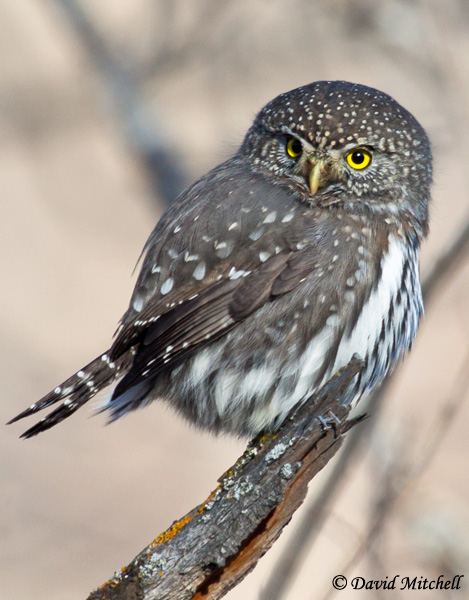
sdakotabirds.com Northern Pygmy Owl
These little owls are particularly interesting owls. Everything about them, from size to nesting habits, is a little different from most owls. For one thing, they're the smallest specie of owl in Colorado, and the second-smallest in the United States (second to the Elf Owl). They only stand a few inches tall, and weigh in at just 2-2.5 ounces, about as much as a slice of bread or ten quarters. But, like most of the small owls (and large owls, for that matter), they are much tougher and more aggressive than their body size implies, and are willing to take on prey much larger than they seem able to kill, such as quail. Smaller prey, however, is the norm, including small birds, rodents, and large juicy insects.
wildsonora.com Showing the false-eyes on the back of the head
Other key features of their appearance: there are three color morphs (red, grey and brown); their tails are proportionally long for an owl; their eyes are bright yellow; and there are two dark spots on the nape of the neck that look like false eyes.
They are also the only local specie of owl that is truly diurnal. Northern Pygmy Owls, therefore, are missing many of the adaptations common among other owls, such as silent flight, above-average hearing, and night vision.
Northern Pygmy Owls live in the western United States, southwestern Canada, and in Mexico south through Guatemala. Their preferred habitat is forest, ranging in elevation up to treeline. They spend the majority of their time in the thicketed areas of forests, where they hunt from perches and fly rapidly between trees for cover.
Northern Pygmy Owls are almost entirely dependent on woodpecker holes to build their nests. They live alone the majority of the year, only coming together during mating season. Unlike most owls, the female doesn't start incubating the eggs until they are all laid, which happens over the course of a week.
The Humans here at the Rocky Mountain Raptor Program just released a Northern Pygmy Owl earlier this week! This bird was found at an intersection in Fort Collins. The bird was largely uninjured, and had probably been caught in the wake of a car rather than actually being hit by a car. Either way, the bird needed awhile to recuperate under the RMRP's care before being safely released into more suitable habitat than a city intersection. Northern Pygmy Owls also are admitted to the RMRP after striking windows, or falling prey to domestic cats. But rest assured, the RMRP is here to help them!
Northern Pygmy Owl at the Rocky Mountain Raptor Program
Well, that's the end of the "Owl of the Week" series! I really hope you learned a lot from it. Remember to check out the original page to refresh yourself on all the reasons Owls Are Cool, and to find a list of all the owl species in Colorado with links to their profiles on this blog. As always, remember you can subscribe to this blog by using the little box in the right sidebar; comments and questions below or at my email address (talonsofdoom@gmail.com) are always welcome; the Rocky Mountain Raptor Program's official website is a great place to visit; our Facebook page is awesome; and you can follow me on Twitter with the name @RaptorProgram. And, finally, yet most importantly, if you support the Rocky Mountain Raptor Program and the life-saving work the Humans do for the raptors in the region, please support us by donating here. Thank you for all you do--we truly wouldn't be here without you!
Good evening all! This week's owl is the Mexican Spotted Owl, a lesser-known resident of Colorado. As I've never met one of these birds, I got most of my information (and all of my pictures) from online sources such as, but not limited to, the endlessly useful annals of Wikipedia. (For the record, the Wikipedia entry for Spotted Owls is one of the most thorough and exhaustively-referenced articles I've ever read on that site, and I'm pretty sure a top-tier Spotted Owl researcher must have written it).
animalconnectionblog.blogspot.com
The reason I have never met a Mexican Spotted Owl is because we don't have them here in the Fort Collins area. As a permanently disabled educational ambassador for the Rocky Mountain Raptor Program I do get to travel around the state a fair amount, but none of our journeys have taken us to southwestern Colorado, which is the only corner of the state that these beautiful owls call home.
There are three variations of the Spotted Owl, only one of which (the Mexican) lives in Colorado. The other two are the Northern Spotted Owl (which claims the Pacific Northwest for its home) and the California Spotted Owl (I'm not going to bother explaining that one). If you're interested in reading more about Human-habitat-owl interactions, I recommend Googling the Barred Owl and the Spotted Owl and checking out the dynamic between those two species in the Pacific Northwest.
paulbannick.photoshelter.com
As for us, we're concerned with the Mexican Spotted Owl for now. They're not terribly large owls, being comparable in weight and wingspan to the Common Barn Owl. That means they weigh in around 1.5 pounds and have a wingspan of 3-4 feet. Their name comes from the tiny white bars in the plumage on their backs and wings. The bars are so small they pretty much look like spots. They have strong facial discs, and large, dark eyes (more info on this below!). Their physiology makes them ideal nocturnal hunters, like most owls. They prey primarily on woodrats, but also enjoy a tasty range of mice, rabbits, voles, and the occasional bat.
US Fish and Wildlife Service
Mexican Spotted Owls live in forests and canyons, and especially love forests in canyons. As you can imagine, this can make it tricky to observe one in the wild. They nest either in trees or on rock ledges. Since they live in such a specialized niche (forests in canyons, remember), small changes in the size of their territory can have big impacts on the species. In the early 2000's it was determined that habitat preservation was critical to the survival of this species (they're on the Threatened Species List), and the US Fish and Wildlife Service succeeded in preserving 8.6 million acres of land for these birds in the Four Corners region, including 322,000 acres in Colorado. The logging industry put up a fight, but the USF&WS service won in the end.
dwrcdc.nr.utah.gov
So, there's what I learned about Mexican Spotted Owls. I'd love to tell you something a little more personal about their habits and behaviors, but as I said, I've never met one. But along the way of researching these birds I did learn something else. I can't tell you how many times I've wondered if eye color has significance among owls. I, as a Great Horned Owl, have big ol' yellow eyes, Barn Owls have dark, almondy-brown eyes, Eagle Owls have orange eyes, and the White-Faced Scops Owl has orangey eyes bordering on red. And now here's the Spotted Owl, another bird with really striking dark eyes. What's up with that? And while I didn't find any answer to why they're different colors, I have determined that the different colors don't indicate whether the owl is diurnal or nocturnal, which is a common theory.
care2.com
The theory goes like this: yellow eyes = diurnal, dark eyes = nocturnal, and orange eyes = crepuscular (active at dawn and dusk). It is true that all dark-eyed owls are nocturnal, but so are most of the others. With the exception of the Burrowing Owl (yellow eyes and largely diurnal), all the yellow-eyed owls are also nocturnal, including Great Horned Owls like me. However, yellow-eyed owls are a little more active during the daytime than dark-eyed owls are. While birds like the Mexican Spotted Owl take cover during the day and don't come out unless they really have to, owls with yellow eyes are a little more willing to venture out during the day. But that's it. Hope you're not too disappointed.
Along the way of researching owl eye colors, I learned more cool things about my eyes than I know what to do with. For instance, I've always known that both my upper and lower eyelids move when I blink, but I didn't know that owls are the only raptors that do this (all the other raptors just blink with just one lid). I also learned why my beak is so low on my face compared to other raptors: owls' eyes are so big that if our beaks were any higher they would get in the way of our eyesight!
That's all I have for you this time. Tune in next week to learn about the Long Eared Owl! As always, you can email me with questions or comments at talonsofdoom@gmail.com, follow me on Twitter @RaptorProgram, check us out on Facebook (Rocky Mountain Raptor Program), and find out more information and stories on our main website (which is brand new and shiny!). If you would like to subscribe to this blog, use the box in the toolbar to the right. Thanks for reading and supporting the RMRP!
Next up in our owl series is the Common Barn Owl! Along with the Great Horned Owl, Common Barn Owls are the most commonly sighted owl in the region. When I go out to programs and exhibits with the Humans, I often overhear stories along the lines of, "I saw this HUGE owl the other day in my barn - what was it?" The answer is Common Barn Owl. However, they're not as big as they seem.
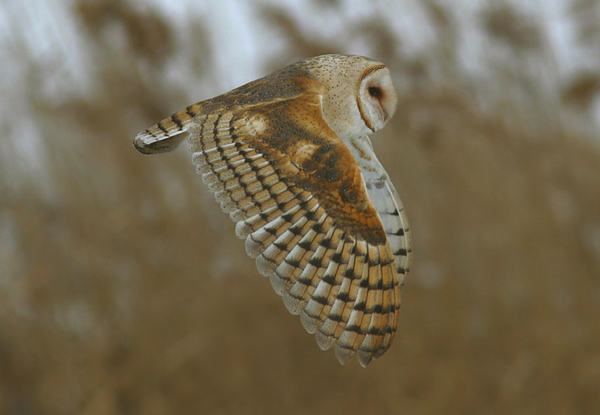
c Jerry Liguari utahbirds.org
Remember how I said Great Horned Owls weigh about 1.5-5.5 pounds? Well, the Common Barn Owl is the next largest owl commonly found in Colorado, and it weighs a mere 0.5-1.5 pounds. Yep, all that wingspan and majesty from a bird that weighs the same as a can of beans. But when it's flying silently toward your face when you enter an abandoned warehouse or a little-used barn, you probably don't care what it weighs, you just don't want it near your eyeballs. Barn Owls, however, are not aggressive birds, and they're merely trying to fly out of the barn to get away from you.
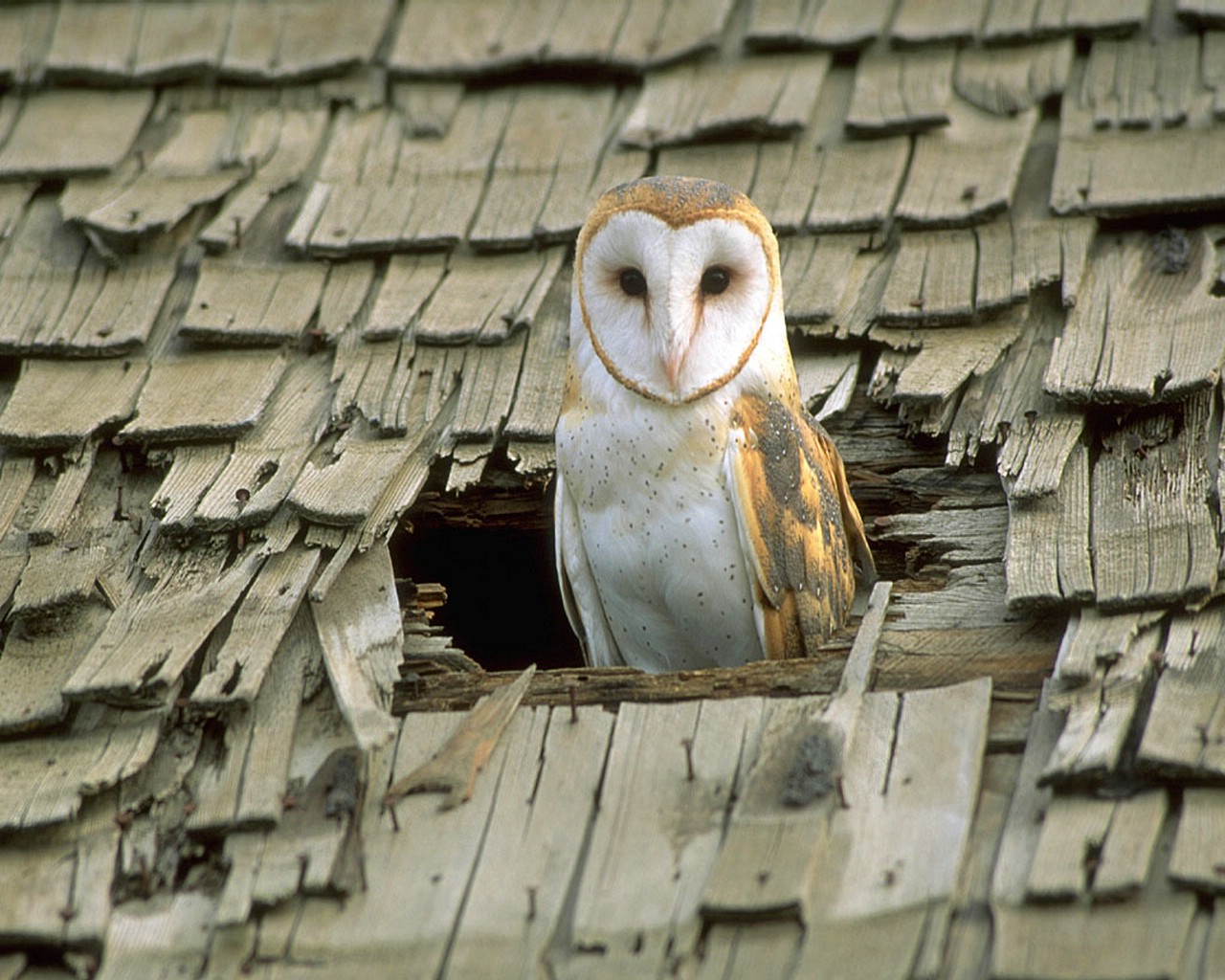
xmwallpapers.com
As the name implies, Common Barn Owls do spend a lot of time in barns. But before there were barns, where did they hang out? Barn Owls are cavity nesters, meaning that instead of building their nests in the sprawling and exposed branches of an oak or pine, they build their nests in tree cavities and hollows, as well as rock nooks and small caves. However, since barns and other Human-made features are so warm, cozy and protected, Barn Owls often opt to nest in barns, silos, warehouses, and church steeples. Barn Owls are also big fans of Human-made nesting boxes. Humans can install these nest boxes on their own properties and see if a pair of Barn Owls comes along to take up residence. Instructions for building your own box are easily found with an internet search. Humans often install Barn Owl boxes to lure Barn Owls to their property as a means of rodent/pest control, as shown in this PBS video.
One reason Barn Owls are so good at controlling rodent populations is that they're insatiable eaters. Catching and eating upwards of six vole-sized critters each night, they can really keep tight reins on the local population. Also, it's incredible how many pocket gophers they can fit into one stomach! Like most owls (including me), they generally swallow their food whole instead of ripping and tearing it like most other raptors do. And Barn Owls don't even blink when it comes to swallowing animals that seem impossibly large. Skip ahead to minute 3:30 in the video below to see what I mean.
The eating pace doesn't slow down at all when there are chicks in the nest, either. Barn Owls lay between four and seven eggs, so that's a lot of mouths to feed when they all hatch. And do they eat smaller, more appropriately sized food? No way. They eat just like mom and dad. It's unreal.
Baby Barn Owls with a feather-duster "mom" at the RMRP
Baby Barn Owls are a little goofy looking. Many Humans think they're adorable, while others think they look like alien pterodactyls. They certainly don't look much like their adult versions until they're many weeks along. Adult Barn Owls, on the other wing, are simply stunning birds. They're in the non-tufted class of owls, meaning they don't have ear tufts like I do. They still have extremely prominent facial discs, however, which is largely responsible for their success as hunters. Females of the species have slightly duskier coloration, with more brown on their faces and chests, while males are more of the snowy-white variety. This often leads to people thinking Barn Owls and Snowy Owls are the same thing, but as you can see in this picture, they're very dissimilar. For the record, Harry Potter had a Snowy Owl, not a Barn Owl.
Snowy Owl on the left, Common Barn Owl on the right
The Common Barn Owl, while obviously not common in appearance or behavior, is called "common" because of its wide range. Barn Owls are found on every continent except Antarctica, and within each continent they inhabit every imaginable ecosystem. Because of their extensive range, Barn Owls have numerous variations and subspecies, between twenty and thirty depending on who you ask. Tyto alba is the Latin name for Common Barn Owls, and the variation in North America is Tyto alba pratincola. Something kind of cool about their Latin name is that the word "tyto" is a Greek onomatopoeia meaning "owl"; "tyto" mimics the classic owl sound, like the English word "hoot".
Educational female Barn Owl foster mom guarding her charge
Barn Owls used to face a lot of intentional persecution as a species. One likely reason for this is the owl's ghostly appearance: with the white plumage, silent flight, and a knack for flying out of barns at Humans, they earned a reputation of evil associated with ghosts and death. This is reflected in their other common names, which include Demon Owl, Ghost Owl and Death Owl. Fortunately, as education about Barn Owls spreads, they're facing less and less intentional persecution. However, like all raptors, they still face threats from the usual suspects: power lines, poisoning, car strikes, and more. Habitat loss has led to the Barn Owl being listed as an endangered species in seven Midwestern states.
Educational Ambassador for the RMRP, male Barn Owl
At the Rocky Mountain Raptor Program, injured Barn Owls are admitted with all the above injuries and more. Another common way for Barn Owls to come to the RMRP is via orphaning. While their nest sites are often excellent cavities, they're not always stable or well-located homes. Nests in hay bales, under trucks, in rafters, and in the walls of buildings are accidentally knocked down each spring, leading to entire nests' worth of baby owls coming to the RMRP to be raised by our resident foster parents.
So, there you have it, the uncommon Barn Owl. Stay tuned next week for a profile on the Mexican Spotted Owl. As always, you can email me with questions or comments at talonsofdoom@gmail.com, follow me on Twitter @RaptorProgram, check us out on Facebook (Rocky Mountain Raptor Program), and find out more information and stories on our main website. If you would like to subscribe to this blog, use the box in the toolbar to the right.
We appreciate your support of the Rocky Mountain Raptor Program in helping us keep raptor populations strong and safe! We're always seeking donations to help us continue our mission of rehabilitation, education and research. Thank you!
Okay, for all you owl lovers out there, the "Why ____ Are Awesome" column will be devoted to owls for the next foreseeable future. Yes, that's right, I'm about to go on an owl binge. That means, for the next eleven weeks, you will learn about a different specie of owl each week. Yeah, that's right, ELEVEN WEEKS. That's because we have twelve species of owl regularly occurring in Colorado, everything from the mighty Great Horned Owl to the equally-mighty but much smaller Northern Pygmy Owl. Did you know that? There are twelve species and eleven weeks because I don't think I can write separately about the Eastern and Western Screech Owls.
So, I started writing about the first specie (can you guess which one I'll be talking about?), and I realized there are a lot of cool things about owls in general that you should know before we delve into the individual species. So this entry will be a sort of background post to get everyone on the same page, so that next week, when I start talking about facial discs and whatnot you'll all know what I'm talking about!
Short-Eared Owl (www.massaudubon.org)
First of all, this is the list of owls that will be discussed:
-And, if you aren't all owled out by then, I'll cover the Great Gray Owl and the Snowy Owl, just because they're so special, even thought they don't normally occur in Colorado.
So, what do all of those birds have in common? They're all owls! And what does it mean to be an owl? It means you're the coolest of the cool, and that you're way better than all other birds, even raptors. Sorry, is that biased? Okay, let me try again.
Owls are a group of raptors (definition: birds who catch and kill their prey using their giant, deadly feet) that are largely nocturnal, and have wide faces in proportion to their beaks. But that's a generalization--not all owls are nocturnal, and some look wildly different than others. The smallest owl is the Elf Owl, coming in at just 1 ounce, and the heaviest is a tie between the Eurasian Eagle Owl and the Blakiston's Fish Owl: the large females in both species can weigh a whopping 10 pounds. For comparison's sake, a Great Horned Owl like me tops out at 5 pounds, and an average male Golden Eagle weighs 8 pounds.
Immature Elf Owl (www.nurkimaderes.blogspot.com)
Blakiston's Fish Owl (www.rareearthtones.org)
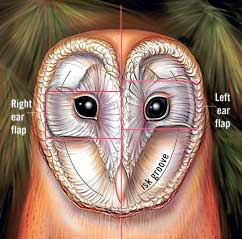
Owls are highly specialized in a variety of ways. Most famously, they have excellent hearing. They have to be able to hear well because most of them hunt at night, when vision won't do them much good. There are a few reasons why their hearing is so excellent. One is that most owls have asymmetrically placed ears that allow them to triangulate the location of what they're listening to.
tucsoncitizen.com
csus.edu Location of ears on a Barn Owl
Also, they have a facial disc, a feather formation that funnels sounds to those asymmetrical ears like a satellite dish.
Great Grey Owl (www.valcitygal.wordpress.com)
Even though owls have excellent hearing, is not quite enough to use exclusively, so their eyesight is pretty great, too. Owls are famous for having large eyes, as is seen in cartoons and art. And while the largeness of owls' eyes contributes to their awesome vision, it's actually the fact that their eyes are elongated that allows them to see so well. It would require a discourse in eye anatomy to fully explain it, but suffice it to say that longer eyes make for larger images on the retina, so the brain and neurons all have more material to work with, and so can see better than most other animals. But, there are a lot of different eye-shapes and eye-colors in owls, as you will see over the next few weeks.
Snowy Owl (www.2expertsdesign.com)
In the same vein of adaptations-for-hunting-at-night, owls also have special feathers. Owls have an incredible ability to fly silently, and this is largely due to the structure of their feathers. While most birds have rigid feathers with straight edges, the leading edge of owl feathers is serrated, and that breaks up the air as it passes over the feathers, rendering them silent. Interestingly, the owls that don't have to be silent to sneak up on prey, namely the fishing owls, do not have feather serrations, and therefore are noisy fliers like most birds.
www.science.howstuffworks.com
Okay, I think that's all you need to know about owls before I delve into the nitty-gritty of individual species. Now when I say, "The Great Grey Owl has the largest facial disc of all the owls", or, "Barn Owls have mastered the evolution of asymmetrical ears," or, "Burrowing Owls are largely diurnal, so they don't need such extreme facial discs," you'll know what I'm talking about.
This owl is excited.
Okay, who's excited to hear all about why each of the owls the Humans treat at the Rocky Mountain Raptor Program are so cool? I know I am. I'll kick it off next week with....I'm not telling. It's going to be a surprise. Kind of.





_J.Slaght_w.jpg)