Pages

Showing posts with label owls. Show all posts

Thursday, November 29, 2012

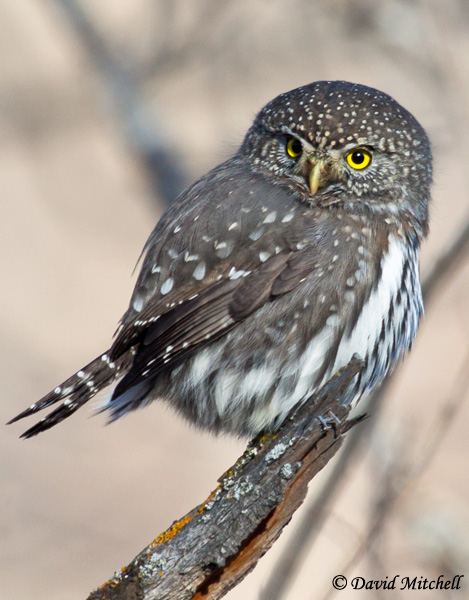
Owl of the Week: Northern Pygmy Owl

Hello again everyone!  I hope you all had a great Thanksgiving.  I myself had an extra helping of mice last Thursday--delicious.  At any rate, this is the final entry in the "Owl of the Week" series.  After today, we will have covered every resident specie of owl in Colorado, and, with the exception of the Mexican Spotted Owl, all the owls the Humans take care of here at the Rocky Mountain Raptor Program.  Well, let's get going on the final owl in the series: the Northern Pygmy Owl.
sdakotabirds.com Northern Pygmy Owl
These little owls are particularly interesting owls.  Everything about them, from size to nesting habits, is a little different from most owls.  For one thing, they're the smallest specie of owl in Colorado, and the second-smallest in the United States (second to the Elf Owl).  They only stand a few inches tall, and weigh in at just 2-2.5 ounces, about as much as a slice of bread or ten quarters.  But, like most of the small owls (and large owls, for that matter), they are much tougher and more aggressive than their body size implies, and are willing to take on prey much larger than they seem able to kill, such as quail.  Smaller prey, however, is the norm, including small birds, rodents, and large juicy insects.

wildsonora.com  Showing the false-eyes on the back of the head
Other key features of their appearance:  there are three color morphs (red, grey and brown); their tails are proportionally long for an owl; their eyes are bright yellow; and there are two dark spots on the nape of the neck that look like false eyes.

They are also the only local specie of owl that is truly diurnal.  Northern Pygmy Owls, therefore, are missing many of the adaptations common among other owls, such as silent flight, above-average hearing, and night vision.

Northern Pygmy Owls live in the western United States, southwestern Canada, and in Mexico south through Guatemala.  Their preferred habitat is forest, ranging in elevation up to treeline.  They spend the majority of their time in the thicketed areas of forests, where they hunt from perches and fly rapidly between trees for cover.

Northern Pygmy Owls are almost entirely dependent on woodpecker holes to build their nests.  They live alone the majority of the year, only coming together during mating season.  Unlike most owls, the female doesn't start incubating the eggs until they are all laid, which happens over the course of a week.

The Humans here at the Rocky Mountain Raptor Program just released a Northern Pygmy Owl earlier this week!  This bird was found at an intersection in Fort Collins.  The bird was largely uninjured, and had probably been caught in the wake of a car rather than actually being hit by a car.  Either way, the bird needed awhile to recuperate under the RMRP's care before being safely released into more suitable habitat than a city intersection.  Northern Pygmy Owls also are admitted to the RMRP after striking windows, or falling prey to domestic cats.  But rest assured, the RMRP is here to help them!

Northern Pygmy Owl at the Rocky Mountain Raptor Program
Well, that's the end of the "Owl of the Week" series!  I really hope you learned a lot from it.  Remember to check out the original page to refresh yourself on all the reasons Owls Are Cool, and to find a list of all the owl species in Colorado with links to their profiles on this blog.  As always, remember you can subscribe to this blog by using the little box in the right sidebar; comments and questions below or at my email address (talonsofdoom@gmail.com) are always welcome; the Rocky Mountain Raptor Program's official website is a great place to visit; our Facebook page is awesome; and you can follow me on Twitter with the name @RaptorProgram.  And, finally, yet most importantly, if you support the Rocky Mountain Raptor Program and the life-saving work the Humans do for the raptors in the region, please support us by donating here.  Thank you for all you do--we truly wouldn't be here without you!

Saturday, November 17, 2012

Owl of the Week: Flammulated Owl

activerain.com
This week's owl is the Flammulated Owl, a tiny specimen that only weighs a couple ounces.  Their name, flammulated, refers to the fire-colored reddish feathers on their otherwise grey-brown faces.  The rest of their plumage is either greyish or brownish depending on the individual.  They are the second smallest raptors in the region, tipping the scales at just 45-65 grams, with a wingspan of 16 inches (about the same as the "wingspan" of Human hands).  Although it doesn't look like it, they actually do have ear tufts (they're just tiny, little ear tufts).

schmoker.org
Being such small, inconspicuous owls, they are difficult to find in the wild, although their populations are actually quite healthy.  In the United States they live in mountain forests, usually Ponderosa Pine and Douglas Fir at elevations up to 10,000 feet.  They are obligate cavity nesters, meaning they only build nests in tree cavities.  Around Colorado they usually use old Northern Flicker or woodpecker holes.  Their range is very scattered, with little patches of habitat in all of the mountain ranges in the Western United States, but not in between.

Flammulated Owls only live around here in the summer breeding season, migrating south to Mexico and Central America during the winter.  This is probably because there's nothing for them to eat up here during the winter.  Unlike other small raptors which eat rodents and supplement their diets with insects, Flammulated Owls almost exclusively eat insects, and only occasionally supplement their diets with very small rodents.  Their favorite bugs to eat are moths, crickets and beetles.  They hunt from a perch at night, like nocturnal flycatchers.
paulbannick.photoshelter.com
One way to actually find a Flammulated Owl in the wild is by listening for its hoot.  It's a unique noise, although very monotonous.  According to the Cornell Ornithology Lab, it sounds like "blowing across the top of a bottle" over and over again.

At the RMRP, the Humans don't admit many Flammulated Owls, maybe one or two every couple of years.  When they are admitted, it's usually when they encounter a car or a window during migration.  They're considered a species of least concern, although they are also considered vulnerable because of their very specific habitat needs.

azgfd.gov
That's all I have for you about the Flammulated Owl.  I'll be taking a break this next week, just like all you Humans, so check back the following week for the final owl in our series, the Pygmy Owl (even smaller than the Flammulated Owl!).  After that, I'll need a new topic to write about, so if you have any ideas about what you'd like to read on this blog, shoot me an email at talonsofdoom@gmail.com with your suggestions!  Have a great holiday week!
seattletimes.com


Friday, October 26, 2012

Owl of the Week: Boreal Owl

wikipedia.com
At first sight, you may think, "The Great-Horned Owl got it wrong, these aren't pictures of Boreal Owls, they're pictures of Saw-Whet Owls!"  Alas, I am not wrong, we just have a case of lookalike birds on our hands (talons?).  The Saw-Whet Owl, which we'll explore next week, is a size down from the Boreal Owl, but otherwise they're very similar in appearance (I'll write a comparison of the two owls' appearances next week once we have pictures of both).  However, they're also different in many ways, so let's get going with the Boreal Owl!

These birds are not super common in these parts.  A small finger of their range extends south from Canada into the US's Rocky Mountains, but for the most part the Boreal Owl is found in far northern North America and Eurasia, in (wait for it) Boreal forests.  They hang out at high elevations when they're at these latitudes, usually in old-growth spruce-fir forests, where they nest in cavities in large trees and snags.  They're reclusive and very much nocturnal, so odds aren't high of you spotting one in the wild.  In fact, the Rocky Mountain Raptor Program sees these birds very rarely, only a handful over that past decade or so.  When they are out and about, they're hunting small rodents such as voles.

Immature Boreal Owl artusobirds.blogspot.com
Some interesting facts about Boreal Owls:

  • Almost all raptors show what is known as "reverse sexual dimorphism", meaning the females are almost always larger than the males.  The Boreal Owl has the most extreme reverse sexual dimorphism of all the North American owls: males tip the scales at a max weight of 4 oz, while females have a minimum weight of 4.5 oz, and can weigh up to 7 oz, almost twice that of the largest males. 
  • Instead of forming life-long mated pairs like most owls, the Boreal Owl only pairs up for a season, then finds a new mate next year. 
  • The chicks look dramatically different than the adults, with an all-over chocolate-brown plumage.
  • I tried finding a legitimate reason for why their Latin name is Aegolius funerus, but while the first bit is easily explained (it means 'owl'), there's no info on why the second name is "funeral."  You'd think a name like that would have some good folk lore behind it, but alas. 
artusobirds.blogspot.com Check out those feathered feet! 


As I mentioned earlier, the Boreal Owl is not seen often at the RMRP.  In fact, one of the last Boreal Owls admitted at the RMRP caught a ride down to Fort Collins from Cameron Pass wedged into the grill of a truck.  However, though not often seen, they face the same threats as other forest-dwelling raptors in the region:  habitat loss from logging (these owls are quite picky about living in large-diameter trees only), and injuries from window strikes and car hits.  And whenever an injured Boreal Owl is brought into the RMRP, you can rest assured it received the best care possible.

Stay tuned next week for information (and stories) about the tiny-but-mighty Northern Saw-Whet Owl!  Two of these little fighters have been admitted to the RMRP in the past couple weeks.  As always, you can email me with questions or comments at talonsofdoom@gmail.com, follow me on Twitter @RaptorProgram, check us out on Facebook (Rocky Mountain Raptor Program), and find out more information and stories on our main website (which is brand new and shiny!).  If you would like to subscribe to this blog, use the box in the toolbar to the right.  Thanks for reading and supporting the RMRP!

Friday, October 12, 2012

Owl of the Week: Long-Eared Owl

hoglezoo.org
Remember when I wrote about the characteristics of owls, and how some owls have ear tufts, and others don't?  Well, here's the king of the tufted owls for you: the Long-Eared Owl.  While it's apparent where the owl gets its name, keep in mind that the ear tufts are just feathers, not ears.  However, this is one of those cool situations where the Long-Eared Owl, though named after its feather tufts, actually has long ears, too.   Kind of.  Owls don't have any external ear, so the ear is essentially a hole going into the head.  With many raptors, this hole is small, about the size of a pea.  In owls, the hole is larger.  In Long-Eared Owls, the hole is massive.  Check it out:
rspb.org.uk
Ears aside, the rest of the Long-Eared Owl is pretty awesome, too.  They're smallish owls, only about a third of the size of me, so they weigh half a pound to one pound.  They are rather tall and skinny for owls, and their tall profile topped with the tall ear tufts helps them blend into tree bark and branches.  
Can you see the owl?  (birdingbeijing.com)

One of my personal favorite things about Long-Eared Owls, including the educational ambassador Long-Eared Owl here at the RMRP, is their facial expression.  Okay, it's not really an expression, it's just the way they look.  Great Horned Owls like me always appear angry because of our markings and feathers, and Long-Eared Owls always look surprised.  Surprised might not be right...perhaps appalled?  You decide:


But make no mistake: despite their slightly giggle-inspiring miens, they are fierce and capable wild creatures.  These birds are very adept at defending themselves and their nests in myriad ways, including posturing to make themselves look huge, acting injured to draw attention away from a nest, hissing and clacking the beak, and, of course, flying at their attacker feet-first.  Their feet are relatively small, but the needle-like talons are plenty sharp and long enough to catch and kill their favorite prey:  small rodents that recklessly leave the safety of their burrows at night.  
ourlives-at-windandsea.info
Long-Eared Owls are widespread throughout the United States and southern Canada, as well as in Europe and parts of Asia.  There are even a few pockets of Long-Eared Owls in East Africa.  They live in forested and vegetated areas, and nest in the abandoned nests of other birds.  Though not on any T&E lists, the Long-Eared Owl is subject to the same dangers that threaten all owls in populated areas:  car strikes, poisoning, illegal shooting, entanglement in barbed wire, and more.  The RMRP admits Long-Eared Owls infrequently, generally no more than one or two a year.  Along with all birds that come through the doors, they receive the best care possible to help them get back out to the wild.

That's all I have for you this time.  Tune in next week to learn about the Short-Eared Owl, the close cousin of the Long-Eared Owl.  As always, you can email me with questions or comments at talonsofdoom@gmail.com, follow me on Twitter @RaptorProgram, check us out on Facebook (Rocky Mountain Raptor Program), and find out more information and stories on our main website (which is brand new and shiny!).  If you would like to subscribe to this blog, use the box in the toolbar to the right.  Thanks for reading and supporting the RMRP!

Saturday, October 6, 2012

Mexican Spotted Owls (and some cool facts about owl eyes)

Good evening all!  This week's owl is the Mexican Spotted Owl, a lesser-known resident of Colorado.  As I've never met one of these birds, I got most of my information (and all of my pictures) from online sources such as, but not limited to, the endlessly useful annals of Wikipedia.  (For the record, the Wikipedia entry for Spotted Owls is one of the most thorough and exhaustively-referenced articles I've ever read on that site, and I'm pretty sure a top-tier Spotted Owl researcher must have written it).
animalconnectionblog.blogspot.com
The reason I have never met a Mexican Spotted Owl is because we don't have them here in the Fort Collins area.  As a permanently disabled educational ambassador for the Rocky Mountain Raptor Program I do get to travel around the state a fair amount, but none of our journeys have taken us to southwestern Colorado, which is the only corner of the state that these beautiful owls call home.

There are three variations of the Spotted Owl, only one of which (the Mexican) lives in Colorado.  The other two are the Northern Spotted Owl (which claims the Pacific Northwest for its home) and the California Spotted Owl (I'm not going to bother explaining that one). If you're interested in reading more about Human-habitat-owl interactions, I recommend Googling the Barred Owl and the Spotted Owl and checking out the dynamic between those two species in the Pacific Northwest.
paulbannick.photoshelter.com
As for us, we're concerned with the Mexican Spotted Owl for now.  They're not terribly large owls, being comparable in weight and wingspan to the Common Barn Owl.  That means they weigh in around 1.5 pounds and have a wingspan of 3-4 feet.  Their name comes from the tiny white bars in the plumage on their backs and wings.  The bars are so small they pretty much look like spots.  They have strong facial discs, and large, dark eyes (more info on this below!). Their physiology makes them ideal nocturnal hunters, like most owls.  They prey primarily on woodrats, but also enjoy a tasty range of mice, rabbits, voles, and the occasional bat.
US Fish and Wildlife Service
Mexican Spotted Owls live in forests and canyons, and especially love forests in canyons.  As you can imagine, this can make it tricky to observe one in the wild. They nest either in trees or on rock ledges.  Since they live in such a specialized niche (forests in canyons, remember), small changes in the size of their territory can have big impacts on the species.  In the early 2000's it was determined that habitat preservation was critical to the survival of this species (they're on the Threatened Species List), and the US Fish and Wildlife Service succeeded in preserving 8.6 million acres of land for these birds in the Four Corners region, including 322,000 acres in Colorado.  The logging industry put up a fight, but the USF&WS service won in the end.
dwrcdc.nr.utah.gov
So, there's what I learned about Mexican Spotted Owls.  I'd love to tell you something a little more personal about their habits and behaviors, but as I said, I've never met one.  But along the way of researching these birds I did learn something else.  I can't tell you how many times I've wondered if eye color has significance among owls.  I, as a Great Horned Owl, have big ol' yellow eyes,  Barn Owls have dark, almondy-brown eyes, Eagle Owls have orange eyes, and the White-Faced Scops Owl has orangey eyes bordering on red.  And now here's the Spotted Owl, another bird with really striking dark eyes.  What's up with that?  And while I didn't find any answer to why they're different colors, I have determined that the different colors don't indicate whether the owl is diurnal or nocturnal, which is a common theory.
care2.com
The theory goes like this: yellow eyes = diurnal, dark eyes  = nocturnal, and orange eyes = crepuscular (active at dawn and dusk).  It is true that all dark-eyed owls are nocturnal, but so are most of the others.  With the exception of the Burrowing Owl (yellow eyes and largely diurnal), all the yellow-eyed owls are also nocturnal, including Great Horned Owls like me.  However, yellow-eyed owls are a little more active during the daytime than dark-eyed owls are. While birds like the Mexican Spotted Owl take cover during the day and don't come out unless they really have to, owls with yellow eyes are a little more willing to venture out during the day. But that's it.  Hope you're not too disappointed.

Along the way of researching owl eye colors, I learned more cool things about my eyes than I know what to do with.  For instance, I've always known that both my upper and lower eyelids move when I blink, but I didn't know that owls are the only raptors that do this (all the other raptors just blink with just one lid).  I also learned why my beak is so low on my face compared to other raptors:  owls' eyes are so big that if our beaks were any higher they would get in the way of our eyesight!

That's all I have for you this time.  Tune in next week to learn about the Long Eared Owl!  As always, you can email me with questions or comments at talonsofdoom@gmail.com, follow me on Twitter @RaptorProgram, check us out on Facebook (Rocky Mountain Raptor Program), and find out more information and stories on our main website (which is brand new and shiny!).  If you would like to subscribe to this blog, use the box in the toolbar to the right.  Thanks for reading and supporting the RMRP!

Thursday, September 13, 2012

All About Owls


Okay, for all you owl lovers out there, the "Why ____ Are Awesome" column will be devoted to owls for the next foreseeable future.  Yes, that's right, I'm about to go on an owl binge.  That means, for the next eleven weeks, you will learn about a different specie of owl each week.  Yeah, that's right, ELEVEN WEEKS.  That's because we have twelve species of owl regularly occurring in Colorado, everything from the mighty Great Horned Owl to the equally-mighty but much smaller Northern Pygmy Owl.  Did you know that?  There are twelve species and eleven weeks because I don't think I can write separately about the Eastern and Western Screech Owls.  


So, I started writing about the first specie (can you guess which one I'll be talking about?), and I realized there are a lot of cool things about owls in general that you should know before we delve into the individual species.  So this entry will be a sort of background post to get everyone on the same page, so that next week, when I start talking about facial discs and whatnot you'll all know what I'm talking about! 
Short-Eared Owl (www.massaudubon.org)

First of all, this is the list of owls that will be discussed:
-Burrowing Owl
-And, if you aren't all owled out by then, I'll cover the Great Gray Owl and the Snowy Owl, just because they're so special, even thought they don't normally occur in Colorado.

So, what do all of those birds have in common?  They're all owls!  And what does it mean to be an owl?  It means you're the coolest of the cool, and that you're way better than all other birds, even raptors.  Sorry, is that biased?  Okay, let me try again.

Owls are a group of raptors (definition: birds who catch and kill their prey using their giant, deadly feet) that are largely nocturnal, and have wide faces in proportion to their beaks.  But that's a generalization--not all owls are nocturnal, and some look wildly different than others.  The smallest owl is the Elf Owl, coming in at just 1 ounce, and the heaviest is a tie between the Eurasian Eagle Owl and the Blakiston's Fish Owl: the large females in both species can weigh a whopping 10 pounds.  For comparison's sake, a Great Horned Owl like me tops out at 5 pounds, and an average male Golden Eagle weighs 8 pounds.
Immature Elf Owl (www.nurkimaderes.blogspot.com)
Blakiston's Fish Owl (www.rareearthtones.org)

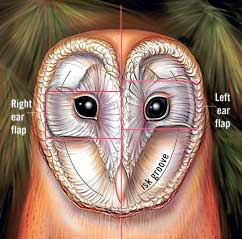
Owls are highly specialized in a variety of ways.  Most famously, they have excellent hearing.  They have to be able to hear well because most of them hunt at night, when vision won't do them much good.  There are a few reasons why their hearing is so excellent.  One is that most owls have asymmetrically placed ears that allow them to triangulate the location of what they're listening to.
tucsoncitizen.com
csus.edu Location of ears on a Barn Owl


Also, they have a facial disc, a feather formation that funnels sounds to those asymmetrical ears like a satellite dish.
Great Grey Owl (www.valcitygal.wordpress.com)
Even though owls have excellent hearing, is not quite enough to use exclusively, so their eyesight is pretty great, too.  Owls are famous for having large eyes, as is seen in cartoons and art.  And while the largeness of owls' eyes contributes to their awesome vision, it's actually the fact that their eyes are elongated that allows them to see so well.  It would require a discourse in eye anatomy to fully explain it, but suffice it to say that longer eyes make for larger images on the retina, so the brain and neurons all have more material to work with, and so can see better than most other animals.  But, there are a lot of different eye-shapes and eye-colors in owls, as you will see over the next few weeks.
Snowy Owl (www.2expertsdesign.com)
In the same vein of adaptations-for-hunting-at-night, owls also have special feathers.  Owls have an incredible ability to fly silently, and this is largely due to the structure of their feathers.  While most birds have rigid feathers with straight edges, the leading edge of owl feathers is serrated, and that breaks up the air as it passes over the feathers, rendering them silent.  Interestingly, the owls that don't have to be silent to sneak up on prey, namely the fishing owls, do not have feather serrations, and therefore are noisy fliers like most birds.
www.science.howstuffworks.com
Okay, I think that's all you need to know about owls before I delve into the nitty-gritty of individual species.  Now when I say, "The Great Grey Owl has the largest facial disc of all the owls", or, "Barn Owls have mastered the evolution of asymmetrical ears," or, "Burrowing Owls are largely diurnal, so they don't need such extreme facial discs," you'll know what I'm talking about. 
This owl is excited.
Okay, who's excited to hear all about why each of the owls the Humans treat at the Rocky Mountain Raptor Program are so cool?  I know I am.  I'll kick it off next week with....I'm not telling.  It's going to be a surprise.  Kind of.

In the meantime, don't forget that you can contact me via the comments below, or at my email address at talonsofdoom@gmail.com.  Also, if you haven't liked the RMRP on Facebook or followed me on Twitter, I highly recommend that you do.  And, finally, please vote for the RMRP in the Chase Giving charity drive today--help us win money from Chase Bank with a simple Facebook vote! Please contact the RMRP for any real questions for the Humans.