Pages

Showing posts with label mississippi kite. Show all posts

Friday, July 27, 2012

Babies and Releases

I know it's been awhile since I've written--the heat has me lazy, and the afternoon storms are distracting--but some pretty exciting stuff has been happening recently and it's well past time to give you all an update!  First of all, check out this progression:
The Tiniest Kestrel is all grown up (except for the head fluff)
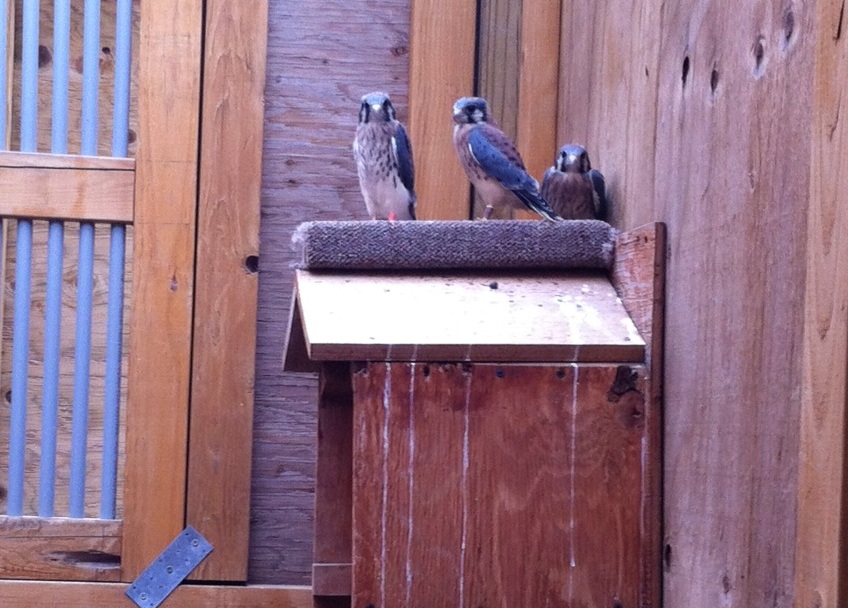
Can you believe how quickly they grow up?  The little Kestrel is now flying like a champ and is due to start live prey testing this week.

Next in line, the baby Cooper's Hawk.  He's not quite as fluffy as he was a week ago, and would you look at the size of those feet?  Cooper's Hawks are accipiters, a certain group of Hawks designed to hunt and kill birds on the wing.  The super-long toes help them reach out and grab their prey in flight.

Baby Cooper's Hawk
The Humans have also been admitting lots of baby Swainson's Hawks, most right on the cusp of fledging (learning to fly).  It is expected that more and more of these kids will be coming in over the next few weeks, looking for a safe place to finish their flight and prey training.  By "safe place" I mean not in the middle of a road or parking lot, which is where a lot of them are found.  Orphaned Swainson's Hawks who come in this time of year simply need to grow up and get kicked out.  However, if a broken Swainson's Hawk comes in towards the end of the summer and doesn't heal in time for the fall migration, the bird will be overwintered in our large flight cages.  We currently have three of last year's birds in there, mostly waiting for better feathers to grow in.  They include the Swainson's Hawk that had all his feathers burned off last year.  He's growing in new feathers like a champ, but he still has a ways to go.


Baby Swainson's Hawk 
An interesting Swainson's Hawk story is unfolding in cage R-14 right now:  there was an adult Swainson's Hawk, probably male, brought in a couple weeks ago with bodily trauma but no broken bones or wounds (likely hit by car).  He was moved out to a small flight cage, R-14, pretty quickly.  Then a grounded immature Swainson's Hawk was found in a parking lot just six blocks away from where the adult male was found.  The Humans put the kid in the cage with the dad, and wouldn't you know it, the kid rushed up to dad and started food begging instantly!  And when the Humans go in to catch the kid, dad gets really defensive and protective over him.  Usually, "foster" raptors act more as role models than parents, so the overt parenting behavior in this dad probably means the two are related.   Looks like a family was reunited! 
Probable Swainson's Hawk father-child reunion 
In other news, lots of birds are being released these days.  Instead of twenty-something Kestrels in the cages, there are only about ten!  Kids are growing up left and right.  And another very exciting release just happened: the beautiful adult Mississippi Kite that was admitted with a broken wing was released in good habitat in Sterling!  The RMRP only sees a handful of Mississippi Kites in a year, if any, and they're usually immatures that fell out of a nest.  The fact that the RMRP got an adult Kite, and were able to successfully heal and release the bird has everyone feeling warm and fuzzy--except for me.  The only time I feel that way is when I have something warm and fuzzy in my talons. 
Mississippi Kite progression and release
And, last but not least, the Peregrine Falcon that came in with a wing injury is flying circles around her cage, building up stamina and  hopefully looking forward to a release soon!
Peregrine Falcon
That's it for now.  I'll honestly try to stop being such a perch-potato and start writing more blog posts!  And remember, I'm always willing to answer questions and take on requests, so email me at talonsofdoom@gmail.com whenever you want to, or leave a comment below!

Wednesday, July 11, 2012

Why Mississippi Kites Are Amazing!

It's been awhile since I've done an installation of "Why ___s Are Amazing", and I apologize for my tardiness.   Perhaps it's because most of the birds at the RMRP right now are American Kestrels, and I've already covered that species?  Whatever the reason, I decided to make it up to you by covering a bird that's really unique: Mississippi Kites.  Okay, so they're not actually that unique.  They're actually quite common birds--just not around here, which is what makes them "unique" to us.

So, the funny thing about this article is that I knew nothing about Mississippi Kites before writing it, so in order to find all the information I wanted to tell you, I (GHOW) interviewed a Mississippi Kite (MIKI) here at the Rocky Mountain Raptor Program.  This bird is currently healing an injured wing.  Here's what I got!

The interviewee
GHOW:  Thank you for joining me today.  How is your wing feeling?
MIKI:  Squeak-choooo!


GHOW:  Oh no, do you have a cold as well?
MIKI:  Squeak-chooo!!


GHOW:  Well, that's terrible luck, isn't it?
MIKI:  Squeak--no cold--chooooo!


GHOW:  What?! Oh! You're not sneezing, that's just how you talk!
MIKI:  Squeak--That's right!--choooo!


GHOW:  Okay, I'm getting the hang of it.  You know, that's funny, you sound just like a squeaky toy!
MIKI:  Har. Har. Har.  Like I've never heard that before. Squeak-choo!!


oklahomabirdsandbutterflies.com
GHOW:  Right. I can see we started off on the wrong wing, so let's try again.  How is your injury?
MIKI: Better, thank you, but I still have a ways to go.  Squeak-choo!


GHOW:  Glad to hear it's improving.  So, where are you from?
MIKI:  Well, I'm from Mead, but I have a lot of relatives in Sterling and in Pueblo.  But most of my species live further east, in the Midwestern plains and down south.

GHOW:  I see, so that's why I've only met a handful of Kites?
MIKI:  Yep, that's right!  We're kind of new to the area.

GHOW: Well, welcome!  Glad to have you! It sounds like you're pretty social birds?
MIKI:  Absolutely!  We live in communal roosts, like Turkey Vultures.  So wherever you see one Mississippi Kite, you're likely to find more.  Squeak-chooo!


GHOW:  Now, correct me if I'm wrong, but I think I overhead another bird say that you only eat insects?? 
watchingthesunbake.blogspot.co
MIKI:  Squeak-chooo!!!!  That's mostly right.  I loooove grasshoppers and dragonflies, but the smaller bugs are good, too.  Occasionally I'll nab a small mouse, or maybe a lizard, but bugs are my meal of choice.

GHOW:  Blech, you can have them.  I'll take a tasty rabbit any day.  Of course, you might not be big enough to take down a rabbit.  How big are you?
MIKI:  Last time the Humans weighed me I was 250g, so about twice the size of a Kestrel.  However, some of us are a little smaller, and some are a bit bigger, about three times the size of a Kestrel.  But even though I'm bigger than a Kestrel, check out my feet:  they're pretty small, right?  So I don't think I'll be hunting rabbits anytime soon.

GHOW:   How do you hunt bugs, anyways?
MIKI:   On the wing, like a swallow, but instead of catching bugs in my mouth, I catch them with my feet, and that makes me a Raptor!  Squeak-chooo! 

GHOW:   Fascinating.  So tell me a little more about your lifestyle, like where you like to build your nest, and stuff like that.
MIKI:   We build our nests in trees, so we always live near woodland.  Out here in the plains we try to find a little riparian forest to call home--after all, water is important for the bugs we hunt.  We make our nests out of twigs, and I must say, they're pretty good by Raptor standards.  The lady-Kites usually lay two eggs per year, and the young are out of the nest nice a quick: one month in the egg, one month in the nest, then fledged and gone.


GHOW:   Do you make a migration?
MIKI:   Yes, most of our populations do. We fly to tropical South America in the winter!

GHOW:  By the way, I just wanted to comment on how beautiful your eyes are.  Most Raptors have dark eyes, or yellow eyes, but yours are bright red!
MIKI:   Cool, huh?  The immature Mississippi Kites don't have red eyes--they're brown.  In fact, immature Kites are streak-brown all over, with none of this striking grey-and-black motif of the adults.

Immature MIKI  (avianweb.com)
GHOW:   This has all been very educational for me--especially learning a new language!  I only have one more question for you:  what makes Mississippi Kites awesome?
MIKI:   I can't name just one thing!  How about three?  1) Our aerial acrobatics when we're catching bugs on the wing,  2) Our appearance (a lot of Humans think we look a bit like Owls, and most Humans don't even recognize us as Raptors), and 3) Our unique call!  Squeak-choo!! 


Well, folks, there you have it!  Now you know a little bit about Mississippi Kites.   Until next time, squeak-choo! 


Wednesday, June 27, 2012

General Update: 6/27/12


First of all, congrats to the little cat-caught Eastern Screech Owl! He passes mouse school with flying colors (flying fur?) and was released yesterday!

And in other big news, the Humans have officially caught up to and surpassed last year's admissions for this time of year.  They have admitted 93 birds for the year, and it seems like half of those came in just these last few weeks!
Young female American Kestrels
The Humans are up to their ears in baby American Kestrels.  Every day they admit new ones, move the last arrivals out to the rehab cages, move the rehab-cage birds to the large flight cages, and start the large-flight birds on live prey testing.  Whew!  There are dozens of the little falcons to keep track of, all with different colored leg bands on to help ID them.  Thank goodness American Kestrels are sexually dimorphic (males have blue backs, females are all brown), or there wouldn't be enough color combinations on leg bands to give them all a unique identifier! 

Young male American Kestrels
Other recent arrivals include a young Red-Tailed Hawk, a hit-by-car (HBC) Swainson's Hawk, and a high voltage trauma (HVT) Peregrine Falcon.  The Peregrine's injury is old, so he probably won't die from the injuries, but it's unsure whether or not he'll be a releasable bird. Stay tuned: the Humans are trying their best.  He's young, just a second-year bird, and he's very handsome:

Peregrin falcon in a critical care cage
Here's a pic of the HBC Swainson's Hawk.  He's a striking bird, with very pale undersides and a very stark bib.  He's also a fighter (even being hit by a car on I-25 didn't break any bones!), and he's a good reminder that not all Swainson's Hawks are "young and dumb".

Swainson's Hawk in a rehabilitation cage
The Mississippi Kite the with fractured wing has had her bandage removed and is trying it out in a larger cage this week.  So far she's holding it straight and using it well, so feathers crossed that it's perfectly healed!  The RMRP rarely admits adult Mississippi Kites, and usually they're broken beyond repair.  It would be a wonderful thing to give a second chance at freedom to this amazing bird.

Mississippi Kite, holding wings well
Perhaps the best news of all is about the two remaining Bald Eagles.  One was a power line victim, and she had a tough time healing the wound the shock left on her wing.  But the Humans were very determined and creative with her medical care, and the wound is now completely healed.  Soon it will be time for flight training!

And the other Bald Eagle is the one who came in at the end of 2011 scarcely able to walk or stand on her own.  It took weeks to get her to move around flat ground, then weeks to get her to perch on low perches.  It seemed like she was making good progress--slow but steady--when she hit a plateau.  For a few months she made no improvements.  The Humans were almost certain she would never be released, but decided to give her a little more time.  Well, whatever needed to click finally did so a few weeks ago, and all of the sudden she's flying and landing and moving around a double-length flight cage with ease!  Every day a Human goes into her cage to encourage her to fly laps so she'll build up strength, stamina and agility.  She's still a little tentative with her feet, so she's not 100% done with rehabilitation yet, but the progress she's made recently is an inspiration to us all.  Here's a photo montage from today, showing her spread her wings and launch from a high perch in her cage:

Here's hoping she continues making progress and gets out of here soon!  Not only do we want her to fly free again, but she eats a lot of food.

Stay tuned for another update: the RMRP has been receiving a lot of phone calls and emails about the High Park Fire and its effect on the RMRP, and I'll be writing about that soon.  But until next time, wish us luck in rehabilitating and releasing my awesome feathered brethren!