Pages

Showing posts with label cooper's hawk. Show all posts

Friday, July 27, 2012

Babies and Releases

I know it's been awhile since I've written--the heat has me lazy, and the afternoon storms are distracting--but some pretty exciting stuff has been happening recently and it's well past time to give you all an update!  First of all, check out this progression:
The Tiniest Kestrel is all grown up (except for the head fluff)
Can you believe how quickly they grow up?  The little Kestrel is now flying like a champ and is due to start live prey testing this week.

Next in line, the baby Cooper's Hawk.  He's not quite as fluffy as he was a week ago, and would you look at the size of those feet?  Cooper's Hawks are accipiters, a certain group of Hawks designed to hunt and kill birds on the wing.  The super-long toes help them reach out and grab their prey in flight.

Baby Cooper's Hawk
The Humans have also been admitting lots of baby Swainson's Hawks, most right on the cusp of fledging (learning to fly).  It is expected that more and more of these kids will be coming in over the next few weeks, looking for a safe place to finish their flight and prey training.  By "safe place" I mean not in the middle of a road or parking lot, which is where a lot of them are found.  Orphaned Swainson's Hawks who come in this time of year simply need to grow up and get kicked out.  However, if a broken Swainson's Hawk comes in towards the end of the summer and doesn't heal in time for the fall migration, the bird will be overwintered in our large flight cages.  We currently have three of last year's birds in there, mostly waiting for better feathers to grow in.  They include the Swainson's Hawk that had all his feathers burned off last year.  He's growing in new feathers like a champ, but he still has a ways to go.


Baby Swainson's Hawk 
An interesting Swainson's Hawk story is unfolding in cage R-14 right now:  there was an adult Swainson's Hawk, probably male, brought in a couple weeks ago with bodily trauma but no broken bones or wounds (likely hit by car).  He was moved out to a small flight cage, R-14, pretty quickly.  Then a grounded immature Swainson's Hawk was found in a parking lot just six blocks away from where the adult male was found.  The Humans put the kid in the cage with the dad, and wouldn't you know it, the kid rushed up to dad and started food begging instantly!  And when the Humans go in to catch the kid, dad gets really defensive and protective over him.  Usually, "foster" raptors act more as role models than parents, so the overt parenting behavior in this dad probably means the two are related.   Looks like a family was reunited! 
Probable Swainson's Hawk father-child reunion 
In other news, lots of birds are being released these days.  Instead of twenty-something Kestrels in the cages, there are only about ten!  Kids are growing up left and right.  And another very exciting release just happened: the beautiful adult Mississippi Kite that was admitted with a broken wing was released in good habitat in Sterling!  The RMRP only sees a handful of Mississippi Kites in a year, if any, and they're usually immatures that fell out of a nest.  The fact that the RMRP got an adult Kite, and were able to successfully heal and release the bird has everyone feeling warm and fuzzy--except for me.  The only time I feel that way is when I have something warm and fuzzy in my talons. 
Mississippi Kite progression and release
And, last but not least, the Peregrine Falcon that came in with a wing injury is flying circles around her cage, building up stamina and  hopefully looking forward to a release soon!
Peregrine Falcon
That's it for now.  I'll honestly try to stop being such a perch-potato and start writing more blog posts!  And remember, I'm always willing to answer questions and take on requests, so email me at talonsofdoom@gmail.com whenever you want to, or leave a comment below!

Thursday, June 7, 2012

Q&A: Identifying Raptors at Your Birdfeeder

Q:  A reader wrote in with a question about the raptors she sees in her back yard in Denver.  She writes, "I have multiple seed and suet feeders in my yard, which as you many imagine attract many sparrows and finches (among others).  This bird population in turn attracts a certain number of raptors.  Several times I have seen small raptors which I believe to be female Merlins, but on looking at your post concerning Sharp-Shinned Hawks, am now indecisive.  How do I tell the difference?"

A:  An excellent question!  Let's see what information I have tucked up my wing. 

1.  Let's take a look at which raptors can be found munching on songbirds in Colorado: the Merlin falcon, the Prairie Falcon, the Peregrine Falcon, the Sharp-Shinned Hawk, the Cooper's Hawk, and the Northern Goshawk.  We can eliminate the Northern Goshawk (the need much more privacy than a city allows). While it's unlikely that a Peregrine Falcon or Prairie Falcon would pop up in an urban/suburban back yard, it's possible, so we'll include it in this discussion. 

2.  The factor that first comes to mind is seasonality: While the Cooper's and Sharp-Shinned Hawks, and the Prairie and Peregrine Falcons all live here year round, Merlins are only found in Colorado in the winter.  So, if you saw a bird yesterday that you think may be a Merlin, odds are it's something else. 

3.  The next thing to determine is whether it's a hawk or a falcon. All of our falcons (including the American Kestrel) have similar characteristics, the most obvious being the "chin straps" or "mustache marks" below their eyes.  Below is a picture of these marking on each of the falcon species. If the bird you are seeing is sporting a mustache, it's a falcon; if there's no mustache, it's probably one of the hawks.

Another ways to determine if the bird is a Sharpie/Cooper's or a falcon is that Sharpies and Cooper's will be showing a lot of naked skinny toothpick leg when they're standing around. 


Falcons, on the other hand, sit a little closer to their feet, and their legs are stockier and more feathered: 

In that montage, you can also see that falcons tend to have dark eyes, whereas the little hawks have orange, yellow, red, or pale eyes. 

4.  It was hard to find or create a side-by-side comparison of the birds, so instead I drew a picture to help you see the difference in coloration and size.  I compared the size of the birds to a one-liter water bottle:


5.  And, finally, there's habitat preference. In a city like Denver, even on the outskirts, you are far more likely to have Cooper's Hawks and Sharp-Shinned Hawks dining on your backyard songbirds than any of the falcons.  In the winter, a Merlin would be more than happy to help you thin the sparrow population a bit, but if you do see one you're very lucky because they're aren't exactly plentiful or common in these parts.  I'm not saying that it's impossible to see a falcon in your backyard, but it's definitely less likely than the other options. 


I sure hope that helps!  Please comment below or email me at talonsofdoom@gmail.com with further questions, clarifications, or even pictures to ID!  Thanks for reading! 

Friday, June 1, 2012

Why accipiters are awesome!

It's been awhile since I added to the collection of "Why ____ Are Awesome." My only excuse is that I've been busy raising babies. Still, since we have had quite a few accipiters in house recently, I figure I should make the time to talk about them.

hawkmountain.org
First of all, what is an accipiter? It's a fancy name for a fancy hawk. Around here we have three accipiter species: Cooper's Hawks, Sharp-Shinned Hawks, and Northern Goshawks. They have short, broad wings, and long narrow tails (as opposed to buteos like Red-Tailed Hawks, which have long broad wings and and shorter broad tails).

Their proportions allow them to zip through tiny spaces, narrow gaps, and complex paths without colliding with things. Why do accipiters need that adaptation? Because they are bird-eating-birds.

That's what really makes an accipiter an accipiter--it all comes down to eating other birds. And since prey-birds are fast, accipiters have to be fast, too, hence the odd proportions and speed-demon tendencies. It's like they live on fast-forward: fast heartbeats, high metabolisms, rapid wingbeats, zippy flight, darting movements, quick escapes, and lightning feet.

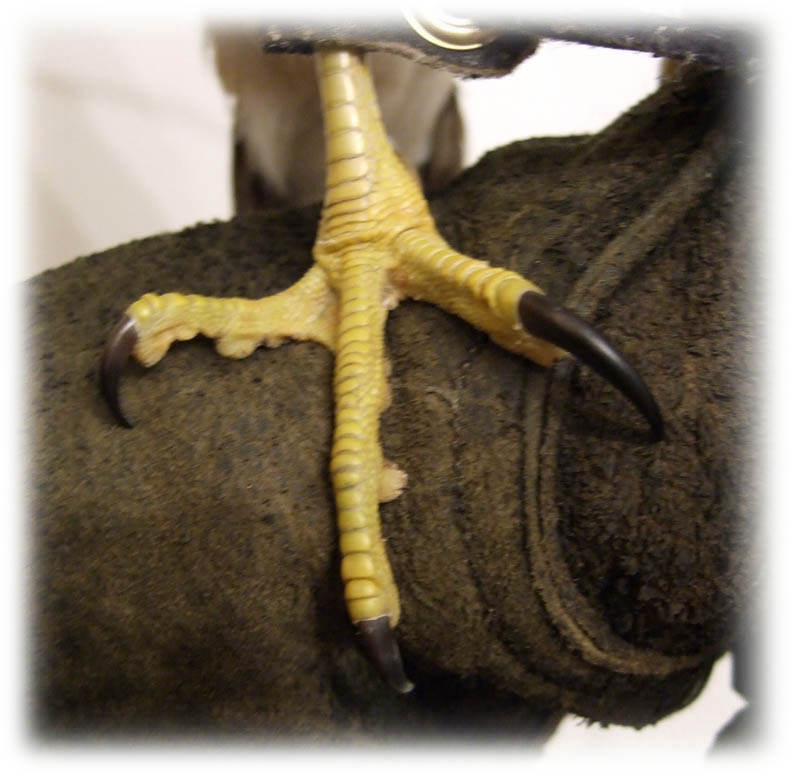
Their feet are particularly cool. Now, as a Great Horned Owl, I'm rather fond of my own feet--they're covered all the way to the toes in warm feathers.  But if I had to choose another birds' feet to have for a day, it would be accipiter feet. Specifically Cooper's Hawk feet (sized up appropriately, of course).  I mean, look at these things! See how long the toes are?
themodernapprentice.com

The toes are like that so the Cooper's Hawk can wrap its feet around a little bird in flight and be sure to not let it slip away. And like I said, their feet are fast: I've heard more than one Human yelp when an accipiter's foot got loose!

Now that I've covered accipiters in general, let's touch on each of the three local species in brief:

Sharp-Shinned Hawk:

Sharpies are the smallest of the local accipiters.  They're just 9-15 inches long, including the super-long tail. Like most raptors, the females are larger than the males, but in accipiter species like Sharpies the difference can be huge, up to 50% heavier for females! They may be small, but they're tough as nails, and they take down prey ranging from hummingbirds to grouse. If you have a bird feeder in your yard, you'll probably attract Sharpies as well...gives a double meaning to bird feeder!  They live in forested areas like dense conifer stands. They are called "Sharp-Shinned" because of a small ridge that runs down the front of each leg. 
allaboutbirds.org

Cooper's Hawk:

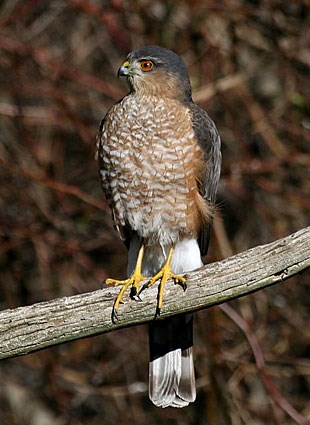
Coopers are just a tiny bit bigger than the Sharpies, with a lot of overlap between the sexes of each species. They prefer slightly more open forest, and are being found more and more in cities (where delicious doves and pigeons live...and the birds at your bird feeder). Despite being a little bigger than Sharpies, they're just as nimble, quick and high-energy. As a side note: the Cooper's was named by French naturalist Charles Lucien Bonaparte, nephew of Emperor Napoleon Bonaparte. He named the bird after New York naturalist William Cooper. 

allaboutbirds.com

Now, for something fun about Coopers Hawks and Sharp-Shinned Hawks: they look almost identical! Twinsies! There are some subtle differences, like Cooper's Hawks have a round tail tip (C shaped for Coopers) and Sharpies have straight tails; Cooper's sometimes have a small crest on their heads...other than that there's not a lot to go on. 

photos from allaboutbirds.com

Northern Goshawk:

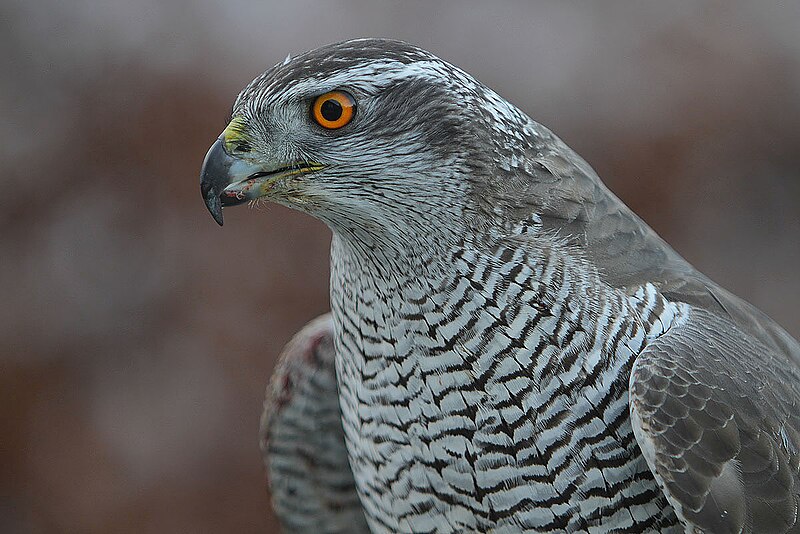
The last of the three US accipiters is the Northern Goshawk.  We don't see a whole lot of these birds come through our doors at the RMRP, but the Humans get pretty excited when it happens. They're such cool birds! And they're considerably different than the "twins" pictured above.  Not only do they look different, they behave differently. For one, they're much more aggressive, territorial and stubborn than the smaller accipiters. They also hunt differently, dropping on their prey from above, but doing so in forests where there's a lot of clutter between them and their prey. They don't care, they just dart/barrel through it. Also, instead of only eating birds, they're big fans of squirrels, rabbits and even big ol' hares. They live in remote, undisturbed forests, so if you ever see a Goshawk in the wild, consider yourself lucky. Or in danger. They are very aggressive birds. 
wikipedia.com
If you want to see how cool Goshawks really are, take a peek at this video of one flying through tiny, tight spaces: http://www.youtube.com/watch?v=2CFckjfP-1E


Alright, that's all I have on accipiters! What would you like to read about next week? Let me know in a comment, or send an email to talonsofdoom@gmail.com.

Wednesday, May 23, 2012

Guest writer for the weekly update: Cooper's Hawk

So, we still have injured accipiters in house here at the Rocky Mountain Raptor Program.  All accipiters are extremely high-energy, and there's one in particular--a Cooper's Hawk--who's getting on my nerves.  It's like someone gave him a triple shot of espresso and asked him to sit still in a corner.  Forget about it.  So in an effort to keep my manic neighbor calm and quiet for an hour or so while I catch some daytime shuteye, I offered him the job of writing this week's update.  Good night, and good luck!
~  ~  ~  ~  ~  ~  ~  ~  ~  ~  ~  ~  ~  ~  ~  ~  ~  ~  ~  ~  ~  ~  ~   ~  ~  ~  ~  ~  ~  ~  ~  ~  ~  ~  ~  ~   


It appears that the evil animals that walk upright and poke me with very sharp, tiny, pointy things (the Owl calls these creatures "Humans") all gather together once a week and talk about us Raptors. They call it "Rounds", but I call it "plotting my demise". So they plotted my demise last night, and this is what they said:

First, they talked about the other Cooper's Hawk that was here, the big gorgeous female who could have squashed me like a bug.  So hot.  She came in about one moon before me, after hitting a window in a Human house and shattering it.  She broke her skull, too, but she never let that get her down, and she was always trying to kill the Humans.  She was awesome.  So, she's been missing for two days, right, and I'm thinking the worst has happened, that the Humans plotted her demise, and followed through on it!  And I'm listening in on this meeting of theirs hoping to hear what they did to her, right, so I could be ready to kill the next Human to come near me, but then they said they released her.  In an "area with fewer windows" they said, and then they all laughed.  Huh.  I wasn't expecting that.  What did she do to them to make them let her go?  I hope I figure it out soon so I can get them to release me as well.  My wing is almost completely better, and I was spending all my time flying in tight circle in this little cage they had me in, and almost escaping every time the Humans tried to catch me, and I guess the Humans didn't like that because this morning they moved me to a much larger cage.  Now I can really begin strengthening my wing and preparing for the day I manage to escape.

Anyways, they also talked about a Sharp Shinned Hawk (he hit a window, too, like me and the other Cooper's), and how he's in a really big cage and how he's flying so fast that no one can seem him long enough to judge how his wing is healing.  They all laughed at that, too.  Then they started talking about releasing him! I have to figure this out!

After the Sharpie, they talked about an American Kestrel that's in the small medical room where the Humans use the pointy things.  She was my neighbor until I moved out today. She got here after I did, and she says she was hit by something (like a car) that messed up her head and her balance, and then she was chewed on by a cat for awhile.  She's been having a really rough time standing up and holding her head straight and eating and everything, but yesterday she started eating on her own, and now she can stand sometimes, and she holds her head the right way more often than she holds it the wrong way, so I think she's getting better, too.

Then the Humans talked about the Bald Eagles.  There are four of them, and I can't keep them straight, but I know that there are at least two that are doing well and getting stronger and healthier. I hope they leave soon because their fish stinks and they poop everywhere. Bald eagles are so gross.

There's also a Red-Tailed Hawk that they call the Undead Red-Tail because he's been sick with a mystery illness for two moons now, and he just won't get better, and because he has no blood in his veins, and because he had this weird lesion thingy in his throat for a long time. He's only a kid, but he's really mean and vicious, but he's still a little subdued because he's trying to fight off whatever infection he has, so he hasn't had a chance to unleash his fury. The Humans don't know this, but when he's finally feeling well they'd better watch out!

After that the Humans starting talking about something called "Renaissance Festival" and started walking around in these really weird clothes, and I lost interest and left, so then I went back to my...OOH, QUAIL!!!  KILL IT!!! OH, IT'S ALREADY DEAD...EAT IT!!!
~  ~  ~  ~  ~  ~  ~  ~  ~  ~  ~  ~   ~  ~  ~  ~  ~  ~  ~  ~  ~  ~  ~  ~  ~   ~  ~  ~  ~  ~  ~  ~  ~   ~
...Wow, accipiters have short attention spans.  Thanks for reading, I'll be back on board tomorrow! 

Wednesday, May 9, 2012

This week's general update

The biggest news (to me, at least) is that my baby has become a good enough flier to graduate to another cage. After all, a mom with a bum wing isn't very good at teaching a kid how to fly. However, thanks to me, that kid was sent over to his new mom with a healthy Great Horned Owl attitude (if he took the "Which Raptor Are You?" quiz, he would definitely get "Great Horned Owl"). Still, I sneaked into his new cage to see how he's doing, and it's clear to me that while he may be able to fly with his new mom, he obviously liked me more:


In other news, the Undead Red-Tail likes to perch with his foot outstretched like a total goofball. He's still under the weather and fighting off an illness/infection, but he's improving daily.

He spends most of his time like this
The Swainson's Hawk that survived a run-in with a methane burner last year is molting out his feathers, and the Humans are hopeful that his new set will be high-quality so he can be kicked out of here this year. Here's a pic of what a feather molted from a hawk that caught on fire looks like:


Amazing that he's okay, isn't it?

There are still four Bald Eagles in house, all plodding their high-maintenance way through the rehabilitation process. And we also have three accipiters (two Cooper's Hawks and a Sharp-Shinned Hawk) at the center, which is a pretty high number for them, too. All three were admitted with impact injuries, probably from hitting windows. This includes the Cooper's Hawk shown below, the one that actually shattered the house window she ran into.

After demolishing a button quail for lunch
The Turkey Vulture that was going to be released now-ish is instead molting in a new set of flight feathers. I think he's doing on purpose so he can keep room service as long as possible. But when he's done growing in new feathers (a couple of weeks), he'll be out of here, too.

And, finally, the Great Horned Owl with the luxated elbow flies great despite the wing droop, and started on Rat School yesterday. Rat School (or Mouse School, depending on the size of the bird) is when the Humans put the about-to-be-released bird in a large flight cage, and give the bird live prey for a few days. Instead of simply flying down to a perch to eat pre-killed rabbit, the bird has to catch and kill the prey itself. Happily, the Great Horned Owl killed his rat. Killed it dead. Full marks for the Great Horned Owl!

That's all for now!