Pages

Showing posts with label high voltage trauma. Show all posts

Wednesday, June 27, 2012

General Update: 6/27/12


First of all, congrats to the little cat-caught Eastern Screech Owl! He passes mouse school with flying colors (flying fur?) and was released yesterday!

And in other big news, the Humans have officially caught up to and surpassed last year's admissions for this time of year.  They have admitted 93 birds for the year, and it seems like half of those came in just these last few weeks!
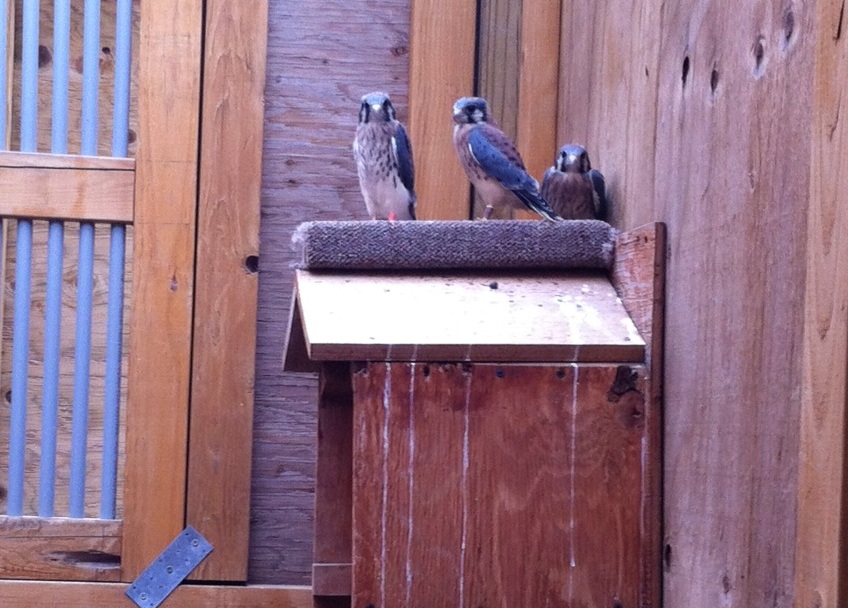
Young female American Kestrels
The Humans are up to their ears in baby American Kestrels.  Every day they admit new ones, move the last arrivals out to the rehab cages, move the rehab-cage birds to the large flight cages, and start the large-flight birds on live prey testing.  Whew!  There are dozens of the little falcons to keep track of, all with different colored leg bands on to help ID them.  Thank goodness American Kestrels are sexually dimorphic (males have blue backs, females are all brown), or there wouldn't be enough color combinations on leg bands to give them all a unique identifier! 

Young male American Kestrels
Other recent arrivals include a young Red-Tailed Hawk, a hit-by-car (HBC) Swainson's Hawk, and a high voltage trauma (HVT) Peregrine Falcon.  The Peregrine's injury is old, so he probably won't die from the injuries, but it's unsure whether or not he'll be a releasable bird. Stay tuned: the Humans are trying their best.  He's young, just a second-year bird, and he's very handsome:

Peregrin falcon in a critical care cage
Here's a pic of the HBC Swainson's Hawk.  He's a striking bird, with very pale undersides and a very stark bib.  He's also a fighter (even being hit by a car on I-25 didn't break any bones!), and he's a good reminder that not all Swainson's Hawks are "young and dumb".

Swainson's Hawk in a rehabilitation cage
The Mississippi Kite the with fractured wing has had her bandage removed and is trying it out in a larger cage this week.  So far she's holding it straight and using it well, so feathers crossed that it's perfectly healed!  The RMRP rarely admits adult Mississippi Kites, and usually they're broken beyond repair.  It would be a wonderful thing to give a second chance at freedom to this amazing bird.

Mississippi Kite, holding wings well
Perhaps the best news of all is about the two remaining Bald Eagles.  One was a power line victim, and she had a tough time healing the wound the shock left on her wing.  But the Humans were very determined and creative with her medical care, and the wound is now completely healed.  Soon it will be time for flight training!

And the other Bald Eagle is the one who came in at the end of 2011 scarcely able to walk or stand on her own.  It took weeks to get her to move around flat ground, then weeks to get her to perch on low perches.  It seemed like she was making good progress--slow but steady--when she hit a plateau.  For a few months she made no improvements.  The Humans were almost certain she would never be released, but decided to give her a little more time.  Well, whatever needed to click finally did so a few weeks ago, and all of the sudden she's flying and landing and moving around a double-length flight cage with ease!  Every day a Human goes into her cage to encourage her to fly laps so she'll build up strength, stamina and agility.  She's still a little tentative with her feet, so she's not 100% done with rehabilitation yet, but the progress she's made recently is an inspiration to us all.  Here's a photo montage from today, showing her spread her wings and launch from a high perch in her cage:

Here's hoping she continues making progress and gets out of here soon!  Not only do we want her to fly free again, but she eats a lot of food.

Stay tuned for another update: the RMRP has been receiving a lot of phone calls and emails about the High Park Fire and its effect on the RMRP, and I'll be writing about that soon.  But until next time, wish us luck in rehabilitating and releasing my awesome feathered brethren! 

Thursday, June 21, 2012

General update 6/21/12

Busy season is in full swing at the RMRP.  The Humans admitted 25 birds in the past two weeks, and most of them have come in clusters: five birds one day, none the next, etc.  The majority of the newcomers are American Kestrel chicks: there are currently 18 Kestrels at the center, and 14 of those are this year's young.  Some of the more interesting of the baby Kestrels include the nest of five chicks that arrived in the same box as a nest of baby Flickers--I don't know which family was more scared!  Both of their nests were accidentally knocked down by construction workers, who then boxed the kids up and brought them in.  The Flickers went to WildKind at the Larimer County Humane Society, and the Kestrels are doing well in our flight cages.  The other interesting Kestrel kid is one that was found fending off the advances of a curious Rottweiler.  The bird was on his back, feet lashing out, keeping the mighty beast at bay.

Aside from young American Kestrels, the only other kid admitted this past week was a cat-caught baby Screech Owl (the third Screech Owl brought home by this one cat!).  The unfortunate thing about cats and baby birds is that a bell on the collar doesn't do any good when the bird can't fly.  The chick is fine, but all cat-caught birds are treated with a round of antibiotics because raptor chicks are particularly susceptible to a bacteria in cat saliva.

As for the rest of the birds, the Mississippi Kite with the fractured and traumatized wing is due to get his bandage off at the end of the week: feathers crossed that it healed well enough for him to fly!  The Great Horned Owl with the deep puncture wound in her face is now maggot free and proud to be!  She'll be moving into a cage with the immature Great Horned Owls soon so she can be a role model for the kiddos and show them what to do with those furry things running around on the ground below them.

And, finally, there are the two remaining Bald Eagles.  One was a high-voltage trauma victim (read: shocked by a power line).  She was having issues with the exit wound on her wing, and was unable to heal over the exposed and necrotic bone.  But the vets at the CSU Vet Teaching Hospital were able to scrape away enough of the dead bone to allow new growth to start, and now only the tiniest remnant of the wound remains!  She'll be heading into a large flight cage to build up her stamina soon.

The last eagle is the one who came in unable to use her legs.  For a couple of months she made slow progress in regaining strength and agility, but then she plateaued for a long time...long enough that no one thought she would get any better.  Still, the Humans gave her a chance, and in the past couple weeks she's made huge progress, enough that the Humans are once again hopeful that she might be saved!  She's started flying around and making good landing, something she didn't have the confidence/ability to do for the past couple months.  Her prognosis is still guarded, but everyone is pulling for her!

So, all in all it's business as usual for the birds and Humans at the Rocky Mountain Raptor Program.  The smoke has thinned out, booth and festival season is ramping up, and everyone is excited to be helping the birds!  As always, I'll be sure to keep you updated as these amazing animals are admitted, fixed up and released!  Oh, and I'm sorry about the lack of pictures in this update--I promise I'll post more soon!

*** Is there anything you would like to read about that I've not touched on?  Like West Nile Virus in raptors?  Or maybe raptor anatomy or diet?  Have questions about that strange bird in your back yard, or want to know why raptors can turn their heads so far around?  Want to know more about what some of the injuries really mean, like what "high voltage trauma" actually does to a bird?  I'm here for you, so let me know what you'd like to read!  Leave a comment below, or email me at talonsofdoom@gmail.com! ***