Pages

Showing posts with label awesome. Show all posts

Friday, December 7, 2012

Owl of the Week: Burrowing Owl

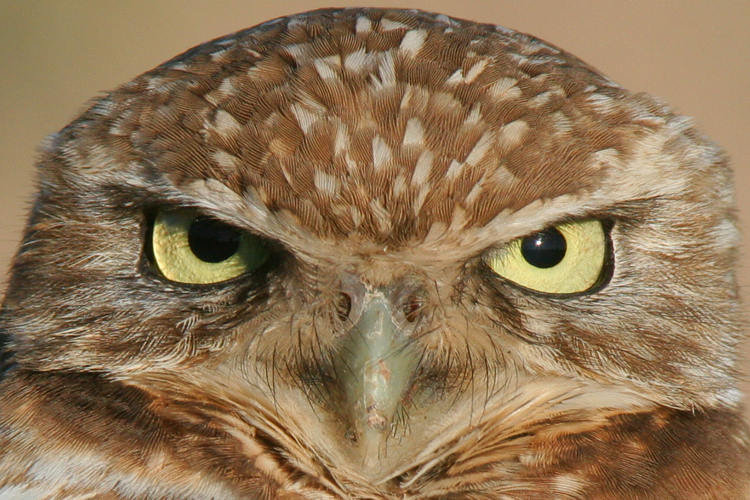
My sincere apologies for leaving the Burrowing Owl out of my Owl of the Week series.  They were in the original list, but somehow I skipped over their place between the Eastern Screech Owl and the Long-Eared Owl.  But make no mistake, these little owls are awesome and well-worth an entire page of this blog.

bird-friends.com
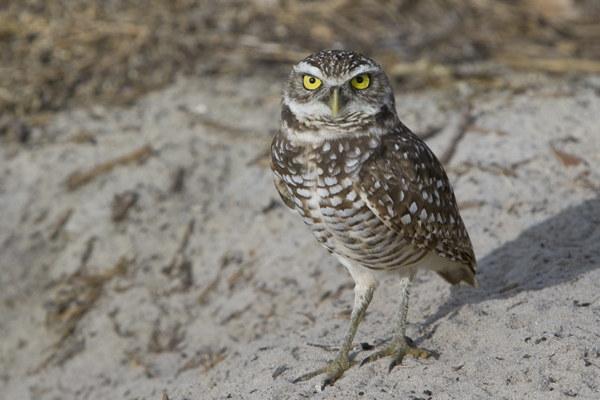
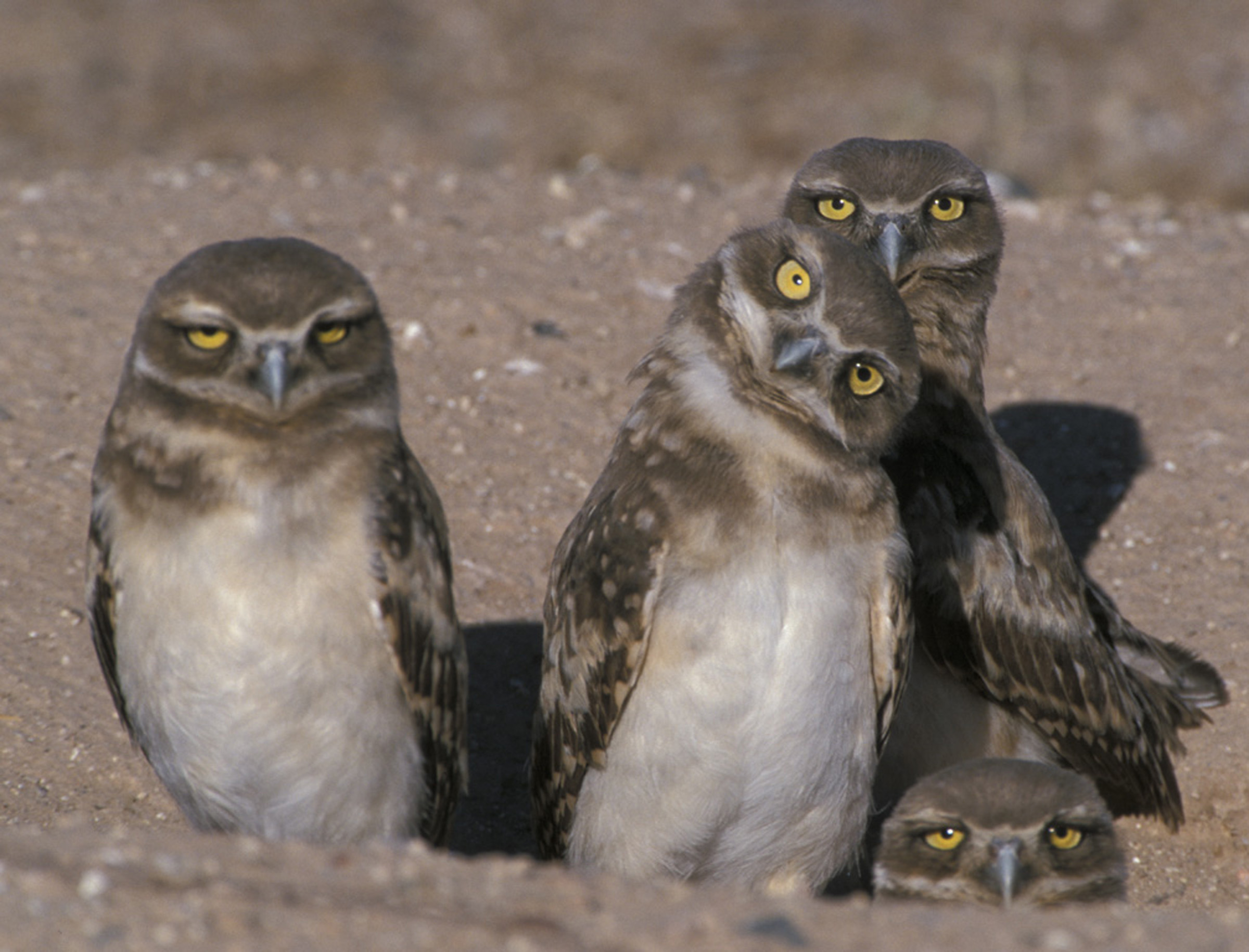
First, a description:  Burrowing Owls are on the small end of things, weighing just half a pound with a wingspan up to two feet.  They're tall and lanky, with long, unfeathered legs below a rounded body.  They are tuftless owls with moderate facial discs.  Adults are brown with white speckles; juveniles are similar, but less speckly and more buff-colored on the chests.

prometheus.med.utah.edu
Burrowing Owls live in open areas west of the Mississippi River from Canada to Argentina, including grasslands, pasturelands and croplands, as well as golf courses and parks and the like.  They live underground in burrows, hence their common name.  Also, the second part of their Latin name (Athene cunicularia) is Greek for "rabbit burrow".  In many of the regions they inhabit, the soils are soft enough for the owls to dig their own burrows, but in Colorado, where the soils are famously hard and rocky, they rely on the abandoned burrows of other animals (more on this later).  They are aggressively territorial about the small area around the burrow, but generally willing to share the larger hunting grounds.

Burrowing Owl family in burrow - snuzzy.com
For hunting, they're surprisingly diverse.  They're neither diurnal nor nocturnal, but some blend of crepuscular (active at dawn and dusk) and insomniac.  In fact, they're active all day and night, taking naps as necessary.  During the day they hunt insects, and at night they catch small mammals like mice.  To accomplish this, they mostly run around on the ground on their stilty legs, or they hunt from low perches like fence posts.  Also--and this is a piece of information I will totally use against my fellow Educational Ambassador Burrowing Owl--they are the only owls to eat fruits and nuts.  Yep, Burrowing Owls are slightly omnivorous, and are partial to cactus fruits, like those of the prickly pear.  My neighbor is never going to live that down.

Juvenile Burrowing Owls - hawksaloft.org
Burrowing Owls are also unique in their vocalizations, and are excellent mimics.  In addition to a high, repetitive "hoot", they have a short barking alarm call like that of a prairie dog, a shaky hiss that's exactly like a rattlesnake rattle, and a variety of other noises.  The Educational Burrowing Owl at the RMRP has recently picked up the scream of the Common Barn Owl, choosing to use it on small children who get too close.  Here a link to their "hoot", and the very last sound on this page is the rattlesnake imitation. 

As for their status, the health of Burrowing Owl populations varies by locations.  In areas with soft soils, they tend to be doing better because they can dig their own burrows.  But out here, where the soils are hard and rocky, they are utterly dependent on Prairie Dogs to provide homes.  This is a problem as Prairie Dog towns are continually being eradicated in Colorado and other Great Plains states.  For Burrowing Owls, it's enough of a problem to place them on Colorado's Threatened Species list.  Populations are diminishing, and will continue to do so until Humans decide to leave room for Prairie Dogs in this state.

Burrowing Owl and Prairie Dog - fws.gov
Burrowing Owls come in to the RMRP pretty infrequently, usually the victims of car stirkes or barbed-wire fence entanglement.  As always, the RMRP provides the best care possible for these birds so they can rejoin their wild populations, and it's your donations that keep this work going!

Burrard-Lucas.com
Alright, this is the end of the Owl of the Week series (for real this time).  Thank you so much for your readership.  If you appreciate the raptors we save and the educational work we do (including this blog), please consider donating using the link above.  Otherwise, I hope to see you at the Open House this Sunday! 

Thursday, November 8, 2012

Owl of the Week: Northern Saw-Whet Owl

Based on the birds being admitted to the RMRP recently, it would have been very timely of me to swap around my article on Saw-Whet Owls (which we admitted two of a few weeks ago), and my article on Boreal Owls (which we admitted one of a few days ago).  Alas, while I'm remarkably wise, I am not prescient.

lloydspitalnikphotos.com
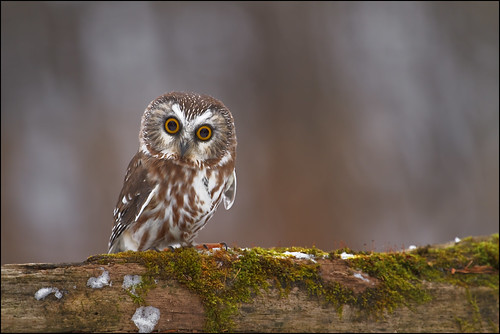
So, let's learn about Northern Saw-Whet Owls.  These birds are the cutest little murder-machines you've ever encountered, kind of like teddy bears armed with knives.  They're one of the smallest North American owls, standing just 5-6 inches high, with a wingspan of 18-22 inches, and weighing 2 1/2 - 4 oz (about as much as a quarter to a half cup of water).  They are non-tufted owls, with rather large heads in comparison to the rest of their little bodies.  They have a distinctive white "Y" shape on their face, and an overall streaked, buffy coloration elsewhere.  Their eyes are their most striking characteristic, slanty and bright yellow, and as innocent looking as doe eyes.  But at the other end of their body, their arsenal of eight small-but-sharp talons are always at the ready.

Saw-Whet Owl talons (richmondaudobon.org)
I've overheard Humans at the RMRP saying, "Saw-Whet Owls have the attitude of a female Golden Eagle packed into a tiny body."  It's not an exaggeration.  Not only do they have the attitude of a bird willing to fight for its life, they also take on (and take down) prey much larger than they are.  While Saw-Whet Owls typically dine on small rodents with a supplementary diet of songbirds and frogs, they don't turn down an opportunity to kill a squirrel, rat, or even a rock pigeon (about 4X heavier than the Saw-Whet Owl).

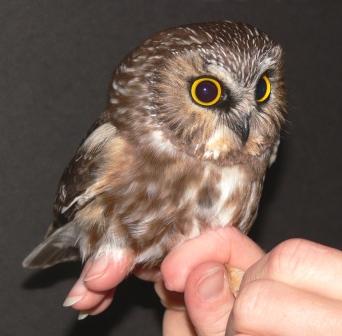
A picture to show the size of a Saw-Whet Owl.  (Please note:
this is a wild bird being held for banding, and this is not how
the RMRP handles birds) guardiansofgahoole.wikia.com

Immature Saw-Whet Owls look very different from the adults, with a dark, chocolate-brown color on their heads, backs and wings, and a light brown color on their fronts.  They still have that clear white "Y" on their faces, though.  Saw-Whet Owls typically lay from 3-7 eggs in cavity nests (much like the other small owls we've learned about recently).  They fledge after 4-5 weeks, and are sexually mature in under a year.  Life moves fast for small birds like these.

Immature Saw-Whet Owls (wikipedia.org)
Their common name refers to the sounds they make when alarmed, which apparently sounds an awful lot like a saw being whetted.  Never having heard a saw being whetted myself, I'll have to take the Humans' word on this one.  The other sounds they make is a long series of "hoop-hoop-hoop", and they only vocalize like this during breeding season.  It sounds like this: Saw-Whet Owl call

kewlwallpapers.com
These birds live in forests with dense areas for nesting.  They're year-round residents of the Rocky Mountains and southern Canada, and winter residents in much of the United States.  In Northern Colorado, a transition zone between the two ranges, they're most commonly seen passing through on migration.  In fact, the RMRP has admitted two Saw-Whet Owls in the past couple weeks, both window-strikes from encountering the large plate-glass windows of beautiful mountain homes as they passed through.  One of these birds has already been released to continue on his way, and the other is still in rehab working out some kinks in her flight.

flickriver.com
An odd habit of these birds is to remain still and not fly away when they're discovered.  They're so adamant about not moving that people can readily approach them, and the owl will just sit and watch.  While it's cool from a photographer's perspective, and it allows an excellent chance to closely observe these birds in the wild, please respect its personal space and don't get so close that the bird is forced to fly away.  A reader of this blog actually discovered one of these owls in the wild a few weeks ago and encountered this unique behavior.  A link to his photo-essay is in the comments section for the Boreal Owl article.  I also recommend checking out that article so you can see the difference between the Saw-Whet Owl and the Boreal Owl, which look quite similar.

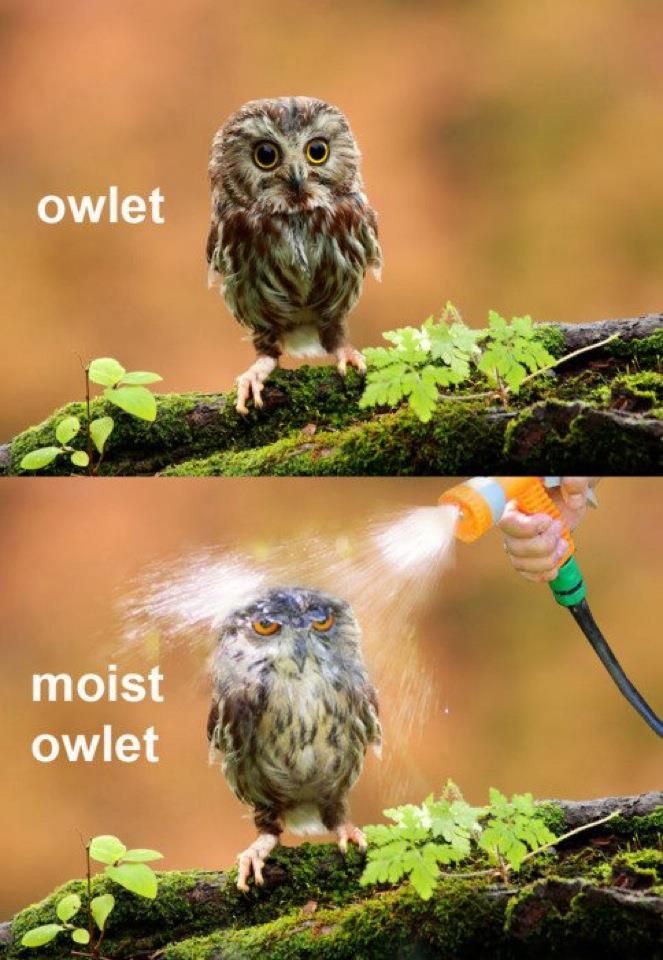
On a side note, I'm sure many of you have seen the following popular joke:

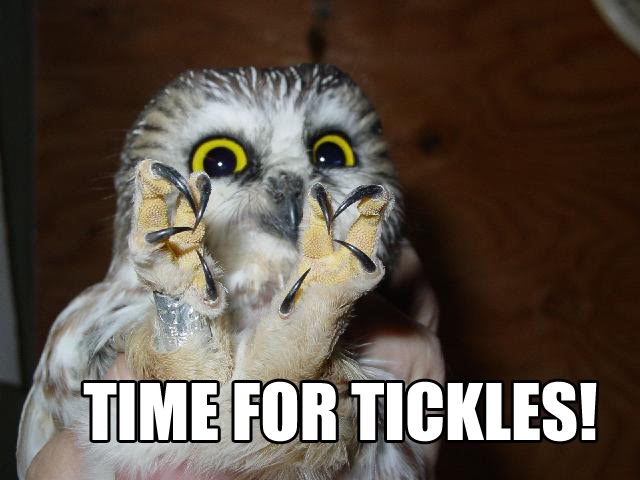
The bird in the top image is a Saw-Whet Owl, but you already knew that.  The owl in the bottom image is the lower half of the original Saw-Whet Owl, with a very photoshopped head of a much larger, very wet Eagle Owl on top.  The Saw-Whet Owl is also the star of the equally popular "Time For Tickles" image:


Now you know. 

Back to the serious stuff, there's not a lot of data about the population of Saw-Whet Owls, but it's clear to see from the recent admissions to the RMRP that they face similar threats as the other small owls:  window strikes, car hits, and other trauma.  The RMRP doesn't see many of these owls, but those that come through the doors here at our main facility are given quality care and the utmost respect, all the way from admit to release.

If you would like to support the RMRP, please use the donation link in the right sidebar.  Also, please follow us on Facebook and Twitter, and check out our official website to learn more.  Next week's owl (there are only two left!) is the dark-eyed Flammulated Owl.  Thanks for reading!

Saturday, November 3, 2012

Owl of the Week: Eastern Screech Owl

I know I said last week that this week's owl would be the Saw-Whet Owl, but I was mistaken.  If we continue in order of size, it's actually time for the Eastern Screech Owl.  But don't worry, the Saw-Whet Owl will be along next week (really).
wildphotosphotography.com

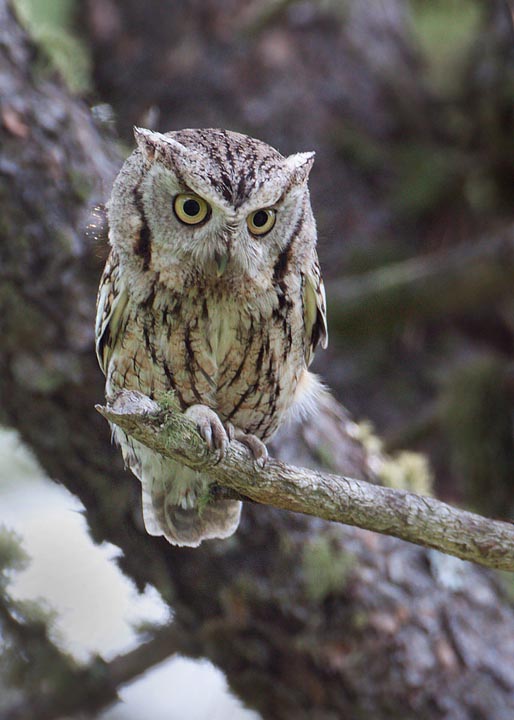
The Eastern Screech Owl is one of the more common small owls in the Northern Colorado region.  In fact, it's one of the more common small owls in the eastern United States.  The northeastern corner of Colorado is one of the western-most points of their range (Montana and Texas also have population bands of these owls).  West of here, the Eastern Screech Owl population fades into the Western Screech Owl population.  I've never seen one myself, but I hear they're very similar in appearance.  In fact, though there are ~23 species of Screech Owl (exclusive to the Americas), they all look remarkably similar.

Eastern Screech Owls are small, tufted owls that live in forested areas.  Their feather patterns allow them to blend into trees easily.  There are two color varieties of Eastern Screech Owls, referred to as 'morphs':  the grey morph and the red morph.  The red morphs make up ~1/3 of the population, but are far more common out east.  Their ear tufts are sometimes held flat, and sometime held upright.  As with the other tufted owls, these tufts help break up their silhouette so they can better blend into trees.

allaboutbirds.org
Being able to blend into trees so well, it makes sense that that's where they build their nests.  Eastern Screech Owls are cavity nesters, building their nests in natural holes in tree trunks, or in the abandoned homes of other cavity-nesting birds.  They readily use nest boxes, and have adapted well to suburban settings, so backyard nest boxes for these birds are quite common.  If you do install a nest box in your yard and Eastern Screech Owls take up residence in it, please be careful about letting your dog or cat outside when the young are fledging: cat-caught or dog-chewed chicks are a sadly common sight at the RMRP in the springtime.

Being so small (only 6-10 inches long, with a wingspan just under 2 feet, and weighing half a pound at most), Eastern Screech Owls don't catch terribly large prey, but they might catch larger prey than you'd think.  While small rodents and big insects are the most common, with a smattering of songbirds on the side, Eastern Screech Owls are quite capable of killing rabbits and grouse.

The Screech Owl actually doesn't make much of a screeching noise.  Its common vocalizations can be heard at this website.  Often times, because these birds are so small and camouflaged, the only way to find one is to hear it at night.

urbanhawks.blogs.com
The Rocky Mountain Raptor Program takes in more Eastern Screech Owls on an annual basis than other small owls.  Part of this reason is the relative abundance of the owl, and part of the reason is their adaptation to urban and suburban settings.  But despite their healthy populations and strong adaptability, they still run into their fair share of trouble.  Many Eastern Screech Owls come in with head trauma and fractures from being hit by cars, and many come in as orphans in the spring and early summer.  Other injuries include window strikes, barbed wire fence encounters, and being caught by a dog or cat.  As with all the birds the RMRP sees, these birds receive the best possible care to get them back out to the wild for a second chance at freedom.  If you would like to support the work the RMRP does, please click here to donate.

naturefriendmagazine.com

Thanks again for taking the time to read this blog of mine.  I just checked the numbers, and page-views on  reached 20,000 today!  It was just six weeks ago that I was over-the-top excited about reaching 10,000 posts, so getting another 10,000 in such a short period of time has me surprised and thrilled.  Tune in next week to learn about the Saw-Whet Owl.  After that we'll only have a couple of owls species to look at, and then I'll need a new topic to focus on.  If you have any ideas, shoot them my way in a comment or email (talonsofdoom@gmail.com).  Just a reminder, you can follow me on Twitter @RaptorProgram, check us out on Facebook (Rocky Mountain Raptor Program), and find out more information and stories on our main website (which is brand new and shiny!).  If you would like to subscribe to this blog, use the box in the toolbar to the right.  Thanks for reading and supporting the RMRP!

Friday, October 12, 2012

Owl of the Week: Long-Eared Owl

hoglezoo.org
Remember when I wrote about the characteristics of owls, and how some owls have ear tufts, and others don't?  Well, here's the king of the tufted owls for you: the Long-Eared Owl.  While it's apparent where the owl gets its name, keep in mind that the ear tufts are just feathers, not ears.  However, this is one of those cool situations where the Long-Eared Owl, though named after its feather tufts, actually has long ears, too.   Kind of.  Owls don't have any external ear, so the ear is essentially a hole going into the head.  With many raptors, this hole is small, about the size of a pea.  In owls, the hole is larger.  In Long-Eared Owls, the hole is massive.  Check it out:
rspb.org.uk
Ears aside, the rest of the Long-Eared Owl is pretty awesome, too.  They're smallish owls, only about a third of the size of me, so they weigh half a pound to one pound.  They are rather tall and skinny for owls, and their tall profile topped with the tall ear tufts helps them blend into tree bark and branches.  
Can you see the owl?  (birdingbeijing.com)

One of my personal favorite things about Long-Eared Owls, including the educational ambassador Long-Eared Owl here at the RMRP, is their facial expression.  Okay, it's not really an expression, it's just the way they look.  Great Horned Owls like me always appear angry because of our markings and feathers, and Long-Eared Owls always look surprised.  Surprised might not be right...perhaps appalled?  You decide:


But make no mistake: despite their slightly giggle-inspiring miens, they are fierce and capable wild creatures.  These birds are very adept at defending themselves and their nests in myriad ways, including posturing to make themselves look huge, acting injured to draw attention away from a nest, hissing and clacking the beak, and, of course, flying at their attacker feet-first.  Their feet are relatively small, but the needle-like talons are plenty sharp and long enough to catch and kill their favorite prey:  small rodents that recklessly leave the safety of their burrows at night.  
ourlives-at-windandsea.info
Long-Eared Owls are widespread throughout the United States and southern Canada, as well as in Europe and parts of Asia.  There are even a few pockets of Long-Eared Owls in East Africa.  They live in forested and vegetated areas, and nest in the abandoned nests of other birds.  Though not on any T&E lists, the Long-Eared Owl is subject to the same dangers that threaten all owls in populated areas:  car strikes, poisoning, illegal shooting, entanglement in barbed wire, and more.  The RMRP admits Long-Eared Owls infrequently, generally no more than one or two a year.  Along with all birds that come through the doors, they receive the best care possible to help them get back out to the wild.

That's all I have for you this time.  Tune in next week to learn about the Short-Eared Owl, the close cousin of the Long-Eared Owl.  As always, you can email me with questions or comments at talonsofdoom@gmail.com, follow me on Twitter @RaptorProgram, check us out on Facebook (Rocky Mountain Raptor Program), and find out more information and stories on our main website (which is brand new and shiny!).  If you would like to subscribe to this blog, use the box in the toolbar to the right.  Thanks for reading and supporting the RMRP!

Saturday, October 6, 2012

Mexican Spotted Owls (and some cool facts about owl eyes)

Good evening all!  This week's owl is the Mexican Spotted Owl, a lesser-known resident of Colorado.  As I've never met one of these birds, I got most of my information (and all of my pictures) from online sources such as, but not limited to, the endlessly useful annals of Wikipedia.  (For the record, the Wikipedia entry for Spotted Owls is one of the most thorough and exhaustively-referenced articles I've ever read on that site, and I'm pretty sure a top-tier Spotted Owl researcher must have written it).
animalconnectionblog.blogspot.com
The reason I have never met a Mexican Spotted Owl is because we don't have them here in the Fort Collins area.  As a permanently disabled educational ambassador for the Rocky Mountain Raptor Program I do get to travel around the state a fair amount, but none of our journeys have taken us to southwestern Colorado, which is the only corner of the state that these beautiful owls call home.

There are three variations of the Spotted Owl, only one of which (the Mexican) lives in Colorado.  The other two are the Northern Spotted Owl (which claims the Pacific Northwest for its home) and the California Spotted Owl (I'm not going to bother explaining that one). If you're interested in reading more about Human-habitat-owl interactions, I recommend Googling the Barred Owl and the Spotted Owl and checking out the dynamic between those two species in the Pacific Northwest.
paulbannick.photoshelter.com
As for us, we're concerned with the Mexican Spotted Owl for now.  They're not terribly large owls, being comparable in weight and wingspan to the Common Barn Owl.  That means they weigh in around 1.5 pounds and have a wingspan of 3-4 feet.  Their name comes from the tiny white bars in the plumage on their backs and wings.  The bars are so small they pretty much look like spots.  They have strong facial discs, and large, dark eyes (more info on this below!). Their physiology makes them ideal nocturnal hunters, like most owls.  They prey primarily on woodrats, but also enjoy a tasty range of mice, rabbits, voles, and the occasional bat.
US Fish and Wildlife Service
Mexican Spotted Owls live in forests and canyons, and especially love forests in canyons.  As you can imagine, this can make it tricky to observe one in the wild. They nest either in trees or on rock ledges.  Since they live in such a specialized niche (forests in canyons, remember), small changes in the size of their territory can have big impacts on the species.  In the early 2000's it was determined that habitat preservation was critical to the survival of this species (they're on the Threatened Species List), and the US Fish and Wildlife Service succeeded in preserving 8.6 million acres of land for these birds in the Four Corners region, including 322,000 acres in Colorado.  The logging industry put up a fight, but the USF&WS service won in the end.
dwrcdc.nr.utah.gov
So, there's what I learned about Mexican Spotted Owls.  I'd love to tell you something a little more personal about their habits and behaviors, but as I said, I've never met one.  But along the way of researching these birds I did learn something else.  I can't tell you how many times I've wondered if eye color has significance among owls.  I, as a Great Horned Owl, have big ol' yellow eyes,  Barn Owls have dark, almondy-brown eyes, Eagle Owls have orange eyes, and the White-Faced Scops Owl has orangey eyes bordering on red.  And now here's the Spotted Owl, another bird with really striking dark eyes.  What's up with that?  And while I didn't find any answer to why they're different colors, I have determined that the different colors don't indicate whether the owl is diurnal or nocturnal, which is a common theory.
care2.com
The theory goes like this: yellow eyes = diurnal, dark eyes  = nocturnal, and orange eyes = crepuscular (active at dawn and dusk).  It is true that all dark-eyed owls are nocturnal, but so are most of the others.  With the exception of the Burrowing Owl (yellow eyes and largely diurnal), all the yellow-eyed owls are also nocturnal, including Great Horned Owls like me.  However, yellow-eyed owls are a little more active during the daytime than dark-eyed owls are. While birds like the Mexican Spotted Owl take cover during the day and don't come out unless they really have to, owls with yellow eyes are a little more willing to venture out during the day. But that's it.  Hope you're not too disappointed.

Along the way of researching owl eye colors, I learned more cool things about my eyes than I know what to do with.  For instance, I've always known that both my upper and lower eyelids move when I blink, but I didn't know that owls are the only raptors that do this (all the other raptors just blink with just one lid).  I also learned why my beak is so low on my face compared to other raptors:  owls' eyes are so big that if our beaks were any higher they would get in the way of our eyesight!

That's all I have for you this time.  Tune in next week to learn about the Long Eared Owl!  As always, you can email me with questions or comments at talonsofdoom@gmail.com, follow me on Twitter @RaptorProgram, check us out on Facebook (Rocky Mountain Raptor Program), and find out more information and stories on our main website (which is brand new and shiny!).  If you would like to subscribe to this blog, use the box in the toolbar to the right.  Thanks for reading and supporting the RMRP!

Thursday, September 27, 2012

The [un]Common Barn Owl


Next up in our owl series is the Common Barn Owl!  Along with the Great Horned Owl, Common Barn Owls are the most commonly sighted owl in the region.  When I go out to programs and exhibits with the Humans, I often overhear stories along the lines of, "I saw this HUGE owl the other day in my barn - what was it?"  The answer is Common Barn Owl.  However, they're not as big as they seem.

c Jerry Liguari utahbirds.org
Remember how I said Great Horned Owls weigh about 1.5-5.5 pounds?  Well, the Common Barn Owl is the next largest owl commonly found in Colorado, and it weighs a mere 0.5-1.5 pounds.   Yep, all that wingspan and majesty from a bird that weighs the same as a can of beans.  But when it's flying silently toward your face when you enter an abandoned warehouse or a little-used barn, you probably don't care what it weighs, you just don't want it near your eyeballs.  Barn Owls, however, are not aggressive birds, and they're merely trying to fly out of the barn to get away from you.

xmwallpapers.com
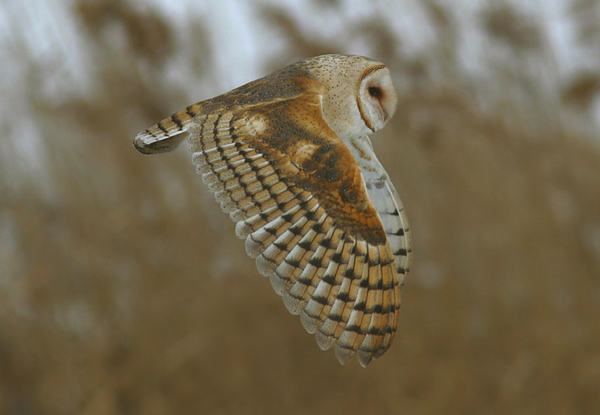
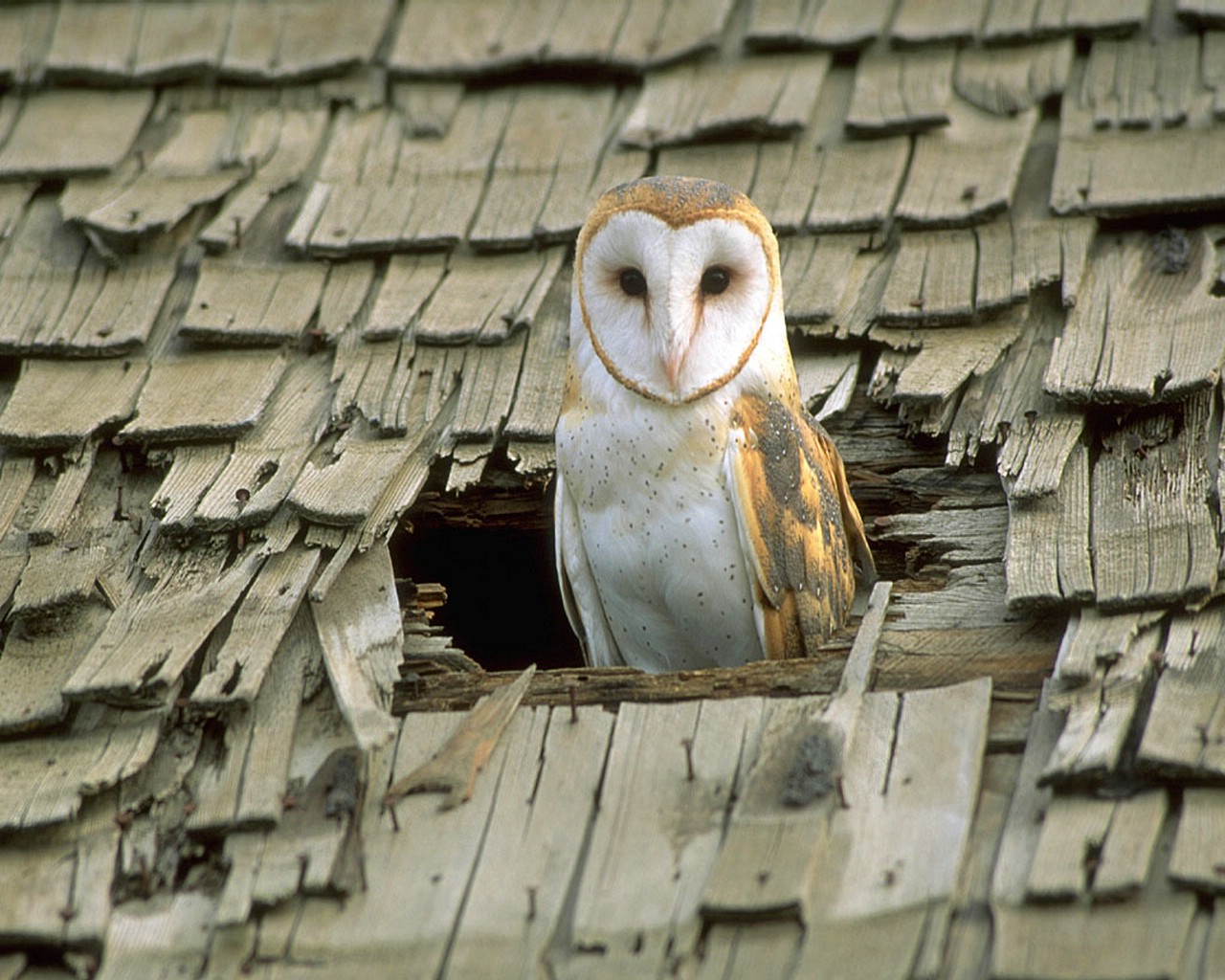
As the name implies, Common Barn Owls do spend a lot of time in barns.  But before there were barns, where did they hang out?  Barn Owls are cavity nesters, meaning that instead of building their nests in the sprawling and exposed branches of an oak or pine, they build their nests in tree cavities and hollows, as well as rock nooks and small caves.  However, since barns and other Human-made features are so warm, cozy and protected, Barn Owls often opt to nest in barns, silos, warehouses, and church steeples.  Barn Owls are also big fans of Human-made nesting boxes.  Humans can install these nest boxes on their own properties and see if a pair of Barn Owls comes along to take up residence.  Instructions for building your own box are easily found with an internet search.  Humans often install Barn Owl boxes to lure Barn Owls to their property as a means of rodent/pest control, as shown in this PBS video.

One reason Barn Owls are so good at controlling rodent populations is that they're insatiable eaters.  Catching and eating upwards of six vole-sized critters each night, they can really keep tight reins on the local population.  Also, it's incredible how many pocket gophers they can fit into one stomach!  Like most owls (including me), they generally swallow their food whole instead of ripping and tearing it like most other raptors do.  And Barn Owls don't even blink when it comes to swallowing animals that seem impossibly large.  Skip ahead to minute 3:30 in the video below to see what I mean.


The eating pace doesn't slow down at all when there are chicks in the nest, either.  Barn Owls lay between four and seven eggs, so that's a lot of mouths to feed when they all hatch.  And do they eat smaller, more appropriately sized food?  No way.  They eat just like mom and dad.  It's unreal.
Baby Barn Owls with a feather-duster "mom" at the RMRP

Baby Barn Owls are a little goofy looking.  Many Humans think they're adorable, while others think they look like alien pterodactyls. They certainly don't look much like their adult versions until they're many weeks along.  Adult Barn Owls, on the other wing, are simply stunning birds.  They're in the non-tufted class of owls, meaning they don't have ear tufts like I do.  They still have extremely prominent facial discs, however, which is largely responsible for their success as hunters.  Females of the species have slightly duskier coloration, with more brown on their faces and chests, while males are more of the snowy-white variety.  This often leads to people thinking Barn Owls and Snowy Owls are the same thing, but as you can see in this picture, they're very dissimilar.  For the record, Harry Potter had a Snowy Owl, not a Barn Owl.
Snowy Owl on the left, Common Barn Owl on the right
The Common Barn Owl, while obviously not common in appearance or behavior, is called "common" because of its wide range.  Barn Owls are found on every continent except Antarctica, and within each continent they inhabit every imaginable ecosystem.  Because of their extensive range, Barn Owls have numerous variations and subspecies, between twenty and thirty depending on who you ask.  Tyto alba is the Latin name for Common Barn Owls, and the variation in North America is Tyto alba pratincola.  Something kind of cool about their Latin name is that the word "tyto" is a Greek onomatopoeia meaning "owl"; "tyto" mimics the classic owl sound, like the English word "hoot".

Educational female Barn Owl foster mom guarding her charge
Barn Owls used to face a lot of intentional persecution as a species.  One likely reason for this is the owl's ghostly appearance:  with the white plumage, silent flight, and a knack for flying out of barns at Humans, they earned a reputation of evil associated with ghosts and death.  This is reflected in their other common names, which include Demon Owl, Ghost Owl and Death Owl.  Fortunately, as education about Barn Owls spreads, they're facing less and less intentional persecution.  However, like all raptors, they still face threats from the usual suspects: power lines, poisoning, car strikes, and more.  Habitat loss has led to the Barn Owl being listed as an endangered species in seven Midwestern states.

Educational Ambassador for the RMRP, male Barn Owl
At the Rocky Mountain Raptor Program, injured Barn Owls are admitted with all the above injuries and more.  Another common way for Barn Owls to come to the RMRP is via orphaning.  While their nest sites are often excellent cavities, they're not always stable or well-located homes.  Nests in hay bales, under trucks, in rafters, and in the walls of buildings are accidentally knocked down each spring, leading to entire nests' worth of baby owls coming to the RMRP to be raised by our resident foster parents.

So, there you have it, the uncommon Barn Owl.  Stay tuned next week for a profile on the Mexican Spotted Owl.   As always, you can email me with questions or comments at talonsofdoom@gmail.com, follow me on Twitter @RaptorProgram, check us out on Facebook (Rocky Mountain Raptor Program), and find out more information and stories on our main website.  If you would like to subscribe to this blog, use the box in the toolbar to the right.

We appreciate your support of the Rocky Mountain Raptor Program in helping us keep raptor populations strong and safe!  We're always seeking donations to help us continue our mission of rehabilitation, education and research.  Thank you!
junglewalk.com

Thursday, September 13, 2012

All About Owls


Okay, for all you owl lovers out there, the "Why ____ Are Awesome" column will be devoted to owls for the next foreseeable future.  Yes, that's right, I'm about to go on an owl binge.  That means, for the next eleven weeks, you will learn about a different specie of owl each week.  Yeah, that's right, ELEVEN WEEKS.  That's because we have twelve species of owl regularly occurring in Colorado, everything from the mighty Great Horned Owl to the equally-mighty but much smaller Northern Pygmy Owl.  Did you know that?  There are twelve species and eleven weeks because I don't think I can write separately about the Eastern and Western Screech Owls.  


So, I started writing about the first specie (can you guess which one I'll be talking about?), and I realized there are a lot of cool things about owls in general that you should know before we delve into the individual species.  So this entry will be a sort of background post to get everyone on the same page, so that next week, when I start talking about facial discs and whatnot you'll all know what I'm talking about! 
Short-Eared Owl (www.massaudubon.org)

First of all, this is the list of owls that will be discussed:
-Burrowing Owl
-And, if you aren't all owled out by then, I'll cover the Great Gray Owl and the Snowy Owl, just because they're so special, even thought they don't normally occur in Colorado.

So, what do all of those birds have in common?  They're all owls!  And what does it mean to be an owl?  It means you're the coolest of the cool, and that you're way better than all other birds, even raptors.  Sorry, is that biased?  Okay, let me try again.

Owls are a group of raptors (definition: birds who catch and kill their prey using their giant, deadly feet) that are largely nocturnal, and have wide faces in proportion to their beaks.  But that's a generalization--not all owls are nocturnal, and some look wildly different than others.  The smallest owl is the Elf Owl, coming in at just 1 ounce, and the heaviest is a tie between the Eurasian Eagle Owl and the Blakiston's Fish Owl: the large females in both species can weigh a whopping 10 pounds.  For comparison's sake, a Great Horned Owl like me tops out at 5 pounds, and an average male Golden Eagle weighs 8 pounds.
Immature Elf Owl (www.nurkimaderes.blogspot.com)
Blakiston's Fish Owl (www.rareearthtones.org)

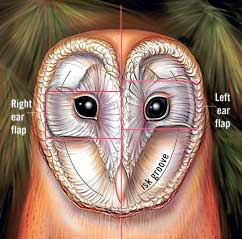
Owls are highly specialized in a variety of ways.  Most famously, they have excellent hearing.  They have to be able to hear well because most of them hunt at night, when vision won't do them much good.  There are a few reasons why their hearing is so excellent.  One is that most owls have asymmetrically placed ears that allow them to triangulate the location of what they're listening to.
tucsoncitizen.com
csus.edu Location of ears on a Barn Owl


Also, they have a facial disc, a feather formation that funnels sounds to those asymmetrical ears like a satellite dish.
Great Grey Owl (www.valcitygal.wordpress.com)
Even though owls have excellent hearing, is not quite enough to use exclusively, so their eyesight is pretty great, too.  Owls are famous for having large eyes, as is seen in cartoons and art.  And while the largeness of owls' eyes contributes to their awesome vision, it's actually the fact that their eyes are elongated that allows them to see so well.  It would require a discourse in eye anatomy to fully explain it, but suffice it to say that longer eyes make for larger images on the retina, so the brain and neurons all have more material to work with, and so can see better than most other animals.  But, there are a lot of different eye-shapes and eye-colors in owls, as you will see over the next few weeks.
Snowy Owl (www.2expertsdesign.com)
In the same vein of adaptations-for-hunting-at-night, owls also have special feathers.  Owls have an incredible ability to fly silently, and this is largely due to the structure of their feathers.  While most birds have rigid feathers with straight edges, the leading edge of owl feathers is serrated, and that breaks up the air as it passes over the feathers, rendering them silent.  Interestingly, the owls that don't have to be silent to sneak up on prey, namely the fishing owls, do not have feather serrations, and therefore are noisy fliers like most birds.
www.science.howstuffworks.com
Okay, I think that's all you need to know about owls before I delve into the nitty-gritty of individual species.  Now when I say, "The Great Grey Owl has the largest facial disc of all the owls", or, "Barn Owls have mastered the evolution of asymmetrical ears," or, "Burrowing Owls are largely diurnal, so they don't need such extreme facial discs," you'll know what I'm talking about. 
This owl is excited.
Okay, who's excited to hear all about why each of the owls the Humans treat at the Rocky Mountain Raptor Program are so cool?  I know I am.  I'll kick it off next week with....I'm not telling.  It's going to be a surprise.  Kind of.

In the meantime, don't forget that you can contact me via the comments below, or at my email address at talonsofdoom@gmail.com.  Also, if you haven't liked the RMRP on Facebook or followed me on Twitter, I highly recommend that you do.  And, finally, please vote for the RMRP in the Chase Giving charity drive today--help us win money from Chase Bank with a simple Facebook vote! Please contact the RMRP for any real questions for the Humans. 


Wednesday, July 11, 2012

Why Mississippi Kites Are Amazing!

It's been awhile since I've done an installation of "Why ___s Are Amazing", and I apologize for my tardiness.   Perhaps it's because most of the birds at the RMRP right now are American Kestrels, and I've already covered that species?  Whatever the reason, I decided to make it up to you by covering a bird that's really unique: Mississippi Kites.  Okay, so they're not actually that unique.  They're actually quite common birds--just not around here, which is what makes them "unique" to us.

So, the funny thing about this article is that I knew nothing about Mississippi Kites before writing it, so in order to find all the information I wanted to tell you, I (GHOW) interviewed a Mississippi Kite (MIKI) here at the Rocky Mountain Raptor Program.  This bird is currently healing an injured wing.  Here's what I got!

The interviewee
GHOW:  Thank you for joining me today.  How is your wing feeling?
MIKI:  Squeak-choooo!


GHOW:  Oh no, do you have a cold as well?
MIKI:  Squeak-chooo!!


GHOW:  Well, that's terrible luck, isn't it?
MIKI:  Squeak--no cold--chooooo!


GHOW:  What?! Oh! You're not sneezing, that's just how you talk!
MIKI:  Squeak--That's right!--choooo!


GHOW:  Okay, I'm getting the hang of it.  You know, that's funny, you sound just like a squeaky toy!
MIKI:  Har. Har. Har.  Like I've never heard that before. Squeak-choo!!


oklahomabirdsandbutterflies.com
GHOW:  Right. I can see we started off on the wrong wing, so let's try again.  How is your injury?
MIKI: Better, thank you, but I still have a ways to go.  Squeak-choo!


GHOW:  Glad to hear it's improving.  So, where are you from?
MIKI:  Well, I'm from Mead, but I have a lot of relatives in Sterling and in Pueblo.  But most of my species live further east, in the Midwestern plains and down south.

GHOW:  I see, so that's why I've only met a handful of Kites?
MIKI:  Yep, that's right!  We're kind of new to the area.

GHOW: Well, welcome!  Glad to have you! It sounds like you're pretty social birds?
MIKI:  Absolutely!  We live in communal roosts, like Turkey Vultures.  So wherever you see one Mississippi Kite, you're likely to find more.  Squeak-chooo!


GHOW:  Now, correct me if I'm wrong, but I think I overhead another bird say that you only eat insects?? 
watchingthesunbake.blogspot.co
MIKI:  Squeak-chooo!!!!  That's mostly right.  I loooove grasshoppers and dragonflies, but the smaller bugs are good, too.  Occasionally I'll nab a small mouse, or maybe a lizard, but bugs are my meal of choice.

GHOW:  Blech, you can have them.  I'll take a tasty rabbit any day.  Of course, you might not be big enough to take down a rabbit.  How big are you?
MIKI:  Last time the Humans weighed me I was 250g, so about twice the size of a Kestrel.  However, some of us are a little smaller, and some are a bit bigger, about three times the size of a Kestrel.  But even though I'm bigger than a Kestrel, check out my feet:  they're pretty small, right?  So I don't think I'll be hunting rabbits anytime soon.

GHOW:   How do you hunt bugs, anyways?
MIKI:   On the wing, like a swallow, but instead of catching bugs in my mouth, I catch them with my feet, and that makes me a Raptor!  Squeak-chooo! 

GHOW:   Fascinating.  So tell me a little more about your lifestyle, like where you like to build your nest, and stuff like that.
MIKI:   We build our nests in trees, so we always live near woodland.  Out here in the plains we try to find a little riparian forest to call home--after all, water is important for the bugs we hunt.  We make our nests out of twigs, and I must say, they're pretty good by Raptor standards.  The lady-Kites usually lay two eggs per year, and the young are out of the nest nice a quick: one month in the egg, one month in the nest, then fledged and gone.


GHOW:   Do you make a migration?
MIKI:   Yes, most of our populations do. We fly to tropical South America in the winter!

GHOW:  By the way, I just wanted to comment on how beautiful your eyes are.  Most Raptors have dark eyes, or yellow eyes, but yours are bright red!
MIKI:   Cool, huh?  The immature Mississippi Kites don't have red eyes--they're brown.  In fact, immature Kites are streak-brown all over, with none of this striking grey-and-black motif of the adults.

Immature MIKI  (avianweb.com)
GHOW:   This has all been very educational for me--especially learning a new language!  I only have one more question for you:  what makes Mississippi Kites awesome?
MIKI:   I can't name just one thing!  How about three?  1) Our aerial acrobatics when we're catching bugs on the wing,  2) Our appearance (a lot of Humans think we look a bit like Owls, and most Humans don't even recognize us as Raptors), and 3) Our unique call!  Squeak-choo!! 


Well, folks, there you have it!  Now you know a little bit about Mississippi Kites.   Until next time, squeak-choo! 


Friday, June 15, 2012

Why Bald Eagles Are Amazing!

fellowshipofminds.wordpress.com
The Bald Eagle!  Proud symbol of America!  A regal and beautiful beast, with a bit of a temper and a lot of power to back it up!  Now that we're down to just two Bald Eagles at the RMRP, this entry isn't as timely as I had hoped it would be (not that I'm complaining: two Bald Eagles is much better than five).  But here we go anyways, an article dedicated to the awesome Eagle.
justanimal.org
Identifying a Bald Eagle is usually a pretty easy task.  First of all, they're enormous, making most other American birds look positively diminutive.  Also, they're strikingly colored: the solid white head and tail contrast starkly with a dark brown body, a color combination that's easy to pick out whether they're perching on a tree or soaring hundreds of feet overhead.  Finally, they have a giant yellow schnoz that stands out like a beacon.
thegeminiweb.com
Despite all those obvious markings, there are times when Bald Eagles are not quite so easy to identify...mostly when they're young and look just like Golden Eagles.  An immature (age 0-5 years) Bald Eagle doesn't have the white head and tail, or the solid brown body, and they end up looking almost identical to immature Golden Eagles, which is why both are protected under Federal law.

Bald Eagles live all across the US, but are mostly found in areas with water (salt water or fresh).  While they don't need to eat fish exclusively, they are darn good at catching fish and it makes up a large portion of their diet.  Unlike Osprey, which submerge themselves completely when they dive for fish, Bald Eagle reach in with their feet and pluck fish out of the water.  Also found on the menu are prairie dogs, large animal carcasses, and aquatic birds like geese and ducks.
birdcapemapy.org
Bald Eagles reach sexual maturity between ages four and five, and then they mate for life...unless the worst should happen.  Then they will find a new mate and start over.  Courtship displays are something to behold: the eagles lock talons and spiral down towards the earth in a death-defying show. Here are two video clips of the action.
The first is pretty old, but impressive: 

And this one is newer, but further away:

Bald Eagles, along with Peregrine Falcons, really hit the spotlight in the 1940's and 1950's when DDT was wreaking havoc on the population.  In the mid-1950's, there were only ~400 pairs in the lower 48.  Since then, a combination of banning DDT and enacting laws to protect eagles has brought their population back up to normal.  In 2007 they were delisted entirely, and are considered a Species of Least Concern!

In terms of personality, Bald Eagles are timid, easily stressed, high-maintenance and unpredictable.  Only a few Humans at the RMRP are qualified to work with these birds, which is why is was soooo difficult to manage FIVE Bald Eagles all at once.

Okay, now that you know what Bald Eagles are, let's clear up some myths about what Eagles are not.  

First of all, they're not the biggest bird in the US. The Golden Eagle and the Bald Eagle overlap a lot, with both of them checking in at 9-14 lbs (some Bald Eagles can weigh a mere 5 lbs), and with wingspans of 6-8 ft. The California Condor blows them both out of the water with an average weight of 18-20 lbs, and a typical wingspan of 8-10 ft.  And for the record, some Trumpeter Swans are even bigger than that.
California Condor (sandiegozoo.org)

Second, they're not just the mighty hunter people believe they are.  Bald Eagles are notorious scavengers of carcasses and dumps, and not just scavengers but thieves!  Bald Eagles exhibit a behavior known as kleptoparasitism, or, in plain English, they steal food that other animals have caught.  For instance, if an Osprey dives into the water and comes out with a large, delicious fish, a Bald Eagle will come along and try to bully it away from the Osprey--and being bigger and badder, the Eagle will usually succeed.  The beautiful picture below shows an Eagle trying to steal a fish from a Great Blue Heron.  They also steal from each other, especially adults from juveniles.
natechappell.500px.com

And third, you know that regal screeching sound you hear in the movies whenever a Bald Eagle (or any other bird for that matter) comes into view?  That's not what Bald Eagles sound like.  That's a Red-Tailed Hawk.  Bald Eagles sound like this:
No wonder Humans use a Red-Tailed Hawk screech in the movies! 

That's all I've got on Bald Eagles!  I hope you learned something new, and if you have any questions feel free to leave a comment below or send me an email at talonsofdoom@gmail.com.