By request, I'm going to write today about one of my favorite feathered brethren. I live with many birds here in the Educational Ambassador cage complex, ranging from Screech Owls to Rough-Legged Hawks to Peregrine Falcons to Barn Owls. But the bird just down the hall from me is easily the Queen of the Hawks. She reminds us all what it means to be a fierce and wild predator, and consequently I have a deep respect, sight unseen, for
any of her species that come through the RMRP's doors.
 |
| jimsburnsphotos.com |
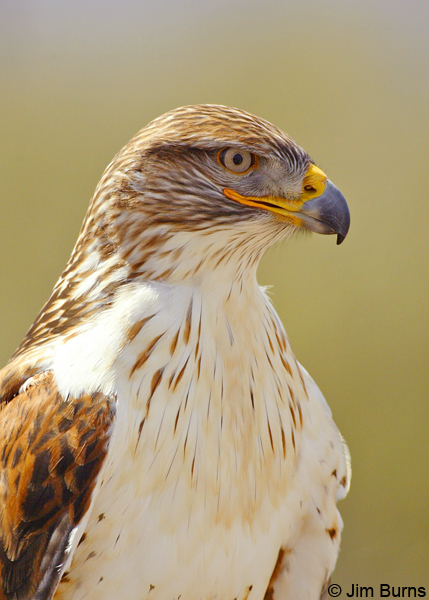
That species is the Ferruginous Hawk, a large and majestic Hawk that sometimes seems more like an Eagle. While the Great Horned Owl is the baddest of the local Owls (yeah, that's right!), the Ferruginous Hawk is the baddest of the Hawks.
What makes them so impressive? It's a combination of appearance and attitude. Say you are walking in the plains and you surprise a Ferruginous Hawk. There are probably two things that you notice right away: it's
huge, and it's coming right for you.
Let's start with appearance. The Ferruginous Hawk is the largest hawk in the world (well, it's a tie, actually, between the Ferruginous Hawk and the Upland Buzzard of Asia), measuring 4-5 feet from wingtip to wingtip, and weighing 2-5 pounds. In comparison, small Golden Eagles have 6 ft wingspans, and weigh ~5-6 pounds. Ferruginous Hawks stand tall and proud with a regal posture, which perhaps is why their Latin name,
Buteo regalis (royal hawk), fits them so well. They're so big that they're often mistaken for Eagles. In fact, numerous species of Eagles around the world are actually
smaller than Ferruginous Hawks (it's takes more than size to qualify as an Eagle).
 |
| Jo Matson |
Along with being big, they're also beautiful, with striking coloration and features. The most prominent color on their undersides, whether they're flying or perching, is white (except in dark morph varieties). Their backs and the tops of their wings are darker, with rusty-reddish upper backs and shoulders, and rusty-reddish feathers on their legs. The rusty leg feathers are what give the bird its common name, Ferruginous (iron, rust). The feathers on their legs are doubly notable because only one other Hawk in North America has feathers all the way down to its feet: the Rough-Legged Hawk.
 |
| David Quanrud |
But it's when you look at their face that you see what an amazing bird this is. They have pale eyes that look right through you, long beaks, and a giant gape (mouth). This all lends a very dinosaur/predator/no-nonsense look to them.
Then there's the attitude. If they're mistaken for Eagles based on size, the same mistake could be made in regards to attitude. Ferruginous Hawks are mean and wild, and have no qualms whatsoever about defending themselves. When the Humans are taking care of an injured Ferruginous Hawk here at the RMRP, only very experienced catchers take on this bird.
The reason for this intense attitude could stem from where these birds live: on the plains. While nests will be built in trees if they're available, Ferruginous Hawks usually nest in open areas such as rock outcrops, or simply on the ground. The plains environment just doesn't provide many protected nesting opportunities. Since nesting sites are so exposed, the birds have to be able to defend themselves not only from aerial predators like most Raptors have to, but also from terrestrial predators like Coyotes. And if the chicks are on the ground for the first month of their lives, you can expect the chicks to be as fierce as the parents.
 |
| Baby Ferruginous Hawk at the RMRP. Chicks have a buff-colored bib. |
Being a plains bird, the Ferruginous Hawk's diet includes a wide range of Prairie critters. The staple food items are the Black-Tailed Jackrabbit and the Prairie Dog. Other prey includes anything from tiny Meadowlarks to enormous White-Tailed Jackrabbits, which weight twice as much as the Hawk. The birds hunt in a variety of styles, including hunting from tall perches or low rocks, soaring, or even waiting on the ground next to a rodent burrow for lunch to appear.
 |
| Ferruginous Hawk on a power pole |
As you can imagine, with Prairie Dogs making up a large portion of the Ferruginous Hawk's diet, the Human penchant for exterminating Prairie Dog towns has been hard on the Hawk's population. While the birds are hovering around "species of concern" status in the US and Canada, the birds are officially classified as Threatened in the state of Colorado (along with Burrowing Owls for similar reasons). Not only is their prey-base disappearing, but so is their habitat as much of the land is cultivated, irrigated, developed, or ranched. With such large wingspans, these birds also have frequent run-ins with power lines. Sadly, many Ferruginous Hawks are shot, as well.
If you see a Ferruginous Hawk in the wild, consider yourself lucky! Be sure to appreciate its awesome beauty and power, and wish it the best of luck out there in the harsh plains environment.