Pages

Showing posts with label amazing. Show all posts

Wednesday, September 19, 2012

Why Great Horned Owls Are Amazing

If you didn't read my last post, here's the news: we're about to go on an owl binge.  That means for the next eleven weeks you will learn about a different specie of owl each week.

When I decided to embark on this venture last week, I was very surprised to look back through my posts (there are 120 of them, but the way, so lots of stuff to look back through if you're interested) and see that I haven't yet written about myself!  I mean, it doesn't get much cooler than Great Horned Owls, and Great Horned Owls don't get much cooler than me, sooo...I don't know what happened.  But rest assured, that all changes now.  Without any further ado:

WHY GREAT HORNED OWLS ARE AMAZING, INCREDIBLE, AND AWESOME, AND PRETTY MUCH THE COOLEST OWLS OUT THERE

(is that too much?                                  ...Nah...)


Man, I don't even know where to start.  Should I talk first about how big and strong we are, or about our hunting habits, or maybe about our ability to live just about anywhere?  I know, let's start with the basics: size and shape and all that.

Great Horned Owls are the largest of the owls found in Colorado.  The heaviest North American owl is the Snowy Owl, and they're just a little heavier than Great Horned Owls.  Great Horned Owls usually weigh between 1.5 and 5.5 pounds, which is as little as a 700 ml bottle of pop, or as much as two Nalgene bottles of water, but we don't generally weigh more than 3.5 pounds around here.
As our name suggests, we have horn-shaped feathers on top of our heads.  Contrary to popular opinion, the horns are not our ears, nor are they located very near our ears.  (For more info on where owl ears actually are, check out last week's post about owls.  I added some diagrams of asymmetrical owl ears.)   The "horns" are called ear tufts, and they help us blend into tree bark by mimicking the back pattern and breaking up the smooth outline of the head, like so:
www.cs.birdwatchingdaily.com
Ear tufts are also used to group owl species.  Colorado's "tufted owls" include the Great Horned Owl, the Long Eared Owl, the Screech Owl (Eastern and Western), and the Short Eared Owl.  Non-tufted owls are those with smooth heads, like the Common Barn Owl and the Saw-Whet Owl.

Comparison of tufted and non-tufted owls
In addition to size and horns, Great Horned Owls are easy to identify because of their shape.  We sit rather low on our feet, we have broad bodies and large heads.  While we're certainly not slender, most of our bulk is feathers.  Wikipedia calls my species "barrel-shaped" but I resent that.  Do I call Humans "log-shaped" or "lolly-pop shaped?" * Not usually.

As for coloration, there's actually a lot of variation.  Some Great Horned Owls are dark with striking contrast, and others are paler.  Some have a vivid white collar, others have the barest hint of one.  But one thing all Great Horned Owls have is gigantic yellow eyes.  The better to see you with, my dear.  In fact, if Humans had eyes proportional to Great Horned Owl eyes, their eyes would be the size of oranges:
If you have a hard time seeing a Great Horned Owl because of its camouflage, you'll have no problem recognizing the hoot of one.  It's the classic hoo-hoo-hoo call, which you can listen to here:


Great Horned Owls have pronounced facial discs because we're largely nocturnal.  During the dusk and dark hours we hunt a wide variety of prey, but rabbits make up a large portion of our diet, as well as small- to medium-sized rodents.  We kill our prey with our feet, like all raptors, but we have beefier feet than many raptors, with 300 pounds per square inch of crushing power.  That makes pretty quick work of a mouse, I can assure you.

If you were a Great Horned Owl, you would be very lucky indeed, for you could count the following among your best traits:
Adult and immature
  • Being very adaptable: We are able to live in almost any environment, from swampland to cities, and are the most widespread owl in the Americas.
  • Good parenting:  We take care of our young for a long time compared to most raptors, keeping an eye on them for as long as seven months after hatching. 
  • Pest controller: We help keep rodent and rabbit populations in check by preying on them as our dominant food source.
  • Awesomeness: We're beautiful and awe-inspiring, and who doesn't like that?
Despite these excellent recommendations, Great Horned Owls are still persecuted across the Americas.  People fear that owls will harm them or their domesticated animals, but Great Horned Owls are not agressive towards people who leave them along, and only take small pets very rarely.  Fortunately, as education about raptors improves, people are realizing that there are better ways to deal with these problems than by offering bounties on owls.  Here is an article on how to keep your pet safe from large raptors.

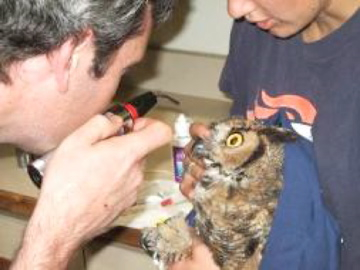
Getting an eye exam - eye trauma is common in impact injuries
Great Horned Owls also fall victim to many Human-related accidents.  Common injuries seen in Great Horned Owls at the Rocky Mountain Raptor Program include those incurred from barbed wire fences, car hits, high voltage trauma from power lines, poisoning, and the occasional and saddening gunshot.  They are also one of the most common birds admitted to the RMRP - 48 were admitted here last year alone. 

That's all I have for now.  If I keep going I'll start talking about how awesome I am instead of my entire species.  Thank you for reading, and I hope you learned something!  Stay tuned next week for a profile on the Common Barn Owl.  I'll show you how very uncommon they are.  As always, you can email me with questions or comments at talonsofdoom@gmail.com, follow me on Twitter @RaptorProgram, check us out on Facebook (Rocky Mountain Raptor Program), and find out more information and stories on our main website.  If you would like to subscribe to this blog, use the box in the toolbar to the right.

We appreciate your support of the Rocky Mountain Raptor Program in helping us keep the raptor population strong and safe!  We're always seeking donations to help us continue our mission of rehabilitation, education and research.  Thank you!

---------

*Answer:  only when making references to the "how many licks" Tootsie-Pop commercial, which, by the way, is entirely inaccurate: owls are only concerned with biting. Lots of biting.  Oh, and taloning.  That too.

Thursday, July 19, 2012

Why Ferruginous Hawks Are Awesome!


By request, I'm going to write today about one of my favorite feathered brethren.  I live with many birds here in the Educational Ambassador cage complex, ranging from Screech Owls to Rough-Legged Hawks to Peregrine Falcons to Barn Owls.  But the bird just down the hall from me is easily the Queen of the Hawks.  She reminds us all what it means to be a fierce and wild predator, and consequently I have a deep respect, sight unseen, for any of her species that come through the RMRP's doors.

jimsburnsphotos.com
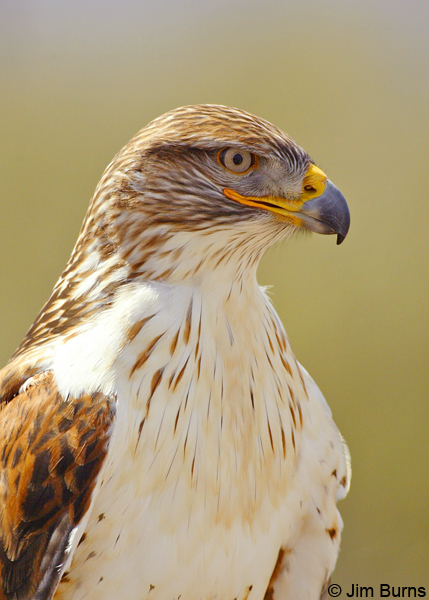
That species is the Ferruginous Hawk, a large and majestic Hawk that sometimes seems more like an Eagle. While the Great Horned Owl is the baddest of the local Owls (yeah, that's right!), the Ferruginous Hawk is the baddest of the Hawks.

What makes them so impressive?  It's a combination of appearance and attitude.  Say you are walking in the plains and you surprise a Ferruginous Hawk.  There are probably two things that you notice right away:  it's huge, and it's coming right for you.

Let's start with appearance.  The Ferruginous Hawk is the largest hawk in the world (well, it's a tie, actually, between the Ferruginous Hawk and the Upland Buzzard of Asia), measuring 4-5 feet from wingtip to wingtip, and weighing 2-5 pounds.  In comparison, small Golden Eagles have 6 ft wingspans, and weigh ~5-6 pounds.  Ferruginous Hawks stand tall and proud with a regal posture, which perhaps is why their Latin name, Buteo regalis (royal hawk), fits them so well.  They're so big that they're often mistaken for Eagles.  In fact, numerous species of Eagles around the world are actually smaller than Ferruginous Hawks (it's takes more than size to qualify as an Eagle).

Jo Matson
Along with being big, they're also beautiful, with striking coloration and features.  The most prominent color on their undersides, whether they're flying or perching, is white (except in dark morph varieties).  Their backs and the tops of their wings are darker, with rusty-reddish upper backs and shoulders, and rusty-reddish feathers on their legs.  The rusty leg feathers are what give the bird its common name, Ferruginous (iron, rust).  The feathers on their legs are doubly notable because only one other Hawk in North America has feathers all the way down to its feet: the Rough-Legged Hawk.

David Quanrud
But it's when you look at their face that you see what an amazing bird this is.  They have pale eyes that look right through you, long beaks, and a giant gape (mouth).  This all lends a very dinosaur/predator/no-nonsense look to them.

Then there's the attitude.  If they're mistaken for Eagles based on size, the same mistake could be made in regards to attitude.  Ferruginous Hawks are mean and wild, and have no qualms whatsoever about defending themselves.  When the Humans are taking care of an injured Ferruginous Hawk here at the RMRP, only very experienced catchers take on this bird.

The reason for this intense attitude could stem from where these birds live: on the plains.  While nests will be built in trees if they're available, Ferruginous Hawks usually nest in open areas such as rock outcrops, or simply on the ground.  The plains environment just doesn't provide many protected nesting opportunities.  Since nesting sites are so exposed, the birds have to be able to defend themselves not only from aerial predators like most Raptors have to, but also from terrestrial predators like Coyotes.  And if the chicks are on the ground for the first month of their lives, you can expect the chicks to be as fierce as the parents.

Baby Ferruginous Hawk at the RMRP. Chicks have a buff-colored bib. 
Being a plains bird, the Ferruginous Hawk's diet includes a wide range of Prairie critters.  The staple food items are the Black-Tailed Jackrabbit and the Prairie Dog.  Other prey includes anything from tiny Meadowlarks to enormous White-Tailed Jackrabbits, which weight twice as much as the Hawk.  The birds hunt in a variety of styles, including hunting from tall perches or low rocks, soaring, or even waiting on the ground next to a rodent burrow for lunch to appear.

Ferruginous Hawk on a power pole
As you can imagine, with Prairie Dogs making up a large portion of the Ferruginous Hawk's diet, the Human penchant for exterminating Prairie Dog towns has been hard on the Hawk's population.  While the birds are hovering around "species of concern" status in the US and Canada, the birds are officially classified as Threatened in the state of Colorado (along with Burrowing Owls for similar reasons).  Not only is their prey-base disappearing, but so is their habitat as much of the land is cultivated, irrigated, developed, or ranched.  With such large wingspans, these birds also have frequent run-ins with power lines.  Sadly, many Ferruginous Hawks are shot, as well.

If you see a Ferruginous Hawk in the wild, consider yourself lucky!  Be sure to appreciate its awesome beauty and power, and wish it the best of luck out there in the harsh plains environment.

Friday, June 15, 2012

Why Bald Eagles Are Amazing!

fellowshipofminds.wordpress.com
The Bald Eagle!  Proud symbol of America!  A regal and beautiful beast, with a bit of a temper and a lot of power to back it up!  Now that we're down to just two Bald Eagles at the RMRP, this entry isn't as timely as I had hoped it would be (not that I'm complaining: two Bald Eagles is much better than five).  But here we go anyways, an article dedicated to the awesome Eagle.
justanimal.org
Identifying a Bald Eagle is usually a pretty easy task.  First of all, they're enormous, making most other American birds look positively diminutive.  Also, they're strikingly colored: the solid white head and tail contrast starkly with a dark brown body, a color combination that's easy to pick out whether they're perching on a tree or soaring hundreds of feet overhead.  Finally, they have a giant yellow schnoz that stands out like a beacon.
thegeminiweb.com
Despite all those obvious markings, there are times when Bald Eagles are not quite so easy to identify...mostly when they're young and look just like Golden Eagles.  An immature (age 0-5 years) Bald Eagle doesn't have the white head and tail, or the solid brown body, and they end up looking almost identical to immature Golden Eagles, which is why both are protected under Federal law.

Bald Eagles live all across the US, but are mostly found in areas with water (salt water or fresh).  While they don't need to eat fish exclusively, they are darn good at catching fish and it makes up a large portion of their diet.  Unlike Osprey, which submerge themselves completely when they dive for fish, Bald Eagle reach in with their feet and pluck fish out of the water.  Also found on the menu are prairie dogs, large animal carcasses, and aquatic birds like geese and ducks.
birdcapemapy.org
Bald Eagles reach sexual maturity between ages four and five, and then they mate for life...unless the worst should happen.  Then they will find a new mate and start over.  Courtship displays are something to behold: the eagles lock talons and spiral down towards the earth in a death-defying show. Here are two video clips of the action.
The first is pretty old, but impressive: 

And this one is newer, but further away:

Bald Eagles, along with Peregrine Falcons, really hit the spotlight in the 1940's and 1950's when DDT was wreaking havoc on the population.  In the mid-1950's, there were only ~400 pairs in the lower 48.  Since then, a combination of banning DDT and enacting laws to protect eagles has brought their population back up to normal.  In 2007 they were delisted entirely, and are considered a Species of Least Concern!

In terms of personality, Bald Eagles are timid, easily stressed, high-maintenance and unpredictable.  Only a few Humans at the RMRP are qualified to work with these birds, which is why is was soooo difficult to manage FIVE Bald Eagles all at once.

Okay, now that you know what Bald Eagles are, let's clear up some myths about what Eagles are not.  

First of all, they're not the biggest bird in the US. The Golden Eagle and the Bald Eagle overlap a lot, with both of them checking in at 9-14 lbs (some Bald Eagles can weigh a mere 5 lbs), and with wingspans of 6-8 ft. The California Condor blows them both out of the water with an average weight of 18-20 lbs, and a typical wingspan of 8-10 ft.  And for the record, some Trumpeter Swans are even bigger than that.
California Condor (sandiegozoo.org)

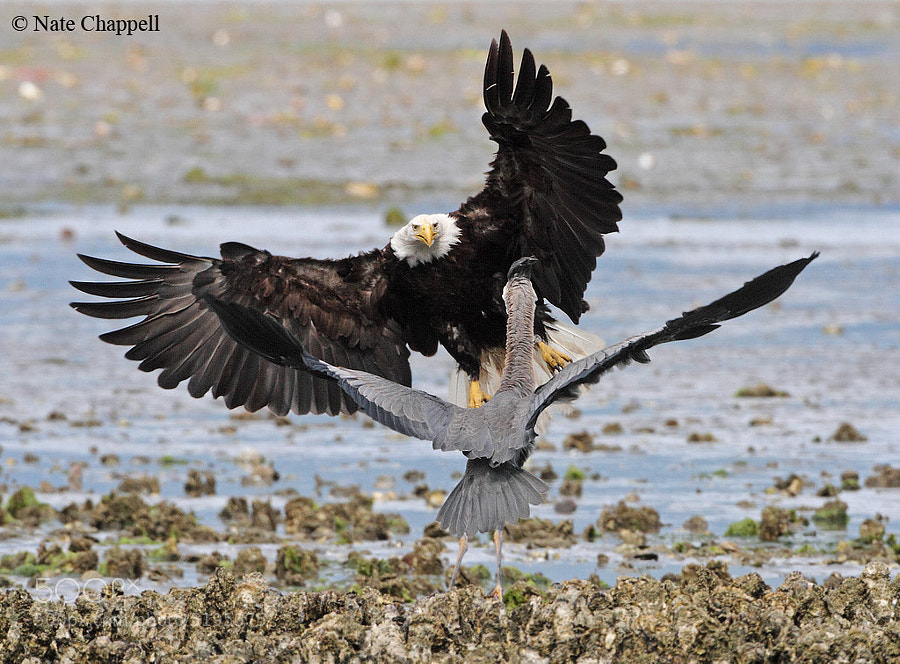
Second, they're not just the mighty hunter people believe they are.  Bald Eagles are notorious scavengers of carcasses and dumps, and not just scavengers but thieves!  Bald Eagles exhibit a behavior known as kleptoparasitism, or, in plain English, they steal food that other animals have caught.  For instance, if an Osprey dives into the water and comes out with a large, delicious fish, a Bald Eagle will come along and try to bully it away from the Osprey--and being bigger and badder, the Eagle will usually succeed.  The beautiful picture below shows an Eagle trying to steal a fish from a Great Blue Heron.  They also steal from each other, especially adults from juveniles.
natechappell.500px.com

And third, you know that regal screeching sound you hear in the movies whenever a Bald Eagle (or any other bird for that matter) comes into view?  That's not what Bald Eagles sound like.  That's a Red-Tailed Hawk.  Bald Eagles sound like this:
No wonder Humans use a Red-Tailed Hawk screech in the movies! 

That's all I've got on Bald Eagles!  I hope you learned something new, and if you have any questions feel free to leave a comment below or send me an email at talonsofdoom@gmail.com.