Pages

Showing posts with label owl. Show all posts

Thursday, November 8, 2012

Owl of the Week: Northern Saw-Whet Owl

Based on the birds being admitted to the RMRP recently, it would have been very timely of me to swap around my article on Saw-Whet Owls (which we admitted two of a few weeks ago), and my article on Boreal Owls (which we admitted one of a few days ago).  Alas, while I'm remarkably wise, I am not prescient.

lloydspitalnikphotos.com
So, let's learn about Northern Saw-Whet Owls.  These birds are the cutest little murder-machines you've ever encountered, kind of like teddy bears armed with knives.  They're one of the smallest North American owls, standing just 5-6 inches high, with a wingspan of 18-22 inches, and weighing 2 1/2 - 4 oz (about as much as a quarter to a half cup of water).  They are non-tufted owls, with rather large heads in comparison to the rest of their little bodies.  They have a distinctive white "Y" shape on their face, and an overall streaked, buffy coloration elsewhere.  Their eyes are their most striking characteristic, slanty and bright yellow, and as innocent looking as doe eyes.  But at the other end of their body, their arsenal of eight small-but-sharp talons are always at the ready.

Saw-Whet Owl talons (richmondaudobon.org)
I've overheard Humans at the RMRP saying, "Saw-Whet Owls have the attitude of a female Golden Eagle packed into a tiny body."  It's not an exaggeration.  Not only do they have the attitude of a bird willing to fight for its life, they also take on (and take down) prey much larger than they are.  While Saw-Whet Owls typically dine on small rodents with a supplementary diet of songbirds and frogs, they don't turn down an opportunity to kill a squirrel, rat, or even a rock pigeon (about 4X heavier than the Saw-Whet Owl).

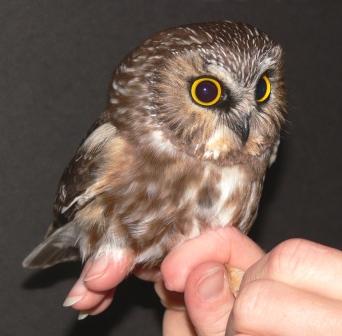
A picture to show the size of a Saw-Whet Owl.  (Please note:
this is a wild bird being held for banding, and this is not how
the RMRP handles birds) guardiansofgahoole.wikia.com

Immature Saw-Whet Owls look very different from the adults, with a dark, chocolate-brown color on their heads, backs and wings, and a light brown color on their fronts.  They still have that clear white "Y" on their faces, though.  Saw-Whet Owls typically lay from 3-7 eggs in cavity nests (much like the other small owls we've learned about recently).  They fledge after 4-5 weeks, and are sexually mature in under a year.  Life moves fast for small birds like these.

Immature Saw-Whet Owls (wikipedia.org)
Their common name refers to the sounds they make when alarmed, which apparently sounds an awful lot like a saw being whetted.  Never having heard a saw being whetted myself, I'll have to take the Humans' word on this one.  The other sounds they make is a long series of "hoop-hoop-hoop", and they only vocalize like this during breeding season.  It sounds like this: Saw-Whet Owl call

kewlwallpapers.com
These birds live in forests with dense areas for nesting.  They're year-round residents of the Rocky Mountains and southern Canada, and winter residents in much of the United States.  In Northern Colorado, a transition zone between the two ranges, they're most commonly seen passing through on migration.  In fact, the RMRP has admitted two Saw-Whet Owls in the past couple weeks, both window-strikes from encountering the large plate-glass windows of beautiful mountain homes as they passed through.  One of these birds has already been released to continue on his way, and the other is still in rehab working out some kinks in her flight.

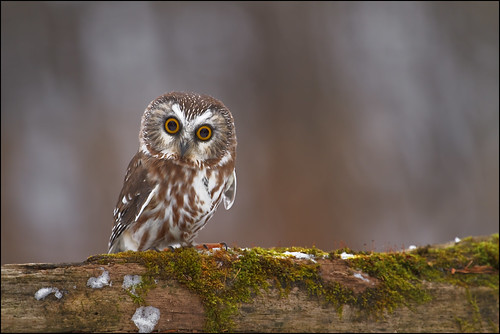
flickriver.com
An odd habit of these birds is to remain still and not fly away when they're discovered.  They're so adamant about not moving that people can readily approach them, and the owl will just sit and watch.  While it's cool from a photographer's perspective, and it allows an excellent chance to closely observe these birds in the wild, please respect its personal space and don't get so close that the bird is forced to fly away.  A reader of this blog actually discovered one of these owls in the wild a few weeks ago and encountered this unique behavior.  A link to his photo-essay is in the comments section for the Boreal Owl article.  I also recommend checking out that article so you can see the difference between the Saw-Whet Owl and the Boreal Owl, which look quite similar.

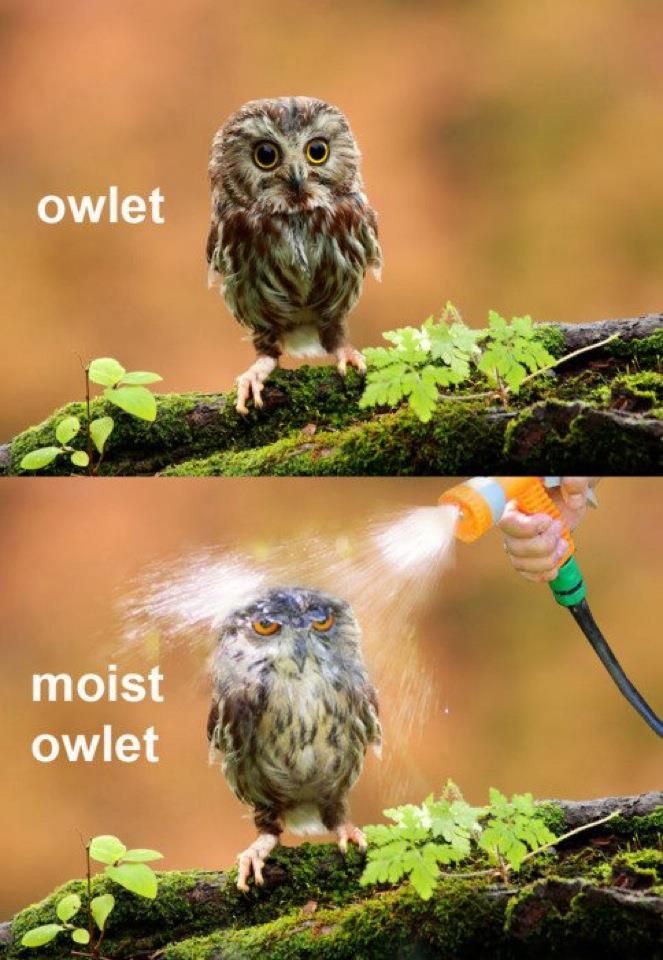
On a side note, I'm sure many of you have seen the following popular joke:

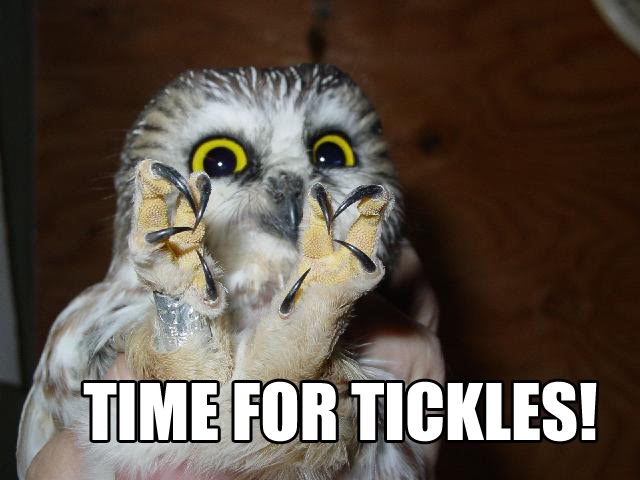
The bird in the top image is a Saw-Whet Owl, but you already knew that.  The owl in the bottom image is the lower half of the original Saw-Whet Owl, with a very photoshopped head of a much larger, very wet Eagle Owl on top.  The Saw-Whet Owl is also the star of the equally popular "Time For Tickles" image:


Now you know. 

Back to the serious stuff, there's not a lot of data about the population of Saw-Whet Owls, but it's clear to see from the recent admissions to the RMRP that they face similar threats as the other small owls:  window strikes, car hits, and other trauma.  The RMRP doesn't see many of these owls, but those that come through the doors here at our main facility are given quality care and the utmost respect, all the way from admit to release.

If you would like to support the RMRP, please use the donation link in the right sidebar.  Also, please follow us on Facebook and Twitter, and check out our official website to learn more.  Next week's owl (there are only two left!) is the dark-eyed Flammulated Owl.  Thanks for reading!

Saturday, October 27, 2012

General update

It's been while since I've written a status update for you all, and having just received some new active-case birds pictures today, there's no time like the present.  

Immature Red-Tailed Hawk
First off, the weather.  Did anyone else notice the snow and freezing temperatures this week?  So much for our Indian summer.  To battle the cold, the birds tucked their heads and feet into their feathers, which they fluffed out like the down parkas you Humans wear.  The bird pictured to the right is not some freakish new species of headless Red-Tailed Hawk, but rather a normal immature Red-Tailed Hawk keeping warm.  

With the cold weather we have officially entered small-owl season.  After seeing hardly any little owls over the summer, we've received a few Eastern Screech Owls and Northern Saw-Whet Owls in the past two weeks.  One of the Saw-Whet Owls was released last week, and flew off so fast there was no hope of snapping a picture.  That's exactly what we like to see, so good for that little owl!  He had been admitted after being hit by a truck going 60 mph on the highway, but suffered no broken bones and was released after just a couple weeks of care. 

The other Saw-Whet Owl was admitted from Loveland, and is a window-strike victim.  He is recovering from head trauma in the Critical Care room, and even though no fractures have been found, he's drooping one wing significantly.  Sometimes this is a side-effect of head trauma/impact injuries, and could resolve on its own.  On the other hand, the impact could have caused irreversible nerve damage.  Despite his guarded prognosis, he's a little spitfire and is not shy about using his little talons to defend himself.

Eastern Screech Owl
The other little owl currently in Critical Care is an Eastern Screech Owl that also hit a window.  He's getting stronger, is starting to use his legs and feet better, and his balance is improving.  He's making slow and steady progress as his head trauma resolves, and whenever a Human looks in at him, he responds with his angry face.

The first-year Northern Goshawk with a fractured scapula is doing well.  Can you guess how he was injured?  Window-strike!  His head trauma is resolving nicely, and he's eating voraciously to prove it.  The bandage comes off in a couple of days, and then the Humans will assess how the bone healed, and the bird's ability to fly.  For a picture of this bird, check out our Facebook page or subscribe to our Twitter feed

Red-Tailed Hawk with severe head trauma
There are also two Red-Tailed Hawks in Critical Care right now.  One of them just came in today, and I don't have much info.  The other one was admitted from Greeley on the 25th.  He was hit by a car, and the impact fractured his skull and dislocated his hock (a joint in his leg).  While the skull fracture and resultant swelling around his right eye look horrible, he's feisty and eating well. He's non-visual in that swollen eye, and is unlikely to regain vision in it, but the RMRP still gives one-eyed birds a chance to attend live prey school:  if the bird can hunt and kill like a pro, fly normally, and keep his feathers in good condition, there's no reason to not release him.  The prognosis on this bird is guarded, but I'll keep you updated on his progress.  

Overwintering Swainson's Hawks
As for the rest of the birds, the ones who have already made it out of critical care and are working towards release, they're all doing quite well.  The RMRP is overwintering quite a few birds, notably seven Swainson's Hawks who missed the migration window this year, and a Mississippi Kite in the same holding-pattern.  They're all doing well and have great chances of being released, but they need to sit tight until the spring to ensure they have the best chance of making it in the wild.  The Red-Tailed Hawk that flew into a truck cab through the open driver's side window is doing well.  The bruising on her wing has resolved, she's holding her wing normally and flying well.  In addition to the Saw-Whet Owl released last week, an American Kestrel that had been trapped in someone's chimney was cleaned off and released last week as well.  

Great Horned Owl recovering in a Hospital Cage
And then there's the Great Horned Owls.  The one who came in so non-responsive in July that she was almost appeared dead is flying great these days, working on her landings, and relearning how to hunt live prey.  She's come a long way!  Another Great Horned Owl with similar head trauma symptoms has moved outside and is eating on her own.  It's expected that her progress will be slow like the other one's.  And a third Great Horned Owl that's non-visual in one eye is being soft-released this week, meaning the Humans will continue to provide food for him on an outdoor platform for as long as he needs it.  But, given the way he's been annihilating rats in live-prey school, he's expected to do just fine in the wild.  On a final note, the Humans have admitted 232 birds for the year.  By comparison, last year's bird #232 was admitted in December. 

Whew, that was a lot of updating!  I should be better about doing it more regularly.  As always, thank you so very much for all your support.  If it weren't for your financial help, the Humans at the RMRP wouldn't be able to help these birds get back out to the wild.  Also, I have a favor to ask.  I can't help but notice the number of window-strike birds coming in recently, so if you have any tips or advice for how to prevent birds from hitting windows, please share them below in the comments! 

Monday, February 20, 2012

Thursday, February 2, 2012

Groundhog Day?

Seriously? Groundhogs get their own holiday, but there's no Great Horned Owl day? When word gets out to the raptor community about this, that groundhog better start watching for bird-shaped shadows.